LINER NOTES
Album: Tabu Artist: Miguel Gomes Label: Unreleased. Or: released once, in 2012, in a format no one was expecting. Running Time: 118 minutes Format: Two sides. Play in order. Do not skip ahead to Side B, though you will want to. Side A earns Side B. Without Side A, Side B is merely beautiful. With it, Side B is devastating.
SIDE A: “PARADISE LOST”
Track listing:
A woman named Pilar lives in Lisbon. She is kind, Catholic, lonely, politically engaged in the way that costs nothing. She attends protests. She volunteers. She prays. She fills her days with the machinery of goodness and goes home to an empty apartment.
Her upstairs neighbor is Aurora, an old woman who is difficult. Aurora gambles. Aurora accuses her Cape Verdean caretaker, Santa, of witchcraft. Aurora talks about Africa, about a farm she once owned, about a crocodile. She is not senile. She is something worse: she is a woman whose present life is too small for the person she used to be, and the compression has made her cruel.
Santa is patient. Santa endures. Santa says almost nothing, and her silence is the most eloquent performance in a half of the film that is all about the failure of eloquence.
Gomes shoots Side A in black-and-white digital. The images are clean, sharp, contemporary. Lisbon looks like Lisbon: tiled facades, cafés, hospital corridors, the Atlantic visible from certain angles. The pacing is deliberate. Scenes last slightly longer than comfort allows. There is humor, but it arrives sideways, through timing rather than jokes, through the gap between what people say they want and what they obviously need.
If the album ended here, you would have a small, precise, melancholy European film about aging and regret and the inability of good intentions to bridge the distance between people. You might admire it. You would not remember it a year later.
The album does not end here.
Aurora dies. On her deathbed, she asks Pilar to find a man. She gives a name. Pilar finds him. He is old. He sits down. And he begins to tell a story.
The needle lifts. You turn the record over.
SIDE B: “PARADISE”
Track listing:
Everything changes.
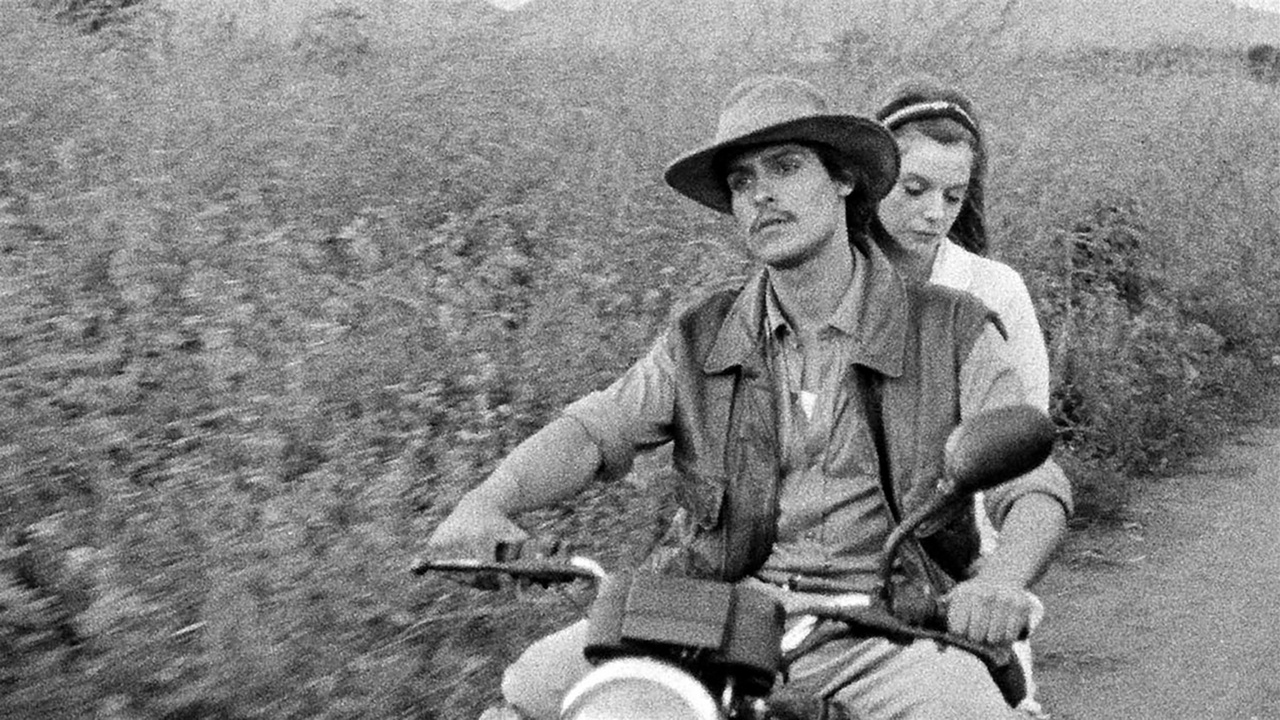
The image changes. Gomes shot Side B on 16mm film, and the texture is different in a way that reaches you physically. The grain is visible. The light is softer, warmer, more fragile. The image looks old. Not degraded. Aged. It looks like something that has been stored in a box for fifty years and still holds its color.
The sound changes. There is no audible dialogue in Side B. The characters speak, you can see their mouths move, but their voices have been removed. In their place: the old man’s voiceover narration, ambient sound, and music. The Ramones. Phil Spector girl groups. Portuguese pop from the 1960s. The music is absurdly, achingly romantic, and it plays over images of a love story that should not work, that has no right to move you as much as it does, and that moves you completely.
The aspect ratio changes. The frame narrows. The world contracts to the dimensions of a memory being told by someone who has held it for half a century.
Here is the story. A young man, Gian Luca Ventura, arrives at a Portuguese colonial settlement in Africa, at the foot of Mount Tabu. He falls in love with Aurora. Aurora is young, married, pregnant. Her husband is kind and oblivious. The affair is passionate, secretive, doomed in the way that all love stories set in colonial Africa are doomed, because the colony itself is doomed, and everyone in it is living inside a structure that will not survive the decade.
Gomes films the affair with a sincerity that is almost reckless. There is no irony. No postcolonial critique layered over the romance. No wink to the audience. The love is real. The desire is real. The tenderness between these two people is real, and it is filmed with the same grain and warmth and borrowed pop music that makes it feel like the most romantic thing you have ever seen.
And you know it is a lie. Not the love. The frame. The paradise. The colonial settlement where Portuguese expatriates drink gin and swim in pools while Africa exists around them as scenery. Gomes knows it is a lie too. He does not need to tell you. The 16mm grain tells you. The voiceover tells you. The absence of dialogue tells you. Everything about Side B’s construction announces that this is a memory, not a document, and that memory romanticizes, and that romanticizing is both the point and the problem.
PRODUCTION NOTES
Miguel Gomes named the film after F.W. Murnau’s 1931 film Tabu: A Story of the South Seas, and the connection is structural, not thematic. Murnau’s film was also split in two: “Paradise” and “Paradise Lost,” in that order. Gomes reversed the sequence. He gives you paradise lost first: the diminished present, the old woman dying in a Lisbon hospital. Then he gives you paradise: the lush, impossible, colonial past. The reversal means that you experience the memory knowing what it will cost. You watch the love story knowing Aurora will become the difficult old woman in the upstairs apartment. You watch the beauty knowing it will curdle into cruelty, gambling, accusations of witchcraft.
This is what makes Tabu peculiar. It is a film that gives you two completely different cinematic experiences and asks you to hold them in the same frame. Side A is a contemporary European art film, quiet and precise. Side B is a silent-era romance filmed on celluloid with pop music and a crocodile. They should not belong to the same object. They do. And the gap between them is where the meaning lives.
The crocodile is in both halves. In Side A, Aurora mentions it. It sounds like the rambling of an old woman. In Side B, the crocodile appears. It is real. It lives in the vicinity of the settlement. It swims in the river. It is present during the affair. Gomes does not explain the crocodile. The crocodile does not symbolize anything. It is a crocodile. It is in the film. It connects the two halves with an image that resists interpretation, and that resistance is part of what makes Tabu so strange and so lasting.
CRITICAL RECEPTION
The album was received with confusion and then devotion. It premiered at the Berlin Film Festival in 2012, where it won the Alfred Bauer Prize and the FIPRESCI Prize. Critics used words like “enchanting,” “beguiling,” “sui generis.” They struggled to categorize it. They still struggle. It appears on lists of the best films of the 2010s alongside films it resembles not at all.
It is not a colonial critique, though colonialism is its subject. It is not a romance, though its second half is one of the most purely romantic things committed to film this century. It is not an homage to silent cinema, though it uses silence as a formal principle. It is not an art film experiment, though its two-halved structure is as experimental as anything in contemporary cinema.
It is an album. Two sides. One melody, played first in a minor key and then in a major key that you cannot trust because you know how the song ends. You know because you heard the ending first.
PERSONNEL
Pilar: Teresa Madruga. Aurora (old): Laura Soveral. Aurora (young): Ana Moreira. Gian Luca Ventura (old): Henrique Espírito Santo. Gian Luca Ventura (young): Carloto Cotta. Santa: Isabel Muñoz Cardoso.
Directed by Miguel Gomes. Cinematography by Rui Poças. The 16mm footage in Side B has a quality that digital cannot replicate. It is the quality of time made visible. Every frame looks like it is being remembered in the moment you see it, and every moment of remembering contains the knowledge that what is being remembered is gone.
A NOTE ON PLAYBACK
Listen to both sides. Side A without Side B is a minor work. Side B without Side A is a gorgeous lie. Together, they are something no other film has achieved: a single object that contains two incompatible truths and asks you to believe both.
The colony was real. The love was real. The beauty was borrowed from a world that was being stolen. The crocodile was there. The music played. The memory is all that remains, and the memory cannot be trusted, and it is the most beautiful thing you will hear all year.
Handle with care. The vinyl is fragile.
Tabu — Directed by Miguel Gomes. Portugal / Germany / Brazil / France, 2012. 118 minutes.


Leave a Reply