You are the judge. Please be seated.
The facts of the case are as follows. In 1989, in Tehran, a man named Hossain Sabzian boarded a bus. He was carrying a book. The book was The Cyclist, a screenplay by the Iranian filmmaker Mohsen Makhmalbaf. A woman seated nearby noticed the book. She asked if he was connected to the film. He said yes. He said he was Mohsen Makhmalbaf.
He was not Mohsen Makhmalbaf. He was a printing press worker. He was unemployed. He was poor.
The woman was Mrs. Ahankhah. She was impressed. She invited him to her home. He accepted. Over the following days, he visited the Ahankhah family multiple times. He told them he was scouting their home as a location for his next film. He told them their son could have a role. He spoke about cinema with passion and authority. The family believed him. They were honoured.
Then they discovered the truth. They had him arrested. He was charged with fraud.
This much is not in dispute.
What is in dispute is everything else.
For the Prosecution
He lied. Let us not romanticize this. He entered a family’s home under false pretences. He accepted their hospitality, their trust, their excitement. He let a mother believe her son would be in a film. He let a family rearrange their lives around a fiction he had invented.
The Ahankhahs are not wealthy people. They are middle-class. Respectable. The kind of family for whom a connection to a famous filmmaker would mean something. Social currency. Pride. He exploited that. He saw what they wanted and he became it.
The defence will argue that he took nothing of material value. This is technically true. He did not steal money. He did not forge documents. But he stole something harder to quantify. He stole weeks of belief. He stole the feeling of being chosen. When the truth arrived, it did not arrive as disappointment. It arrived as humiliation.
The prosecution asks: if a man walks into your home and makes you love a lie, does it matter that the lie was beautiful?
For the Defence
Hossain Sabzian is a man who loves cinema. Not casually. Not the way most people love cinema, as entertainment, as distraction. He loves it the way a person loves the thing that saved their life.
He is poor. He has almost nothing. But he has seen Makhmalbaf’s The Cyclist and it broke something open in him. The film is about a man so desperate for money that he agrees to ride a bicycle in circles for days without stopping. Sabzian saw himself in that man. He saw his own exhaustion, his own invisible suffering, projected onto a screen where it became visible. Where it became art. Where someone cared about it.
When Mrs. Ahankhah asked him on the bus if he was connected to the film, something happened. For the first time in his life, a stranger looked at him with respect. Not pity. Not indifference. Respect. And the respect was not for him. It was for the artist he claimed to be. But for a few weeks, the difference didn’t matter.
He did not plan the deception. He has said this repeatedly. It began with a single moment of weakness on a bus, and then it grew, because the Ahankhahs kept inviting him back, and each visit felt more real than his actual life. He was not stealing from them. He was borrowing an identity that fit him better than his own.
The defence asks: if a man with nothing pretends to be an artist, and in doing so becomes more generous, more articulate, more alive than he has ever been, is the pretending the crime? Or is the crime the world that gave him nothing to be?
Exhibit A: The Film Itself
This is where the case becomes impossible to adjudicate. Because Abbas Kiarostami heard about Sabzian’s arrest, and he went to the courthouse, and he asked to film the trial. The real trial. The actual legal proceedings. Sabzian agreed. The Ahankhahs agreed. The judge agreed.
Then Kiarostami did something unprecedented. He went back and recreated the events that led to the arrest. He asked Sabzian to play himself. He asked the Ahankhahs to play themselves. He filmed the recreations with the same camera, the same film stock, the same light as the trial footage. He edited them together.
You cannot tell which scenes are real and which are staged.
Read that again. A film about a man who impersonated a filmmaker was made by a filmmaker who asked the impersonator to perform the impersonation again, this time for real cameras, and the result is a film in which the boundary between truth and performance does not exist. Kiarostami did not make a documentary about Sabzian. He made Sabzian’s lie come true. He gave a man who pretended to be a filmmaker the thing he pretended to have: a film.
Testimony of the Accused
At the trial, Sabzian weeps. He does not weep for sympathy. He weeps because he is finally being asked the question no one in his life has ever asked him: why?
Why did you do it?
Because when I was Makhmalbaf, people listened to me. Because when I talked about cinema, I was saying true things. The feelings were real. The ideas were real. The only thing that was false was the name. And what is a name? Makhmalbaf is a man who makes films about suffering. I am a man who suffers. The distance between us is not talent. It is luck. It is money. It is the accident of being born into a life where someone hands you a camera instead of a wrench.
He says this, or something very close to this, in the actual courtroom, on actual film, and it is one of the most devastating moments in cinema. Not because it is dramatic. Because it is true. And because the judge, the real judge, listens.
Exhibit B: The Meeting
Kiarostami arranged for Sabzian, upon his release, to meet the real Mohsen Makhmalbaf. The two men had never spoken. Sabzian had built his entire deception around a man he had never met, knew only through his films, loved only through a screen.
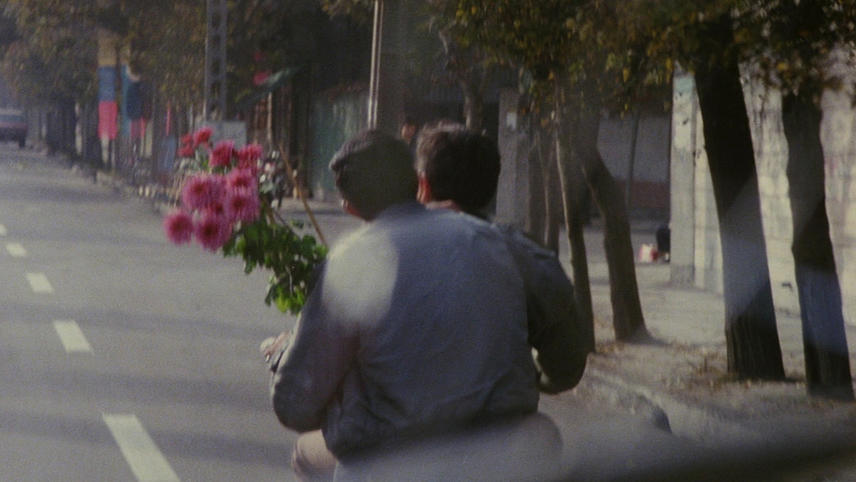
They meet on a Tehran street. Makhmalbaf gives Sabzian flowers. They climb onto a motorcycle together. They ride through the city. The camera follows from a car.
And here, something happens that may be the most peculiar moment in this entire film of peculiar moments. The audio fails. The microphone cuts in and out. We catch fragments of their conversation but not enough to follow it. Kiarostami later said it was a technical malfunction.
Many people do not believe him.
Many people believe Kiarostami deliberately let the audio fail because the conversation between Sabzian and Makhmalbaf was too private, too fragile, too real to be recorded. He had spent an entire film dissolving the line between documentary and fiction, and at the very end, at the moment of greatest truth, he looked away. He gave them silence.
It is the most generous act of filmmaking I have ever encountered.
The Verdict
There is no verdict. The film does not offer one. The judge in the real trial asked the Ahankhahs if they would forgive Sabzian. They did, reluctantly. He was released. He went back to his life. He remained poor. He remained unknown.
But he had been in a film. A real film. By a real filmmaker. The lie had, through some alchemy that only cinema can perform, become true.
You are the judge. You have heard the evidence. You have seen a man commit fraud out of love. You have seen a filmmaker turn that fraud into art. You have seen the real and the staged become so entangled that the distinction loses all meaning.
Was Sabzian guilty?
The court awaits your answer. The court suspects you will never be able to give one.
Close-Up (Nema-ye Nazdik) Directed by Abbas Kiarostami Iran, 1990 | 98 minutes

Leave a Reply