THE DOCUMENT
A woman and a man have sex. They film it. The footage is explicit. It is also ordinary: two adults, a bedroom, a camera. There is nothing remarkable about the act itself. There is nothing remarkable about filming it. Millions of people have done both. The footage was never intended for distribution.
It was distributed.
Radu Jude opens his film with the tape. He does not censor it. He does not cut away. He shows you exactly what millions of strangers saw when the video leaked, and he forces you to reckon with the first and most essential fact of the film: there is nothing wrong with what is on the screen. Two consenting adults. A private act. The only thing that makes it a crisis is that other people saw it. Everything that follows is the world’s reaction, and the world’s reaction is the catastrophe, not the tape.
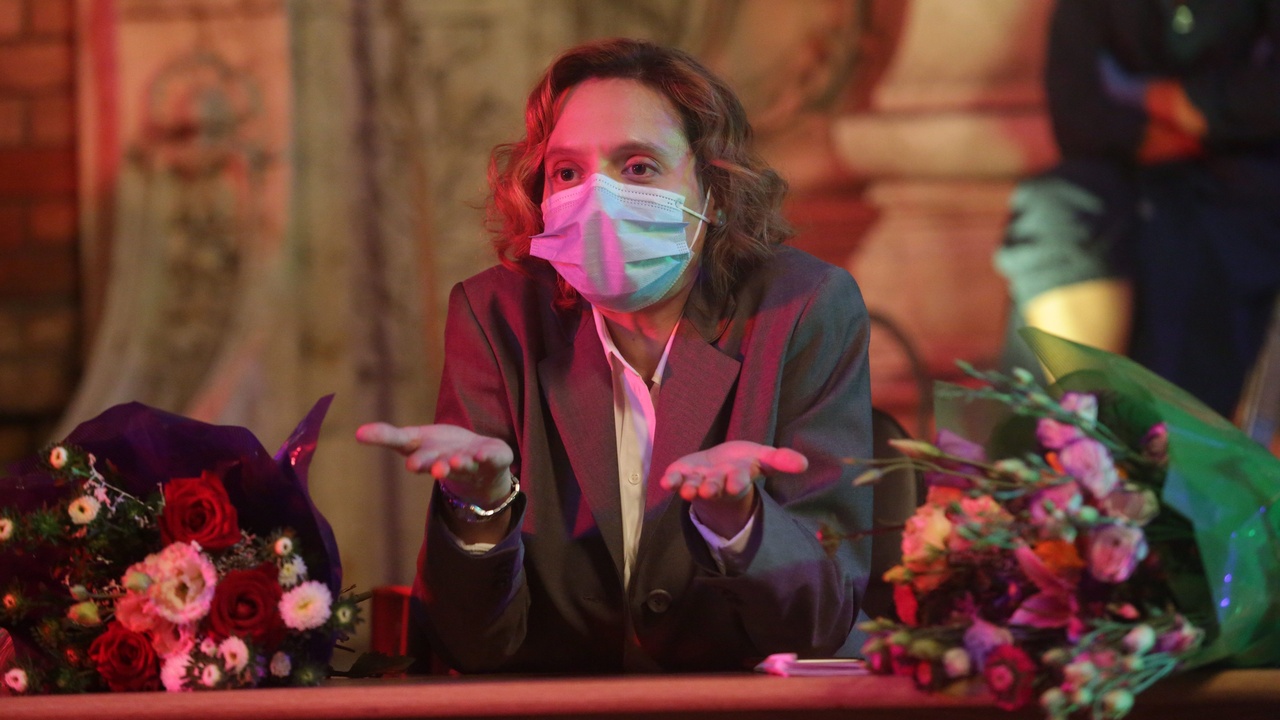
The woman is Emi, a schoolteacher in Bucharest. Katia Pascariu plays her, and she is magnificent: steady, furious, embarrassed, defiant, exhausted, and entirely unwilling to apologize for something that requires no apology. The school has called a hearing. The parents will vote on whether she keeps her job. She has until evening.
ANNOTATION 1: THE WALK (Part One of the film)
[Note in margin: This section is a documentary about Bucharest disguised as a character walking through it.]
Emi walks through the city. She has errands. She moves through traffic, shops, sidewalks. Jude follows her with a handheld camera, and the city presses in from every direction: car horns, construction, shouting, advertising, a man urinating on a wall, a woman screaming at a driver, posters for products that promise transformation, signage for businesses that will be gone in a year.
Bucharest is filmed as a sensory assault. Not beautiful, not ugly. Loud. Constant. Indifferent. The city does not care about Emi’s tape. The city does not care about Emi. The city is too busy being itself to notice that a woman is walking through it toward her own trial.
[Marginal note: Jude is showing you the society that will judge Emi. He is showing you its texture. The texture is crude, chaotic, commercial, and entirely unqualified to judge anyone for anything.]
Emi encounters obstacles. A car nearly hits her. A pharmacist is rude. A man exposes himself. She handles each encounter with the practiced patience of someone who has learned that public space belongs to everyone except her. The walk is long. It is frustrating. It is also very funny, in the way that cities are funny when you pay close enough attention to the absurdity of how they function.
[Annotation crossed out and rewritten: The walk is not funny. The walk is a portrait of a society that has lost the ability to distinguish between what matters and what does not, and that loss is the reason Emi’s sex tape is a crisis at all.]
ANNOTATION 2: THE DICTIONARY (Part Two of the film)
[Note in red ink: This section should not exist. It exists anyway. It won the Golden Bear.]
The film stops. The narrative pauses. Jude inserts an encyclopedia.
Part Two is titled “Short Dictionary of Anecdotes, Signs, and Wonders.” It is a montage of images, film clips, photographs, text cards, advertisements, and archival footage, organized alphabetically by concept. Each entry juxtaposes an idea with an image that illuminates, contradicts, or detonates it. An entry on “children” is followed by footage of Romanian orphanages. An entry on “history” is accompanied by photographs from the Holocaust in Romania. An entry on “pornography” includes Renaissance paintings of nude figures hanging in museums where schoolchildren are brought on field trips.
[Marginal annotation: Jude is building the prosecution’s case and the defense’s case simultaneously, using the same evidence.]
The dictionary is confrontational. It is designed to make you uncomfortable, regardless of where you stand on Emi’s situation. If you believe the tape is immoral, the dictionary shows you that Romanian culture is saturated with images more explicit, more violent, and more damaging than anything two adults do in a bedroom. If you believe the tape is harmless, the dictionary shows you the historical atrocities that the same society has normalized, and asks whether a culture that can absorb genocide without flinching has any coherent framework for moral judgment at all.
[Note added in different handwriting: The dictionary is the most radical structural choice in any film on this site. Jude stops telling a story and starts building an argument. The argument has no conclusion. The entries accumulate until the weight of them becomes the point.]
[Counter-annotation: The dictionary is also a stunt. It is Jude showing off. It is a filmmaker drunk on his own intelligence. Both readings are correct.]
ANNOTATION 3: THE TRIAL (Part Three of the film)
[Highlighted passage: This is where everything converges.]
Evening. The school courtyard. Plastic chairs arranged in rows. The parents sit. The principal presides. Emi stands before them. The hearing begins.
Jude films the trial as a single, extended scene, and it is one of the most excruciating and brilliant sequences in contemporary cinema. The parents speak. They are outraged. They are reasonable. They are hypocritical. They are sincere. One parent argues that a teacher must be a moral example. Another argues that Emi’s private life is irrelevant. A third watches the tape on his phone during the hearing and seems aroused. A fourth delivers a speech about Romanian values that slides, without warning, into nationalism, then into antisemitism, then into a rant about George Soros.
[Marginal note: Jude does not caricature these people. That is what makes the scene unbearable. Every parent is recognizable. Every argument has been made, in some form, by someone you know. The film’s refusal to create easy villains is its cruelest and most generous quality.]
Katia Pascariu sits through this. She listens. She responds when asked. She does not grovel. She does not rage. She occupies the specific position of a woman who knows she has done nothing wrong and also knows that knowing this will not save her. The parents have the vote. The parents have the power. The facts are irrelevant. The tape exists. Shame has been decided in advance.
[Annotation in pencil, barely legible: The trial is about the tape the way every trial is about the evidence: partially. The trial is actually about who gets to define acceptable behavior, and the answer is: whoever has the majority.]
ANNOTATION 4: THE ENDINGS
[Note stapled to the margin: There are three.]
Jude gives the film three endings. Three possible outcomes of the vote. He labels them. He plays them sequentially. One is realistic. One is comic. One is cathartic in a way that should not be described.
The three endings are not a gimmick. They are the final annotation. They say: the document you have been annotating does not have a single meaning. It has as many meanings as there are people in the courtyard, in the audience, in the country. The verdict depends on who is watching and what they brought with them. Jude will not choose for you. He will give you three choices and let the discomfort of choosing be the film’s final act.
ANNOTATION 5: THE CLASSIFICATION PROBLEM
[Marginal note, written over previous annotations until the original text is no longer visible:]
There is no genre for this film.
It has been called a satire. It is too angry to be satire. Satire maintains distance. Jude is in the room, swinging. It has been called a provocation. It is too structured to be mere provocation. Every formal choice is precise: the walk, the dictionary, the trial, the three endings. Each section does something the others cannot. It has been called essay film, social comedy, courtroom drama, experimental cinema. It has been called the best Romanian film of the decade, which may be true but does not help you understand what you are watching.
What you are watching is a film that takes a single event — a sex tape leaks — and uses it to x-ray an entire society. The x-ray shows everything: the hypocrisy, the nationalism, the misogyny, the genuine concern for children, the bad faith, the good faith that has been corrupted by proximity to bad faith, the history that no one wants to discuss, and the present that no one can agree on.
The document has been annotated beyond legibility. The margins are full. The corrections contradict the corrections. The original text — two people, a bedroom, a camera — is still there, underneath everything, unchanged. It was never the problem. The annotations were always the problem. The annotations are always the problem.
Bad Luck Banging or Loony Porn (Babardeală cu bucluc sau porno balamuc) — Directed by Radu Jude. Romania, 2021. 106 minutes.

Leave a Reply