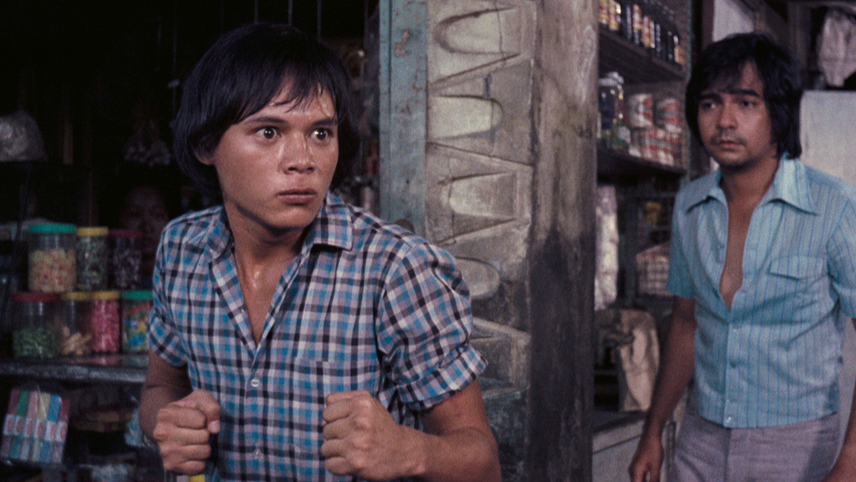
MISSING PERSON — INITIAL REPORT
Name of missing person: Ligaya Paraiso Age: Approximately 19 Last known location: Manila, Philippines Reported missing by: Julio Madiaga, fisherman, province of Marinduque Relationship to missing person: Boyfriend Circumstances of disappearance: Subject was recruited from her village by a woman claiming to offer employment in Manila. Subject left voluntarily. No further contact.
Description of subject: Young woman. Small build. Last seen wearing [not recorded]. No photograph available.
Action taken: Reporting party has traveled to Manila to conduct his own search.
This is where the film begins. Julio Madiaga arrives in Manila with nothing but a name and the belief that Ligaya is somewhere in the city. He has no address, no contact, no money. He has the assumption — reasonable, human, catastrophic — that if you love someone and they are lost, you go and find them.
Lino Brocka made Manila in the Claws of Light in 1975, during the Marcos dictatorship. It was based on a novel by Edgardo M. Reyes. It is a film about a man searching for a woman in a city that is designed, at every level, to make people disappear.
SUPPLEMENTARY REPORT — CURRENT STATUS OF REPORTING PARTY
Name: Julio Madiaga Current employment: Construction laborer, Manila Working conditions: Twelve-hour shifts. No contract. Wages withheld at foreman’s discretion. Housing provided: a plywood partition in a workers’ dormitory shared with thirty men. Physical condition: Declining.
Julio works construction. The buildings he helps erect are part of the new Manila — glass, concrete, modernity. The scaffolding is bamboo. The workers are provincial men like him, drawn to the city by the promise of wages, held there by the absence of alternatives. Brocka films the construction site the way a naturalist films a feeding ground. The building rises. The men at the bottom do not.
This is not subtext. Brocka was not interested in subtext. He was interested in surfaces — in the visible, filmable, undeniable surfaces of poverty, labor exploitation, and urban predation. Manila in the Claws of Light is shot in real locations, in real slums, with the camera pushed so close to the sweat and the concrete and the bodies that you can feel the heat.
But here is what makes the film peculiar, and what separates it from the social realism it resembles. Brocka does not film Manila as a backdrop. He films it as a mechanism. The city is not where the story happens. The city is what happens. Every neighborhood Julio passes through — the construction site, the Chinese merchant district, the red-light streets of Chinatown — is a different organ of the same predatory body. The city digests people. It takes in provincial bodies and extracts labor, sex, money, and hope, and it expels what’s left.
UPDATED REPORT — SEARCH PROGRESS
Leads pursued: Julio has traced Ligaya to the household of a Chinese merchant named Ah Tek. Current status of missing person: Located. Subject is being held as a domestic servant. Conditions suggest forced labor. Obstacles to recovery: Ah Tek’s household is guarded. Julio lacks resources to intervene legally. No authorities have been contacted. Reason authorities have not been contacted: [This field is left blank in the film. The answer is visible in every frame. The authorities are not a resource available to people like Julio.]
Brocka was the most important Filipino filmmaker of the twentieth century, and possibly still. He made over sixty films before his death in a car accident in 1991 at the age of fifty-two. Many were commercial — melodramas, studio pictures, work for hire. The ones that mattered were the ones where he turned the camera on the people the Marcos regime preferred to keep invisible: the urban poor, the laborers, the women trafficked from provinces into the city’s service economy.
Manila in the Claws of Light is the one that broke through internationally. It screened at Cannes. It is now in the Criterion Collection. It is regularly cited as one of the greatest films in Philippine cinema history. And it is almost impossible to categorize.
It is not a thriller, though Julio’s search for Ligaya has the structure of one. It is not a social-realist document, though every location is real and every condition it depicts was verifiable. It is not a melodrama, though the love story at its center would be at home in one. It is not a political film in the sense of making an argument, though the politics are so present they stain the lens.
What it is, finally, is a film about what a city does to a body. Julio’s body. His body arriving in Manila with muscle and hope. His body working on scaffolding. His body sleeping in a partition. His body wandering through streets at night, looking for a face. His body at the end.
FINAL REPORT — CASE STATUS
Missing person (Ligaya Paraiso): Found. Circumstances of recovery: [redacted for content]. Reporting party (Julio Madiaga): Status changed.
Details of status change: In the final act of the film, Julio acts. He does what the city has been designed to make impossible. He intervenes. The consequences are immediate, total, and filmed by Brocka with a directness that makes the screen feel like a wall you’ve walked into.
The ending of Manila in the Claws of Light is one of the most disputed in Filipino cinema. It has been read as political allegory, as class warfare made literal, as Catholic martyrdom, as the inevitable outcome of a system that consumes its own labor force. Brocka never explained it. He didn’t need to. The film has already shown you what Manila does to people who arrive looking for someone they love. The ending is not a surprise. It is a receipt.
ADDENDUM — FILED BY NO ONE
Case closed.
There is no one to close the case. There is no case. Julio Madiaga was never a person the system was designed to track. Ligaya Paraiso was never a person the system was designed to protect. The missing persons report was never filed because the category of “missing” requires that someone, somewhere, is expected to be present. In Manila, in 1975, in the neighborhoods Brocka filmed, presence was not expected. Presence was temporary. The claws were permanent.
The title is not a metaphor. Brocka did not deal in metaphor. The city has claws. The light is what you see by while the claws do their work.
Manila in the Claws of Light Directed by Lino Brocka | Philippines | 1975 | 125 minutes

Leave a Reply