Decree No. 1: Music is forbidden.
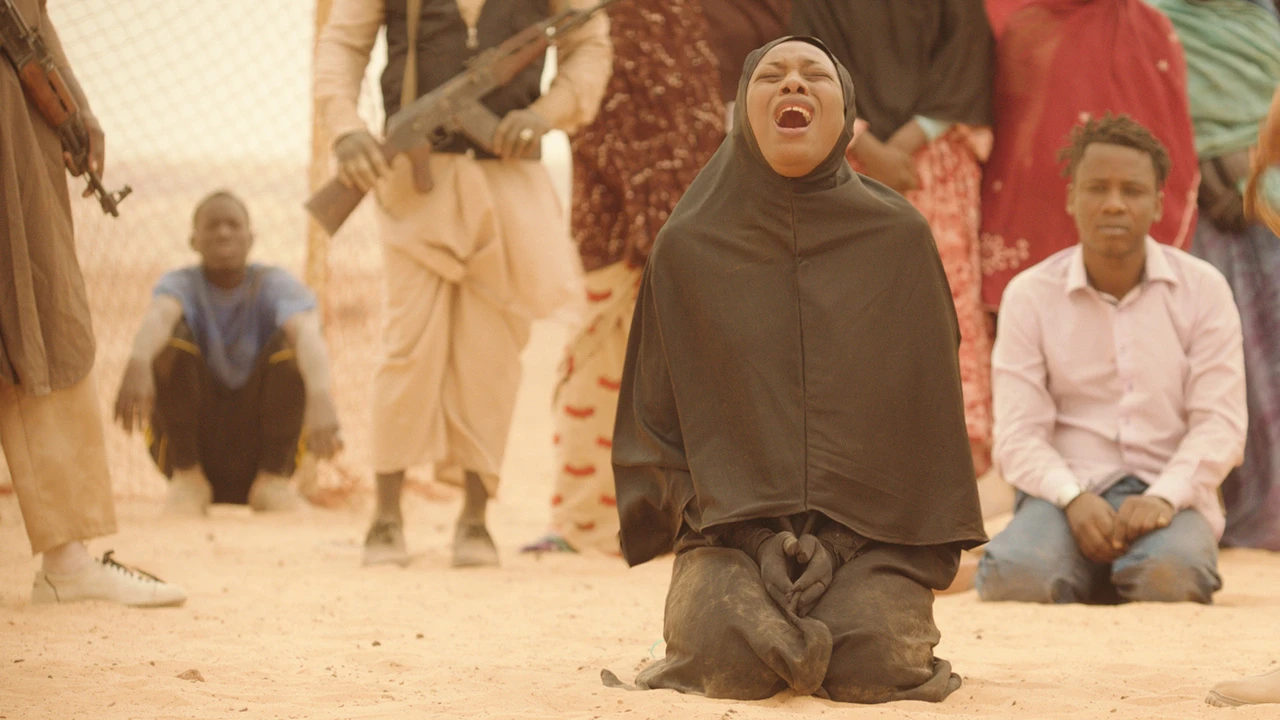
A woman sings. She is in her home. Her voice carries. The jihadists arrive and tell her to stop. She sings louder. They take her outside and whip her. She sings while they whip her. She does not stop. They do not know what to do with someone who will not stop.
This is how Timbuktu operates. Abderrahmane Sissako’s 2014 film is set in and around the city of Timbuktu during a jihadist occupation. Armed men in pickup trucks issue prohibitions. The people of Timbuktu violate them, not out of organized resistance, but because the prohibitions are asking them to stop being alive.
Decree No. 2: Football is forbidden.
Boys play football without a ball. They run across a sandy pitch, passing nothing, heading nothing, celebrating goals scored with nothing. The camera watches them from a distance. The game is complete. Every tackle, every break, every burst of joy. The ball is the only thing missing, and its absence changes nothing about the reality of the match.
This is one of the most written-about scenes in recent world cinema, and it deserves to be. It is funny. It is also one of the most precise images of defiance ever filmed. You can ban the object. You cannot ban the desire for the object. You cannot ban the shape the body makes when it wants to play.
Decree No. 3: Smoking is forbidden.
The jihadists smoke. They do it behind a dune, away from the checkpoint, passing a cigarette the way teenagers do when their parents are nearby. They know their own rules are absurd. They follow them publicly and break them privately, and the gap between their authority and their behavior is one of the film’s most quietly devastating observations.
Sissako does not make these men into monsters. That is part of what makes the film so difficult to classify. A polemical film would give you villains. A war film would give you combat. A political thriller would give you a plot to resist. Timbuktu gives you jihadists who argue about football. One of them records a video announcing his commitment to jihad and can’t get through a single take. He stumbles over his words. He starts again. The scene is, by any measure, comic. And you are watching a man rehearse an ideology that is destroying a city.
Decree No. 4: Gloves must be worn by women selling fish in the market.
A woman at the fish market says she cannot wear gloves. She works with her hands. She guts fish. The jihadist insists. She holds up her wet, scaled hands and says: how? He has no answer. The decree stands. The hands stay bare.
Sissako is Mauritanian, born in Mali, raised partly in the Soviet Union, based in France. His films are quiet, unhurried, politically furious beneath surfaces so beautiful they could be mistaken for calm. Timbuktu was his response to the 2012 occupation of northern Mali by Ansar Dine and associated groups. He did not make a documentary. He did not make an outrage delivery system. He made a film in which life and its suppression exist in the same wide shot, and the camera does not tell you which one to look at.
Decree No. 5: Gatherings of more than three people are forbidden.
A man named Kidane lives in a tent in the dunes outside the city with his wife Satima, his daughter Toya, and a young shepherd named Issan. He plays guitar. He tends cattle. He does not go into town. The occupation is something that happens elsewhere, on the other side of the sand.
Then one of his cows wanders into a fisherman’s net. The fisherman kills the cow. Kidane confronts him. There is a struggle in shallow water. A gun goes off. The fisherman dies. Kidane is brought before the jihadist court, which sentences him under a system of law that did not exist in this place six months ago.
This is the closest Timbuktu comes to a conventional plot, and even here it resists. The killing is an accident. The trial is calm. The sentence is carried out without spectacle. Kidane’s death happens in the same wide shot as his daughter running across the dunes toward him. The camera does not cut to her face. It holds.
Decree No. 6: Any form of worship not sanctioned by the occupying authority is forbidden.
An imam stands in his mosque and argues, gently, with the jihadists who have entered with guns. He tells them they cannot enter the mosque with weapons. They tell him they are implementing God’s law. He tells them he has been implementing God’s law in this mosque for decades. They do not shoot him. They do not leave. The conversation has no resolution. It simply happens, and then another scene begins.
This is the quality that makes Timbuktu peculiar. It is not structured as a rising action. It is structured as a series of encounters between an immovable population and an unstoppable ideology, and each encounter produces a small, precise, unrepeatable human moment that no genre can hold.
It is not a war film. Nobody fights. It is not a political film. No argument is made. It is not a comedy, although the football scene is joyful and the smoking scene is absurd. It is not a tragedy, although a man dies and a girl runs toward him too late. It is all of these things simultaneously, in a tone so even that you might mistake its composure for detachment.
It is not detached. It is the furthest thing from detached. It is a film that believes the clearest way to show what occupation destroys is to show, in detail, what existed before the trucks arrived. The music. The football. The bare hands in the fish market. The guitar in the tent. Not as symbols of resistance. As Tuesday. As what people do.
Decree No. 7: [This decree was never issued. The wind took the paper. The city went on.]
Timbuktu Directed by Abderrahmane Sissako | Mauritania / France | 2014 | 97 minutes

Leave a Reply