Page 1 — On the Nature of Shadows
“There exist certain beings whose connection to the supernatural has been well documented…”
A standard opening. The kind of sentence you find in every 19th-century occult text. Whoever owned this book before me has underlined it twice.
Page 7 — On the Behavior of Shadows in the Presence of the Undead
The book claims that shadows, in places where a vampire has taken hold, may detach from their owners and move independently.
Note in the margin, in pencil: I saw this. The shadow of a man digging, but the man was sitting still.
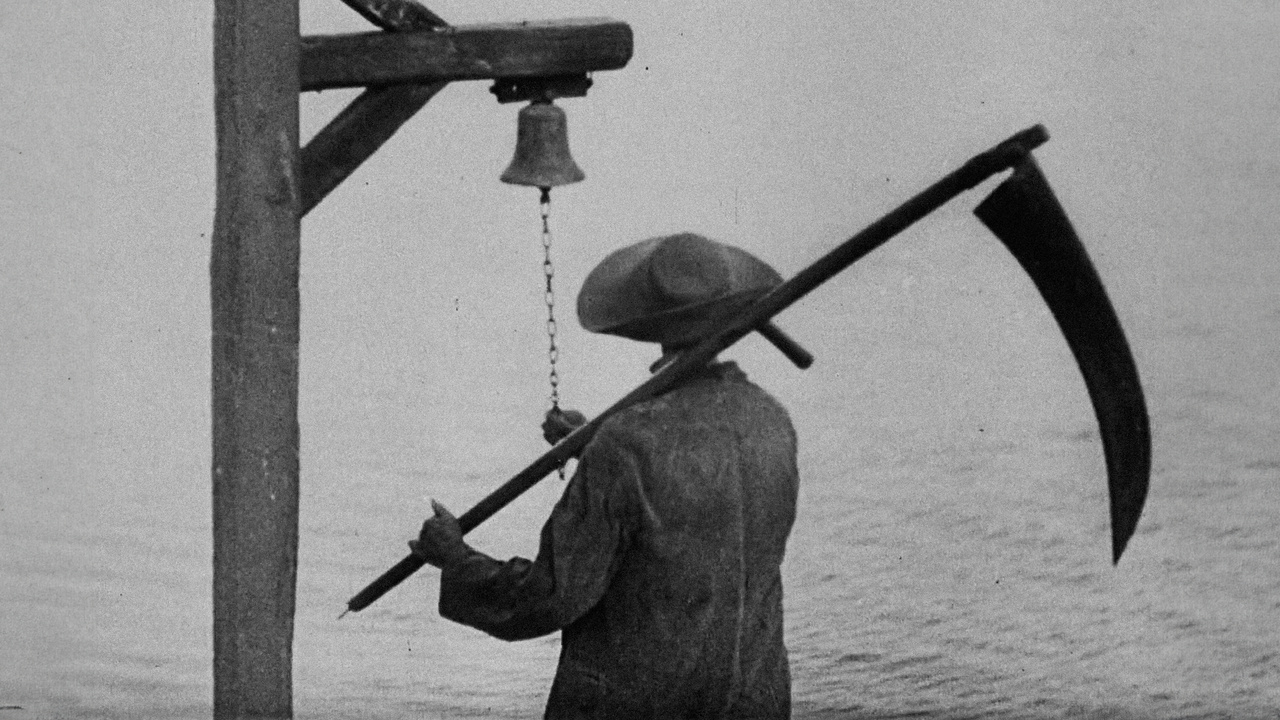
This needs context. Carl Theodor Dreyer made Vampyr in 1932, three years after the technically flawless The Passion of Joan of Arc. Where Joan of Arc was made with the best equipment available in a custom-built studio, Vampyr was financed by a young aristocrat named Baron Nicolas de Gunzburg, who also starred in it under a pseudonym. Dreyer shot it on location in a village outside Paris, deliberately smeared the lens, and printed the film on stock that made every frame look like it had been left in a drawer for fifty years.
The result is a vampire film that looks like it was found, not made. Every image appears to be decomposing as you watch it. Shadows move without bodies. Figures appear in rooms they didn’t enter. A man watches his own corpse through the glass lid of a coffin. The film doesn’t feel projected so much as remembered — badly, incompletely, by someone who isn’t sure they were awake.
Page 12 — On the Victims
“The victim does not die at once. There is a period in which the soul belongs to neither the living nor the dead…”
Margin note, same pencil: Léone’s face. She smiled at the doctor. It wasn’t her smile.
In the film, a character named Allan Gray arrives at a village inn. An old man enters his room uninvited, leaves a package labeled “To be opened upon my death,” and disappears. Gray wanders the estate. He sees a shadow sitting in a chair while the man who owns it stands elsewhere. He sees another shadow dancing alone. He follows a shadow to a factory where shadows are working independently of any human presence.
This is not how vampire films are supposed to work. In 1932, Bela Lugosi’s Dracula had been released the year before. Vampires were capes and castles and puncture wounds. Dreyer wasn’t interested in any of that. He was interested in what happens to perception when the boundary between living and dead softens. Not in the monster. In the fog.
Page 19 — On the Doctor
“The vampire rarely acts alone. There is frequently an accomplice among the living — a physician, or a figure of authority, who enables the predation while maintaining the appearance of care.”
No margin note on this page. Just a fingerprint at the bottom, in something too dark to be ink.
Page 23 — On the State Between
“The victim enters a condition that is neither sleep nor waking. They see and hear what occurs around them but cannot act. They are buried in this state. They are aware.”
Margin note, heavier now, pressed hard: The coffin scene. I need to describe the coffin scene.
Here is the coffin scene. Gray lies in a coffin. The coffin has a small glass window above his face. The camera looks up through the window, from inside, from his point of view. You see the ceiling move. You see the edge of a building pass overhead. You see tree branches. You see sky. You are being carried to your burial. You are conscious for it.
Nothing in the film has prepared you for this and nothing after it explains it. It might be a dream. It might be a vision. It might be what happens. Dreyer treats all three possibilities with identical visual grammar. There is no signal that says: this is real, this is not. The gauze on the lens does not clear. The double exposures do not resolve. The film stocks do not improve. You are always in the between state.
That is what makes Vampyr peculiar, not the vampires. Every vampire film since Nosferatu has known that vampires are frightening. Dreyer understood something stranger: that the real horror is not the monster, but the condition of being unable to distinguish what is happening from what is being dreamed, read, imagined, or remembered. The vampire is almost incidental. What persists is the fog.
Page 31 — On the Cure
“The vampire may be destroyed by driving a steel bar through the heart of the corpse. When this is done, the victims awaken and the shadows return to their owners.”
Margin note, barely legible: It works. In the film, it works. The girl wakes up. The shadows reattach. The doctor dies in a flour mill, buried in white dust that pours over him until he vanishes. But what kind of cure is this? The film is over. The fog on the lens doesn’t lift. The image never becomes clean. You were promised a resolution and you received one, and nothing about the way the film looks or moves or breathes has changed. You are still watching through gauze. The cure is narrated. It is not experienced.
Page 36 — Final Annotation
The last page of the book is blank. In the film, Gray reads this book in a chair while shadows move around him. He reads his own situation and cannot act on what he reads. The book tells him what is happening. It does not tell him how to feel about it. It does not tell him whether he is awake.
Dreyer was fifty-three when he made Vampyr. It was a commercial disaster. He would not complete another film for twelve years. When he returned, he made Day of Wrath, then Ordet, then Gertrud — four films in thirty-two years. Each one stripped cinema down further. Each one moved more slowly. Each one cared less about what you thought was happening and more about what you were unable to look away from.
Vampyr is the earliest of these. It is also the one where Dreyer was least in control, where the borrowed money and the smeared lenses and the accidental light leaks produced something he might not have been able to make on purpose. It looks like a film that arrived from somewhere else. Not from a studio. Not from a script. From the page of a book that someone read too late, in a room where the shadows had already started moving on their own.
The margin notes end here. The pencil was found on the floor. The book was open to this page.
Vampyr Directed by Carl Theodor Dreyer | Germany / France | 1932 | 73 minutes



Leave a Reply