THE FIRST TELLING
Before the film begins, the prophecy is already complete. Everything that will happen has already been spoken. The father will hunt the son. The son will run. They will meet. Light will consume them both. The earth will be changed.
Souleymane Cissé made Yeelen in 1987, in Mali, in the Bambara language, using the structures of Bambara cosmology as both narrative and form. He did not adapt a myth for Western audiences. He did not translate. He built a film that operates entirely within a system of knowledge that most viewers will not share, and he trusted that the power of the images and the clarity of the confrontation would carry meaning across every border.
He was right.
THE FATHER RISES
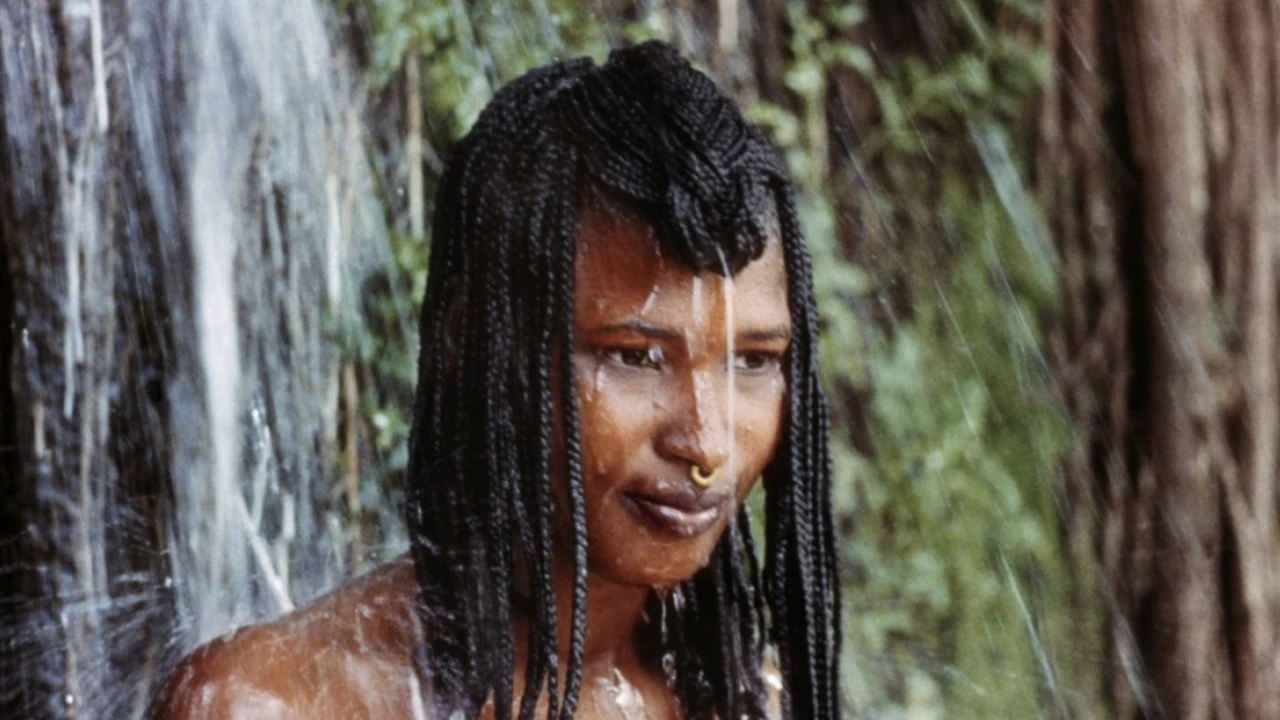
Soma Diarra is a sorcerer of the Komo society, the highest order of Bambara spiritual power. He possesses the Komo wing and the Kolón fire, sacred objects whose nature the film reveals through use, not explanation. When Soma raises the wing, the air changes. When he invokes the fire, light moves across the screen like something alive.
Soma is searching for his son, Nianankoro, and he intends to kill him.
Cissé does not explain why. Not in the way a Western film would explain: no flashback, no exposition scene, no argument delivered for the audience’s benefit. The reason exists inside the cosmology. Nianankoro possesses power. The father fears the son’s power because the prophecy says the son will surpass the father. In Bambara tradition, this is not jealousy. It is the order of things, and Soma has decided to break that order rather than submit to it.
Niamanto Sanogo plays Soma with a stillness that is more frightening than any display of rage. He walks. He invokes. He waits. His face reveals nothing except certainty. He is a man who has looked at the shape of the future and decided to cut it out of the world rather than live inside it.
THE SON RUNS
Nianankoro moves across the savanna. He is young. He carries his own power, inherited from his mother’s line, and he does not fully understand it yet. He meets a Fulani king. He is given a wife. He heals the sick. He defeats a rival sorcerer. Each encounter is a station in a journey that resembles initiation: the young man tested, transformed, prepared for something he does not yet know he must face.
Issiaka Kane plays Nianankoro with an openness that is the opposite of his father’s sealed authority. He is curious. He makes mistakes. His power frightens him. When he uses it, the film shows the effect without spectacle: a gesture, a change in light, a shift in the behavior of water or fire or sand. Cissé’s magic is not special effects. It is the world responding to the presence of someone who knows how to speak to it.
The landscape of Mali is filmed as a participant, not a backdrop. The savanna is golden. The trees are enormous and ancient. The rivers are slow and wide. The sky is so open it seems to have a weight of its own. Cissé and cinematographer Jean-Noël Ferragut shoot this landscape with a patience that feels devotional. Each wide shot holds long enough for you to feel the distance Nianankoro must cross, and the distance Soma is closing behind him.
THE MOTHER SPEAKS
Nianankoro’s mother sends him to find his uncle, Djigui, who possesses knowledge that can protect him. She is the one who set the son’s journey in motion. She is the reason Soma’s pursuit has failed so far. She is the counterweight.
Cissé does not make the mother a character in the Western sense. She is a force. She appears, delivers knowledge, and the knowledge changes what is possible. In Bambara cosmology, knowledge is not abstract. It is material. It has weight and direction. When the mother speaks, the prophecy advances.
This is what makes Yeelen genuinely peculiar, and what separates it from every other film about magic, myth, or the supernatural. Cissé does not present Bambara cosmology as belief. He does not frame it as superstition to be admired from a safe anthropological distance. He presents it as fact. Within the world of this film, the Komo wing works. The Kolón fire burns. The prophecy is accurate. The sacred objects are sacred. There is no gap between the spiritual and the physical, no wink to the audience, no rational explanation waiting in the wings.
You are watching a film that asks you to accept a complete cosmological system on its own terms, without translation, without apology. If you can do that, the film opens like a door. If you cannot, the film remains a beautiful enigma. Both experiences are legitimate. But only one gives you Yeelen.
THE CONFRONTATION IS FORETOLD
They will meet. The prophecy has always said so.
Soma walks south. Nianankoro walks north. The geometry is simple and absolute. Two sources of light moving toward each other across a landscape that cannot contain what will happen when they converge.
Cissé builds the final act with a patience that would be unbearable if the images were not so extraordinary. The pace does not quicken. The music, composed by Michel Portal and drawing on traditional Malian instruments, does not accelerate. The film simply moves, at the speed of fate, toward the point where father and son will stand in the same frame.
THE LIGHT
They meet. The sacred objects are raised. The two powers face each other.
What happens next is one of the most astonishing sequences in the history of cinema, and it lasts only seconds. Light. Not metaphorical light. Not poetic light. Light as a physical force that fills the screen, obliterates the image, and destroys both men. The screen goes white. The world is remade.
After the light fades, two stone pillars stand where father and son stood. A child finds them. The child picks up two eggs from the sand between the pillars. The eggs are the future. The knowledge has been passed. The cycle begins again.
Yeelen won the Jury Prize at Cannes in 1987. It was the first sub-Saharan African film to win a major prize at the festival. This fact is significant and also insufficient, because it frames the film as a milestone in African cinema’s relationship to European institutions, when the film itself has no interest in that relationship whatsoever. Yeelen does not speak to Cannes. It speaks to the Bambara tradition it emerges from, and Cannes was wise enough to listen.
THE PROPHECY COMPLETED
There is no genre for this film.
It has been called fantasy, but fantasy implies invention. Cissé did not invent this cosmology. It is real. It is practiced. It has existed for centuries. Calling Yeelen fantasy would be like calling a film about the Eucharist fantasy because it depicts transubstantiation.
It has been called an epic, but its scale is intimate. Two men, a landscape, a confrontation. The stakes are cosmic, but the frame is human.
It has been called world cinema, which is a category that means nothing except “not from here,” and Yeelen deserves better than to be defined by where it is not from.
What it is: a film made from within a tradition that most of global cinema ignores, using that tradition’s own grammar, at a level of craft and beauty that stands beside anything produced anywhere in the world in any decade. A film where light is not a metaphor. A film where a father and a son destroy each other because the shape of time demanded it. A film that trusts you to meet it where it stands.
The prophecy said they would meet. They met. The prophecy said light would come. It came.
Everything the prophecy said was true.
Yeelen (Brightness) — Directed by Souleymane Cissé. Mali, 1987. 105 minutes.

Leave a Reply