[unlabeled]
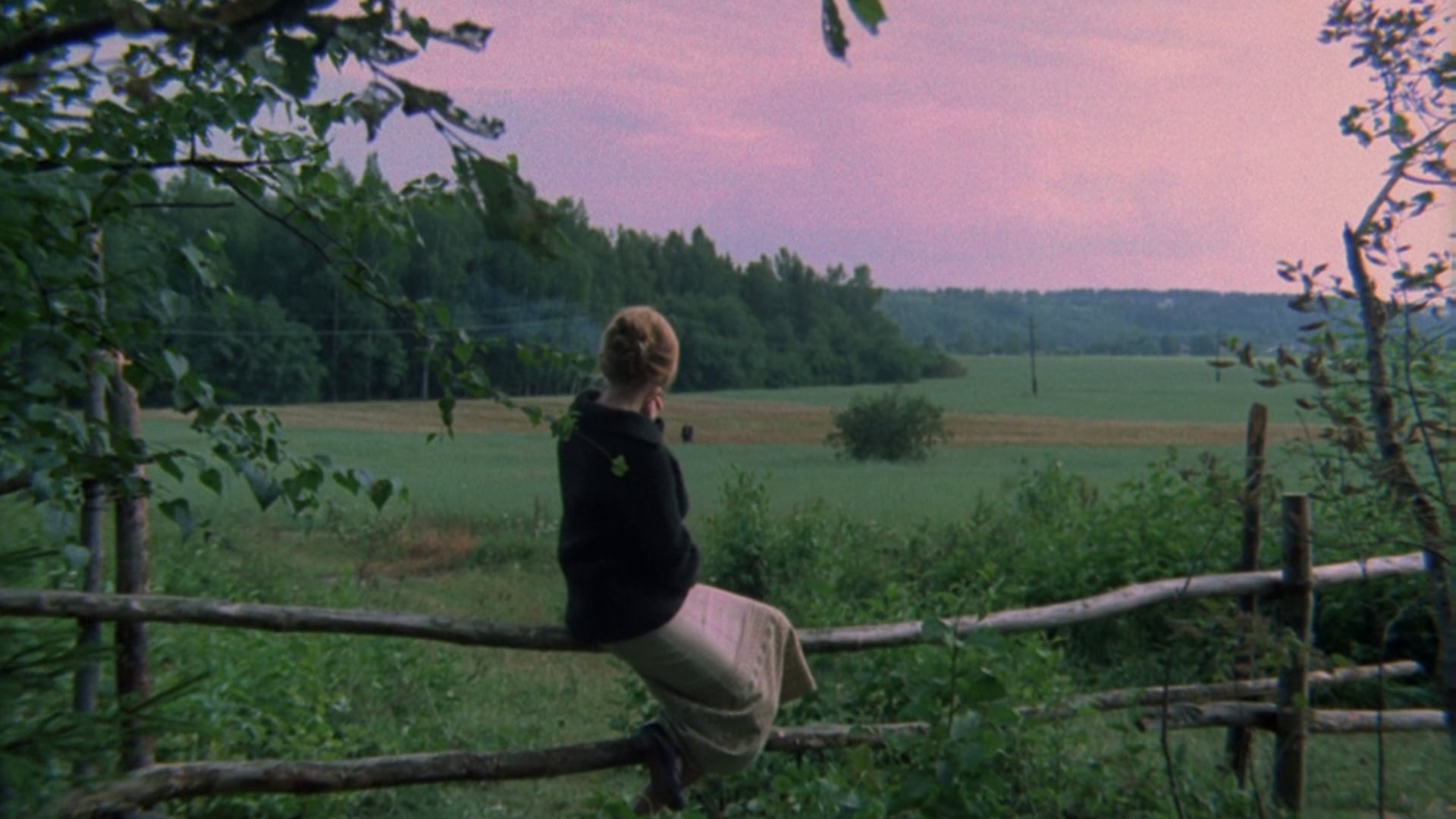
A woman sits on a fence in a field. The grass is tall. A man approaches on a path. He asks for directions. The wind moves through the grass before she answers. The wind is the most important thing in the frame. Not the woman, not the man, not the question. The wind.
This might be the 1930s. It might be the 1940s. It might be neither. The woman might be the filmmaker’s mother. She might be his wife. She is played by the same actress, Margarita Terekhova, in both roles, and the film does not always tell you which one you’re looking at.
[unlabeled]
A barn is on fire. The fire is real. It was an actual barn, actually burning, and Tarkovsky waited for rain to begin before filming so that the fire and the rain would exist in the same shot. A boy watches. A woman carries water. The fire does not go out. The rain does not put it out. The image has no context, no cause, no consequence. It simply exists in the film the way a burning barn exists in memory: sudden, total, unexplained, more vivid than anything that happened before or after it.
[unlabeled]
Newsreel footage. Soviet soldiers crossing Lake Sivash during the Second World War. The water is chest-high. The men carry equipment above their heads. The footage is real. It was shot by a military cameraman. Tarkovsky found it and placed it inside a film about his mother and his childhood and his marriage, and it fits. That is the impossible thing. Documentary footage of a wartime crossing fits inside a man’s private memory of his mother’s face, because memory does not sort by category. Memory sorts by weight. The soldiers crossing the lake weigh the same as the burning barn. They weigh the same as the wind in the grass. Everything that matters weighs the same.
Andrei Tarkovsky made The Mirror in 1975. He was forty-three. He had already made Ivan’s Childhood, Andrei Rublev, and Solaris. He would go on to make Stalker, Nostalgia, and The Sacrifice. Each of these films is extraordinary. None of them is like The Mirror, because none of them attempts what The Mirror attempts, which is to make a film structured exactly the way human memory works.
Not a film about memory. Not a film that uses flashbacks. A film that is memory.
[unlabeled]
A printing press. A woman — the mother? the wife? — works at a printing house. She rushes through corridors. She believes she has made a typographical error in something she proofread. She is terrified. She arrives, checks the text, finds no error. The terror does not subside. It lingers in the corridor after she leaves.
This scene takes five minutes. It has almost nothing to do with the rest of the film. It connects to nothing before it and nothing after it. It is one of the most precise depictions of anxiety ever filmed, and Tarkovsky places it in the middle of his autobiography the way you would tell someone about a time your mother was afraid: suddenly, out of sequence, because something reminded you.
That is the structural principle. There is no plot. There is no chronology. There are three approximate timelines — the 1930s (the filmmaker’s childhood), the 1960s–70s (the filmmaker’s adult life and failing marriage), and the 1940s (the war) — and they do not alternate in any pattern. They interrupt each other. A room in one decade leads to a corridor in another. A boy’s face dissolves into a man’s face. The mother becomes the wife becomes the mother. The same actress. The same expression. Different light.
[unlabeled]
A boy holds a book. The camera moves across the pages. The pages show Leonardo da Vinci’s anatomical drawings. There is no dialogue. The boy’s hand moves. The sound of Tarkovsky’s father, the poet Arseny Tarkovsky, reading his own poetry plays on the soundtrack.
This is the other impossible thing about The Mirror. Arseny Tarkovsky’s poems are read aloud at several points in the film. They are not explained. They are not illustrated. They simply exist alongside the images the way a parent’s voice exists alongside a child’s visual memory of a room. You hear your father reading while you remember your mother’s face, and the two sensations occupy the same space without interfering with each other.
The Soviet authorities did not know what to do with this film. It was not banned. It was not celebrated. It was released in a limited run, shown in smaller theaters, discussed with suspicion. Tarkovsky later wrote that audiences either loved it completely or rejected it completely, and that the people who loved it sent him letters describing their own memories as if the film had been about them.
That is not a metaphor for the film’s success. That is the film’s method. The Mirror is structured so precisely like memory that it activates your own. You watch Tarkovsky’s mother sitting on a fence and you remember your mother sitting somewhere. The wind in his grass becomes wind in your grass. The burning barn becomes whatever burned in your childhood, whatever image arrived without warning and never left.
[unlabeled]
A woman washes her hair. Water runs down a wall. The ceiling is leaking or the wall is weeping or the apartment is coming apart. The camera watches the water. The woman is not alarmed. She lives with this. The water is part of the house the way memory is part of the body. It comes through without permission. It stains things. It doesn’t stop.
[unlabeled]
A boy in snow. Or a different boy. Or the same boy at a different age. He stands at the edge of a field. The camera is far away. The trees are bare. Arseny Tarkovsky’s voice reads a poem about time. The boy does not move. The poem does not explain the image. The image does not illustrate the poem. They coexist.
[unlabeled]
An old woman — the mother, now elderly, played by Tarkovsky’s actual mother, Maria Vishnyakova — sits in a chair by a window. The camera holds on her face. She is looking at something outside the frame. She does not speak. The film is almost over.
Tarkovsky died in 1986, in Paris, in exile. He was fifty-four. He had made seven feature films. The Mirror is the one that cannot be described, because the act of describing it — putting scenes in sequence, assigning meaning, identifying characters — violates its basic principle. It does not move forward. It does not move backward. It moves the way you move through a room you lived in as a child: sideways, by association, touching a wall and suddenly remembering the texture of a different wall in a different house in a different decade.
No genre can hold this. It is not a memoir. It is not an essay film. It is not a tone poem, though that phrase gets used. It is a mirror. You look into it and see your own memory arranged in someone else’s images. The captions are missing because memory does not caption itself. It simply arrives, insists on its own weight, and stays.
[unlabeled]
The field again. The grass. The wind. The woman on the fence. The man has gone. The boy is there now, or was always there. The camera pulls back. The trees at the edge of the field are the same trees from the beginning. Everything is the same, seen from further away. The distance changes nothing and everything.
The Mirror Directed by Andrei Tarkovsky | Soviet Union | 1975 | 108 minutes

Leave a Reply