There is a perfectly reasonable way to describe Hausu. You could call it a 1977 Japanese horror film about seven schoolgirls who visit a countryside mansion and are consumed by it, one by one. That description is accurate. It is also completely useless.
Because Hausu is not a film you describe. It is a film you survive. And then, still shaking, you try to explain to someone what just happened to you. You will fail. You will sound unhinged. You will want them to watch it immediately.
The Setup Sounds Normal. It Isn’t.
Gorgeous, a schoolgirl whose name is literally Gorgeous, can’t go on summer vacation with her father because he’s bringing home a new stepmother. So she writes to her aunt in the countryside. She invites six friends to come along. Their names are Fantasy, Prof, Melody, Mac, Kung Fu, and Sweet.
Yes. Those are their names. Each girl is exactly one trait, and nothing more. This should feel lazy. In the hands of director Nobuhiko Obayashi, it feels like a fairy tale stripping itself down to its bones.
The girls board a train. The countryside looks painted. The sky bleeds color like a child’s watercolor set left in the rain. Already, something is wrong with the world of this film. Not wrong in a threatening way. Wrong in a way that feels too beautiful, too deliberate, too sweet.
Then the House Opens Its Mouth
They arrive. The aunt greets them from a wheelchair. She is lovely. She is also, almost certainly, not alive in any way that matters.
And then the house begins to eat.
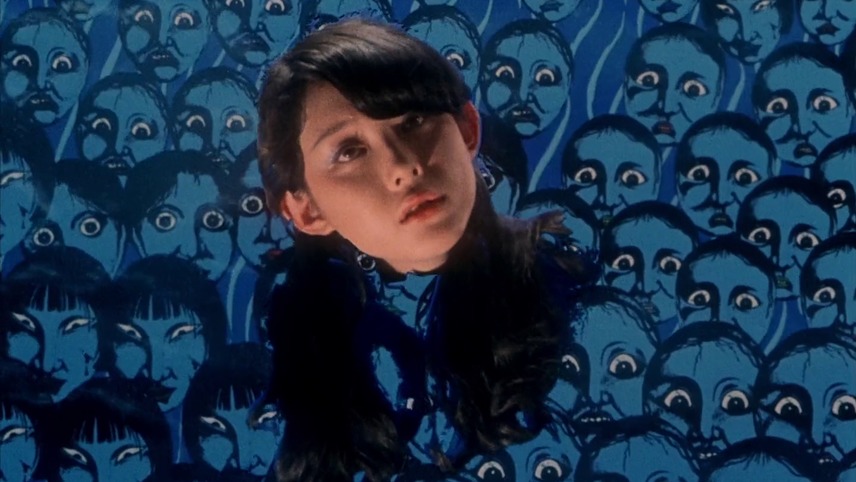
A piano bites off Melody’s fingers. It keeps playing. Her disembodied legs perform a little dance nearby. A clock bleeds. A pile of mattresses attacks someone. A girl’s severed head floats out of a well and bites another girl on the rear.
This is not a joke. This is not a parody. This is the film.
How Does It Look?
Like nothing else. Obayashi came from experimental advertising, and he brought every trick with him. Painted backdrops. Crude animation layered over live action. Kaleidoscopic transitions. Collage. Freeze frames. Saturated color that pulses like a migraine. The effects are deliberately, aggressively fake. They don’t try to convince you. They try to overwhelm you.
Imagine a ransom note made of magazine clippings, but the ransom note is a movie, and the kidnapper is a seven-year-old girl.
Because that is actually what happened.
The Origin Story Is the Key
Obayashi’s daughter, Chigumi, was seven years old when he asked her what frightened her. Not what frightened adults. Not what worked in horror films. What scared her.
She said she was scared of a mirror that would show a reflection doing something different from the person looking into it. She was scared of a piano that would eat the person playing it. She was scared of a futon that would try to smother her.
Obayashi took her fears seriously. He did not filter them through adult logic or cinematic convention. He built the film from the raw, irrational material of a child’s nightmares. This is why Hausu feels so alien. It operates on a different fear logic than adult horror. Things happen not because they make narrative sense but because they feel true to the way a child experiences dread: associative, sudden, total, absurd.
No adult would have written this screenplay. That’s the whole point.
Where the Film Breaks Your Brain
There is a scene where Kung Fu fights the possessed firewood. She kicks the logs. The logs fly. Her legs multiply in the frame like a martial arts Busby Berkeley number. The soundtrack plays jaunty pop music. A cat portrait on the wall watches and its eyes glow.
You will laugh. You will also feel deeply uneasy. The two sensations will refuse to separate.
This is Hausu‘s secret power. It doesn’t choose between comedy and horror. It doesn’t alternate between them. It fuses them so completely that you can’t locate where one ends and the other begins. The laughter doesn’t relieve the tension. The tension doesn’t kill the laughter. They coexist. They feed each other.
You’ve never felt this before.
The Sadness Underneath
Here is the thing nobody tells you about Hausu: it is quietly, unexpectedly devastating.
The aunt. She was young once. She was waiting for her lover to come home from the war. He never did. She kept waiting. The house became her. Her hunger became the house’s hunger. She consumes these girls because she was never allowed to live the life she was promised.
In the middle of this pop-art psychedelic fever dream, Obayashi buried a story about a woman destroyed by war. About youth devoured by the grief of the generation before it. About Japan itself, haunted by what it lost and what it did.
You won’t notice this the first time. You’ll be too busy watching a cat vomit blood onto a painting. But it’s there. And when you watch the film again, it changes everything.
The Aftermath
Hausu was a massive hit in Japan in 1977. It was almost completely unknown in the West for over thirty years. Then Janus Films restored it. Criterion released it. A new generation discovered it.
And nobody could agree on what it was.
Horror? Comedy? Satire? Pop art? Fairy tale? Anti-war allegory? Children’s nightmare? Avant-garde experiment?
Yes.
Why It Belongs Here
Some films are unusual because they break one rule. Hausu doesn’t break rules. It operates in a space where the rules were never written. It is not transgressive. It is not avant-garde in the chin-stroking sense. It is a film made by a father who listened to his daughter’s fears and decided they were more interesting than anything an adult screenwriter could invent.
It is funny and terrifying and beautiful and stupid and profound and tacky and heartbreaking and absolutely, irreversibly peculiar.
You cannot compare it to anything. You cannot recommend it with a straight face. You cannot forget it.
Welcome to Peculiar Cinema.
Hausu (House) Directed by Nobuhiko Obayashi Japan, 1977 | 88 minutes


Leave a Reply