Submitted to: American Film Institute, Centre for Advanced Film Studies Submitted by: David Lynch, Fellow Date: 1972 Projected budget: $10,000 (initial) Projected runtime: Approximately 90 minutes Format: 35mm, black and white
I. Synopsis
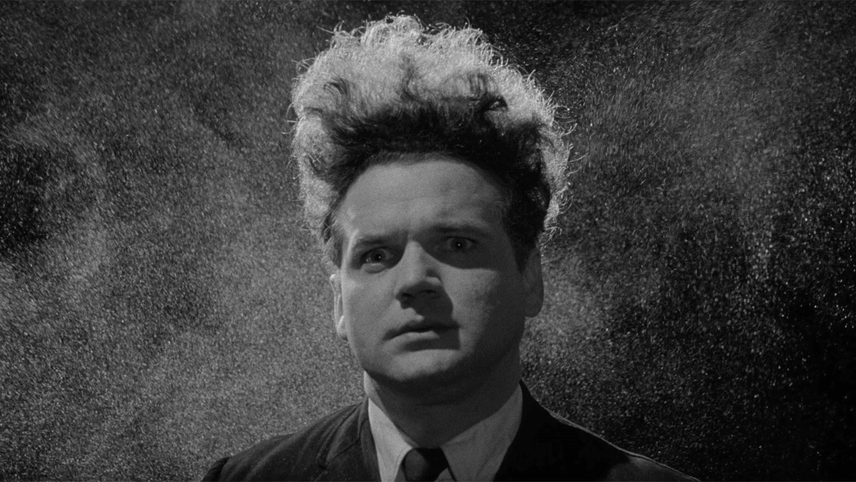
A man named Henry Spencer lives alone in a small apartment in an industrial district. The district is characterized by constant mechanical noise, puddles of unidentified liquid, and an absence of vegetation. Henry is on vacation from his job at a printing factory. He has tall hair.
Henry’s girlfriend, Mary X, has given birth. The child is premature. The doctors are not sure it is a baby. Henry and Mary attempt to live together in his apartment with the child. The child cries without stopping. Mary leaves. Henry raises the child alone.
During this period, Henry experiences a series of visions involving a woman who lives inside his radiator. She has swollen cheeks. She performs a song-and-dance routine on a small stage. She stomps on creatures that fall from above. The creatures resemble spermatozoa.
Henry also becomes involved with a woman who lives across the hall. He has a dream in which his head detaches from his body and is taken to a factory where it is used to make pencil erasers.
The child becomes ill.
Henry makes a decision.
II. The Baby
The baby will be the central visual element of the film. It will not resemble a conventional infant. It will be small, approximately the size of a swaddled newborn, with large eyes, no visible hair, and a body that appears to lack skin. It will be wrapped in bandages that hold its internal structure in place. Its head will move. Its mouth will open and close. It will produce a continuous, high-pitched crying sound.
The applicant declines to describe how the baby will be constructed. The method of construction is proprietary and will not be disclosed during or after production.
Note to the committee: The applicant understands that this may raise questions. The applicant assures the committee that the baby will be convincing. The applicant also understands that the word “convincing” is doing unusual work in this context.
III. Sound Design
The applicant proposes to spend approximately one year on the sound design of this film following the completion of principal photography. This is not a misprint. One year. The applicant and his collaborator, Alan Splet, will soundproof a studio and construct the sonic environment of the film element by element.
The film will feature continuous low-level industrial noise in every scene. This noise will not correspond to any visible source. It will create an atmosphere of persistent, unlocatable threat. The audience will not be consciously aware of the noise for most of the film. They will feel it. The noise will become part of their breathing.
Additional sounds will include: the baby’s crying; the hiss of the radiator; the sound of machines operating at unspecified distances; organ music by Fats Waller; a song called “In Heaven” which does not yet exist and will be written for the film; and various unidentifiable sounds that blur the boundary between the mechanical and the organic.
The applicant believes that sound, not image, is the primary medium of fear.
IV. Visual Approach
The film will be shot in black and white. This is not an aesthetic choice. It is a necessary condition. The world of the film does not contain color. Color implies variety, warmth, the possibility of beauty. The world of Henry Spencer contains none of these things. It contains concrete, metal, liquid, skin, and darkness. Black and white is the only honest way to photograph a world in which the only colors are grey and worse.
The cinematography will employ long static shots, slow tracking movements, and extended close-ups of faces, textures, and objects. The applicant is interested in surfaces: the surface of skin, the surface of walls, the surface of water, the surface of the baby. The film will spend considerable time looking at things that most films look away from.
The industrial landscape will be shot on location in the surrounding area. The apartment interior will be constructed on the Institute’s premises. The applicant will live on set. This is not a metaphor. The applicant will physically reside in the set of Henry Spencer’s apartment for the duration of production.
V. The Lady in the Radiator
A woman lives inside Henry’s radiator. She stands on a small stage with a black-and-white checkered floor. She has cheeks that are distended to an unusual degree. She smiles. She performs a shuffling dance. Small worm-like or sperm-like creatures drop from above and she crushes them under her feet.
She sings a song. The lyrics, in their entirety, are: “In heaven, everything is fine. You’ve got your good things, and I’ve got mine.”
The applicant recognizes that this description raises additional questions. The applicant does not have answers to these questions. The applicant believes the Lady in the Radiator is the most important character in the film and also the character he understands least, and that this is not a contradiction but a necessary condition of the work.
VI. Themes
The applicant has been asked by a previous reader of this proposal to identify the themes of the film. The applicant offers the following:
Fatherhood.
The applicant acknowledges that this single word may not satisfy the committee’s requirements. The applicant adds: anxiety, isolation, biological horror, the city as organism, the body as machine, the machine as body, the terror of reproduction, the impossibility of love in an environment designed to prevent it, and the suspicion that somewhere inside a radiator there is a woman who knows the answer to everything and the answer is that in heaven everything is fine.
The applicant has also described this film as “my most spiritual work.” The applicant stands by this description and declines to elaborate.
VII. Budget Considerations
The initial grant of $10,000 will not be sufficient to complete this film.
The applicant is aware of this. The applicant intends to supplement the budget through the following means: a paper route; a Wall Street Journal delivery route; odd jobs; donations from his friend Jack Fisk, a production designer, and Fisk’s wife, the actress Sissy Spacek; donations from the wife of the lead actor; and any additional funding the applicant can secure through means that he will describe as “whatever it takes.”
The applicant estimates that production will take approximately one year.
Revised estimate: Production will take approximately five years.
The applicant is aware that five years is an unusual production timeline for a student film. The applicant notes that the lead actor, Jack Nance, will be required to maintain his hairstyle for the duration of this period. Mr. Nance has agreed to this condition. The applicant is grateful for Mr. Nance’s commitment and also for Mrs. Nance’s patience.
VIII. Market Analysis
The applicant has not conducted a market analysis. The applicant does not believe a market exists for this film. The applicant does not believe a market should exist for this film. The applicant believes the film will find its audience in the same way Henry Spencer finds the Lady in the Radiator: by accident, in the dark, when everything else has broken down.
Subsequent note, appended 1977: The film premiered at the Filmex festival in Los Angeles as a midnight screening. A distributor named Ben Barenholtz watched it and decided, before the film reached its midpoint, that it was “a film of the future.” The film began screening at midnight in New York. It screened every Friday and Saturday at midnight for years. The audience arrived. The audience kept arriving. The audience has not stopped arriving.
IX. Comparable Works
The applicant has been asked to identify comparable works for the committee’s reference. The applicant has considered this request carefully and responds as follows:
There are no comparable works.
The applicant is aware that this answer is unhelpful. The applicant offers the following partial and inadequate comparisons: the paintings of Francis Bacon, in which the human body is distorted by forces it cannot name. The industrial landscapes of Philadelphia, where the applicant lived in a neighborhood so bleak it permanently altered his understanding of what a city could do to a person. The sound of factories at night. The feeling of holding a child you do not understand.
None of these are films. The applicant is not proposing a film that resembles other films. The applicant is proposing a film that resembles a feeling, and the feeling is one that the applicant has not been able to express in any medium other than this one, which does not yet exist, and which will take five years and all of his money and a significant portion of his sanity to bring into existence.
The applicant thanks the committee for its consideration.
Postscript, 2004: Eraserhead was selected by the Library of Congress for preservation in the United States National Film Registry as being “culturally, historically, or aesthetically significant.” The baby remains unexplained. David Lynch never revealed how it was made. Nobody who worked on the film has ever broken their silence. The baby is the most famous special effect in the history of independent cinema, and it is the only one whose method of creation constitutes a genuine secret. The applicant took it to his grave.
Eraserhead Director: David Lynch Country: United States Year: 1977 Runtime: 89 minutes



Leave a Reply