PETITION THE FIRST
To His Excellency the Governor of the Province, and through him to the Viceroy of the Río de la Plata, and through him to the Crown:
Don Diego de Zama, corregidor of this settlement, respectfully requests transfer to a post of greater consequence. The undersigned has served faithfully in this remote station. He has administered justice. He has maintained order. He has done everything asked of him in a place where almost nothing is asked, and he would like to go home now.
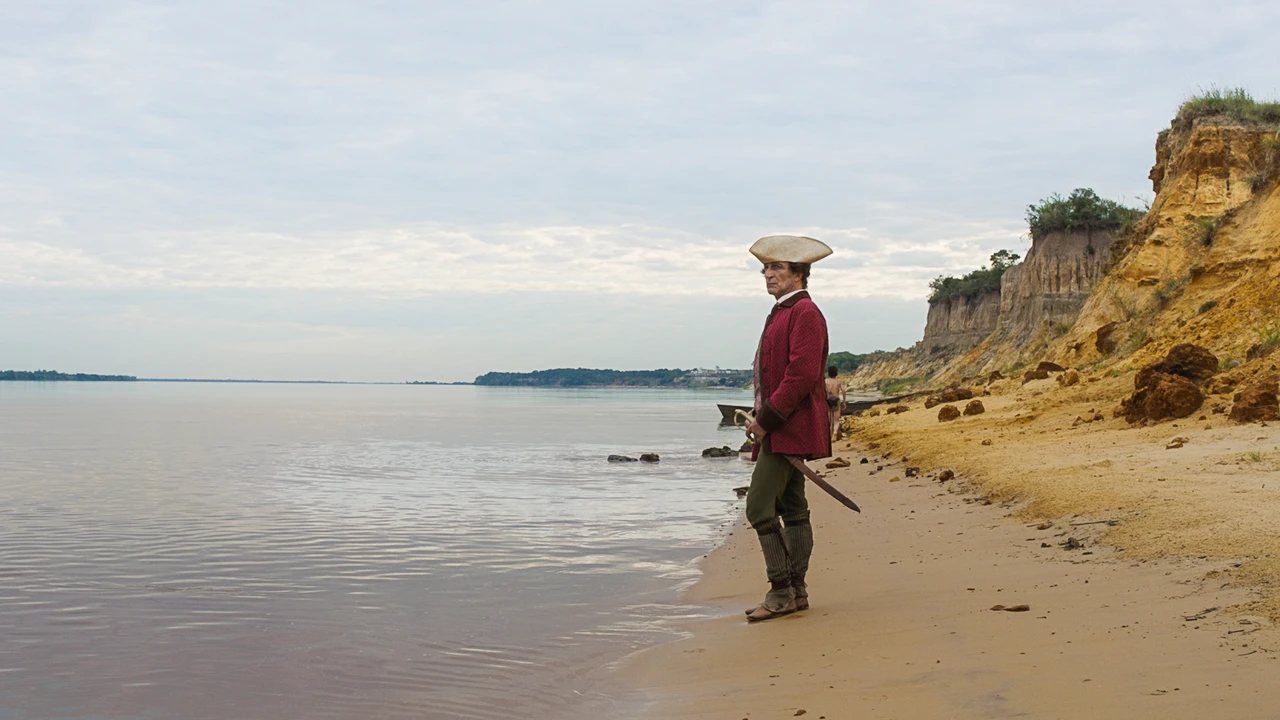
He stands on the shore at the opening of the film, watching the muddy water. The camera holds. Indigenous women bathe nearby. He watches them without approaching, and the watching is the entire character in a single gesture: a man who desires but does not act, who observes but does not participate, who stands at the edge of everything and mistakes his position for authority.
Lucrecia Martel adapted Antonio di Benedetto’s 1956 novel, one of the masterpieces of Argentine literature, and what she built from it is not a period film. It wears the costumes and sets of a period film. It occupies the geography of a period film. But its rhythm, its attention, its refusal to provide the pleasures of historical drama make it something else entirely. There are no sweeping vistas. The camera stays close, often at Zama’s shoulder, often slightly behind him, as though it too is waiting for something and has been placed in the wrong position to see it arrive.
Daniel Giménez Cacho plays Zama. He is perfect. He has the face of a man who was once handsome and is now merely present, the face of someone whose best years were spent in a place that did not notice them. He wears his wig. He holds his posture. He performs the rituals of colonial authority in a settlement where the rituals have no audience and the authority reaches no further than the edge of town.
The petition is submitted. No response is received.
PETITION THE SECOND
To His Excellency the Governor, with renewed urgency:
Don Diego de Zama again requests consideration for transfer. The undersigned notes that his previous petition has not been acknowledged. He attributes this to the difficulties of correspondence in remote territories and not to any diminishment of his standing. He remains confident that his service record speaks clearly. He reminds the administration that he has a family. He has not seen them. He would like to see them.
Time passes in Zama, but Martel refuses to mark it the way period films mark it. There are no title cards reading “Three Years Later.” No seasonal changes. No aging makeup. You know time has passed because the walls are slightly more discolored, because Zama’s wig fits slightly worse, because the people around him have rearranged themselves in ways that suggest shifts of power too small and too slow to have been noticed in the moment.
The sound design is the most radical element. Martel has always been a filmmaker of sound. In Zama, the soundtrack is layered with noises that do not belong to the image: animal calls from the jungle that press against the walls of every interior, the hum of insects that never stops, conversations in indigenous languages that occur at the edges of the frame without translation. The colony is surrounded. Not by enemies but by a world that does not recognize its authority, does not acknowledge its categories, and will be here long after its buildings have returned to mud.
No response is received.
PETITION THE THIRD
To whomever currently holds the office of Governor:
The undersigned requests clarification regarding his status. There have been administrative changes. The previous governor has been replaced. Or has not been replaced. The undersigned is uncertain. Information reaches this settlement slowly, and some of it contradicts other information, and the contradictions are never resolved but merely joined by further contradictions.
The undersigned also notes that his living situation has deteriorated. His quarters are smaller. His role within the settlement has become less defined. He was once consulted on matters of governance. He is no longer consulted. He is not sure when the consultations stopped. They may have stopped gradually, in which case the process is ongoing and may continue until the consultations reach zero, which is a number the undersigned can see from where he currently stands.
Martel does something in Zama that very few filmmakers have attempted: she makes colonialism boring. Not boring as a flaw. Boring as a diagnosis. The daily reality of colonial administration in a remote outpost was not adventure or conquest. It was paperwork, waiting, petty hierarchies, furniture that smelled of mildew, and the slow, corrosive realization that the empire you represent does not think about you at all. Zama is not a victim of colonial violence. He is a perpetrator of colonial presence, and his punishment is that the presence has become purposeless but cannot be abandoned because abandoning it would mean admitting that it was always purposeless.
This is what makes the film peculiar. A conventional colonial narrative would give Zama a dramatic arc: a fall from grace, a moral reckoning, a confrontation with the indigenous world he has displaced. Martel gives him none of this. She gives him what colonialism actually gives its middle managers: a slow reduction of status, comfort, and self-knowledge, conducted so gradually that the person experiencing it cannot identify the moment it began.
No response is received.
PETITION THE FOURTH
To the administration:
Transfer. The undersigned requests transfer. The undersigned has been requesting transfer. The word “transfer” has begun to feel strange in the undersigned’s mouth, the way any word feels strange if repeated enough times. Transfer. A movement from one place to another. The undersigned is in one place. He would like to be in another. This should not be complicated.
A woman arrives. She is Spanish. She is beautiful. Zama is drawn to her. He visits her. He sits in her parlor. He says very little. She says very little. The scenes between them are excruciating in their stillness, two people performing the rituals of courtship in a place where the rituals have been emptied of everything except form. He wants her. She may want him. Neither of them can act on wanting because action requires a future, and Zama’s future has been suspended pending a transfer that exists only as a word in a petition that no one reads.
Lola Dueñas plays this woman with a precision that matches Giménez Cacho’s. She is present. She is opaque. She is someone in a film that does not explain its characters because its characters have stopped being able to explain themselves.
No response.
PETITION THE FIFTH
The undersigned no longer remembers the correct form of address.
The undersigned volunteers for a military expedition to capture a bandit named Vicuña Porto. The expedition is a disaster. The jungle is not navigable. The men are not competent. The bandit may not exist. Or the bandit may be among the expedition party. Or the bandit may be a story the colony tells itself to justify sending men into territory it does not control and cannot map.
Martel films the expedition as a hallucination that happens to be real. The jungle is dense, wet, indifferent. The men move through it like men moving through a substance that is not quite liquid and not quite solid. Their clothes disintegrate. Their weapons become useless. Their hierarchies, already fragile, collapse entirely. Zama, who joined the expedition hoping it would demonstrate his value to the administration, finds himself in a place where value has no meaning and administration is a word from a language no one here speaks.
The film’s final act is among the most disorienting in contemporary cinema. Not because anything surreal occurs. Because everything that occurs is real, and the reality has become so degraded, so far from the starting point, that it might as well be hallucination. Zama’s wig is gone. His clothes are rags. His hands are ruined. He is carried in a canoe by indigenous people whose names he does not know, through water that does not appear on any colonial map, toward a destination that does not exist in any administrative record.
PETITION THE SIXTH
No petition is submitted.
The transfer does not come. The transfer was never going to come. The film knows this from its opening shot. The audience knows this from the first petition. Zama is the last to know, and watching him arrive at this knowledge is one of the most quietly devastating experiences in recent cinema.
There is no genre for what Lucrecia Martel made. It is not a historical drama because it refuses every pleasure of historical drama: the sweep, the spectacle, the moral clarity, the sense that history is a story with a shape. It is not a character study because Zama is not a character in the conventional sense; he is an absence in a wig, a man defined entirely by what he is waiting for, and what he is waiting for never arrives. It is not an anti-colonial film in the way that term is usually used, because it does not position indigenous people as subjects of sympathy or resistance; it positions them as the world, the actual world, going on with its life while a man in European clothes stands at its edge and writes letters to no one.
Zama is a film about waiting that makes you feel the weight of every minute waited. It is a film about empire that shows you exactly how boring and pointless and destructive empire is at the level of the individual functionary. It is a film that takes a man apart so slowly that you do not notice the disassembly until the man is gone and only the landscape remains.
The petition was never read. The office to which it was addressed may no longer exist. The undersigned is no longer sure he exists either.
The jungle continues without comment.
Zama — Directed by Lucrecia Martel. Argentina / Brazil / Spain, 2017. 115 minutes.


Leave a Reply