BEFORE
Kris is a graphic designer. She lives alone. She has a house with equity and a bank account with savings and a job she is good at and a life that is organized and functional and hers. These are not extraordinary things. They are the ordinary architecture of a person’s existence, the foundation so stable you forget it is there, the way you forget about gravity until you fall.
She goes to a club. A man approaches her outside. He has something he wants to sell. She declines. He stuns her with a taser. He forces a capsule into her mouth. The capsule contains a larva.
This is where the before ends. Not with a dramatic event but with a small white worm, smaller than your finger, sliding down her throat. The before is a house and a bank account and a job. The after is everything else.
AFTER
She cannot say no. The larva has made her suggestible in a way that erases the word “no” from her vocabulary. Not metaphorically. Literally. The man, credited only as the Thief, gives her instructions and she follows them the way your hand follows the instruction to pull back from a flame. It is not a choice. It is a reflex that has replaced all her other reflexes.
He tells her to make paper chains. She makes paper chains. Each link contains a passage she has transcribed from Henry David Thoreau’s Walden. She copies the text by hand, over and over, link after link, while the Thief performs other tasks in her house. The tasks include emptying her bank account. Pulling the equity from her home. Redirecting her finances into his possession. She does not notice. She is making paper chains. She is copying Walden. The transcription is the distraction, and the distraction is total, and by the time the larva’s effects begin to wear off, everything she owned belongs to someone else.
The Thief leaves. Kris wakes up, if waking is the right word for what happens when a parasite releases your brain and returns it to you emptied of context. Her house is a mess. Her accounts are drained. Days have passed that she does not remember. She goes to work. She cannot explain her absence. She is fired. She carries a cardboard box of belongings out of the building. She does not know what happened to her. She will never fully know.
But the worm is still inside her.
She can feel it. Moving under her skin. Bulging. Surfacing in ridges along her arms and legs. She tries to cut it out with a kitchen knife. The scene is filmed with the quiet precision Shane Carruth brings to everything: the blade, the skin, the blood, the failure to extract something that has burrowed deeper than a knife can reach.
A sound reaches her. Low, pulsing, rhythmic. It comes from somewhere she cannot identify. She follows it. It leads her to a farm.
AFTER (THE FARM)
A man lives here. He is credited as the Sampler. He tends pigs. He records sounds: a rock sliding down a drainage pipe, the hum of power lines, the wind through a specific field at a specific hour. He manipulates these sounds on digital processors. He releases them as music through a small label called Quinoa Valley Rec. Co.
He is waiting for her. Not the way the Thief was waiting. The Sampler is not malicious. He is something harder to name. He is an observer. He is the middle point in a cycle he did not design and does not fully control.
He performs a procedure. The worm is drawn from Kris’s body and transferred into a pig. The pig is marked. The pig is hers now, in a sense that neither science nor language can accommodate. When the pig feels something, Kris will feel it. When Kris feels something, the pig will absorb it. They are connected by the residue of the parasite, the ghost of the worm, the trace it left behind when it moved from one body to another.
Kris wakes up on the side of a highway. She does not remember the farm or the Sampler or the pig. She does not remember the Thief. She remembers almost nothing. She has a scar on her abdomen that she cannot explain.
AFTER (THE TRAIN)
A year later. Kris rides a commuter train. She works at a copy shop now. She is smaller than she was before. Not physically. The space she occupies in the world has contracted. She sits on the train and a man sits near her and they do not speak.
His name is Jeff. He has the same scar. He does not know he has the same scar. He lost his job as a broker after company funds were moved around to cover money that was stolen from him, money he does not remember being stolen, an event he attributed to a drug problem he does not remember having. His before was also erased. His after is also this: a reduced life, a copy shop, a train.
They are drawn to each other. Not romantically, at first. Magnetically. As if the parasite that passed through both of them left a trace that recognizes itself in another body. Their first conversations are tense, irritable, awkward. They snap at each other. They cannot stop returning to each other. They spend a night together and discover the matching scars and do not know what the scars mean but know, in a place beneath language, that they share something no one else shares.
They begin to read Walden. Neither of them remembers transcribing it onto paper chains. Neither of them knows why the book feels so familiar. They read it to each other in bed. On trains. In an abandoned SUV parked against a sky the color of dusk. The words enter them the way the worm entered them: without permission, without explanation, leaving something behind that cannot be removed.
AFTER (THE BLUR)
Their memories begin to merge. Kris remembers things that happened to Jeff. Jeff remembers things that happened to Kris. They argue about whose memory belongs to whom. They tell the same stories as if they lived them. They did not live them. Or they both did. The parasite connected them through the pigs and the pigs are connected to each other because the Sampler placed them together and the pigs mated and now the connection is doubled, tripled, woven into something neither of them can see or name.
Shane Carruth films this with match cuts so precise they feel surgical. A shot of Kris’s hands becomes a shot of Jeff’s hands becomes a shot of a pig’s body becomes a shot of an orchid. The editing does what the parasite does: it transfers sensation from one body to another without announcing the transfer. You do not notice the cuts. You feel them. The film moves the way infection moves: silently, through contact, through proximity, through the invisible passages that connect one living thing to another.
The Sampler walks among them. He approaches their pig and through the pig he enters their lives. He stands beside Kris in her kitchen. He watches Jeff at his desk. They cannot see him. He is not invisible. He is simply on the other side of the connection, the side they do not have access to, the upstream that gives the film its title. He observes. He samples. He takes what he sees and turns it into sound and the sound becomes music and the music is sold and nobody who buys it knows that it was extracted from the lives of people who were robbed and infected and connected to pigs against their will.
AFTER (THE PIGLETS)
The pig that carries Kris’s parasite becomes pregnant. Kris, in her apartment, believes she is pregnant. She takes a test. She visits a doctor. The doctor tells her she has had endometrial cancer. The cancer was removed. She cannot have children. She was never pregnant. The pregnancy belonged to the pig.
The Sampler takes the newborn piglets. He places them in a bag. He throws the bag into the river.
In her apartment, Kris feels something tear. Not physically. Below the physical. In the place where the pig’s life and her life overlap. She feels the loss of children she never had, children that were never hers, children that were piglets in a bag in a river, and the grief is the most powerful emotion the film contains because it is the grief of a mother who has lost her children without ever knowing she had them, without any framework to explain why the world has suddenly become unbearable.
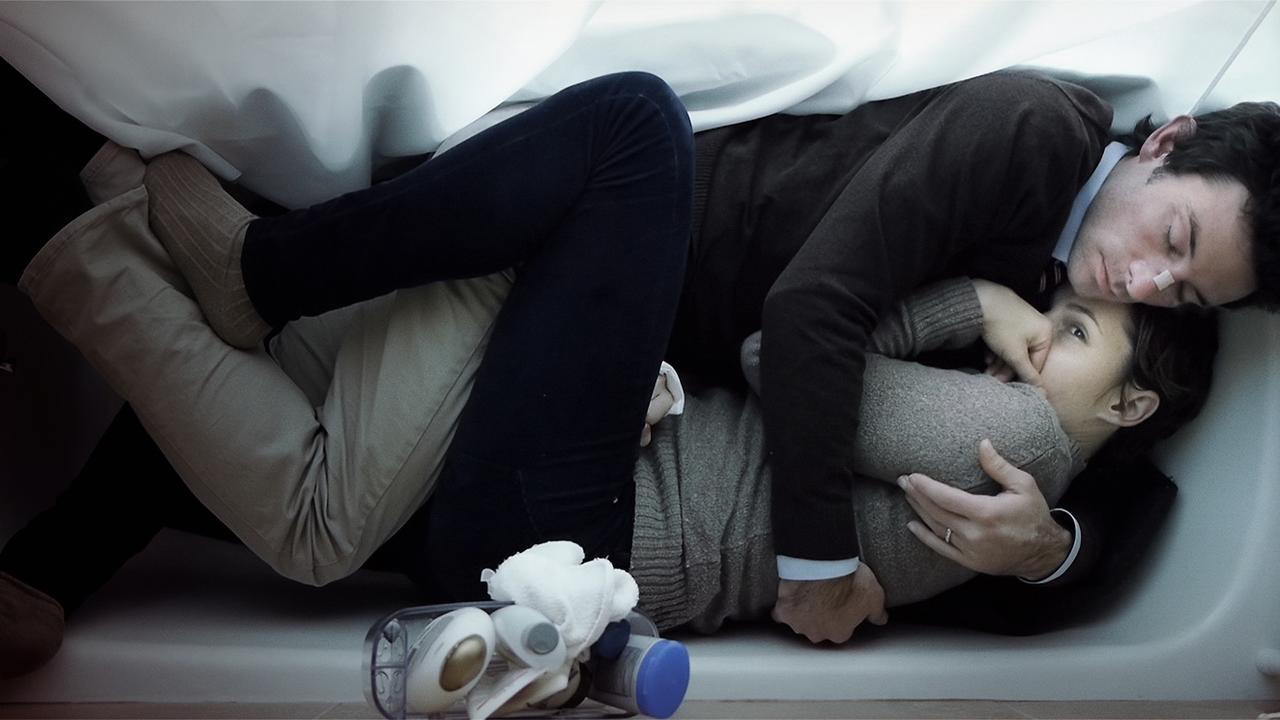
She and Jeff huddle together. They arm themselves. They hide in a bathtub. They are preparing for something they cannot name. The piglets decompose in the river. A blue substance leaches from their bodies into the water. The blue substance is absorbed by orchids growing along the bank. The orchids turn from white to blue. The orchid farmers harvest them. Inside the blue orchids, new larvae grow. The Thief collects the larvae. The cycle is complete.
Worm. Human. Pig. Orchid. Worm.
And somewhere in the middle: two people on a train who fell in love because they were infected by the same parasite, who read the same book because it was used to rob them, who feel the same grief because their pigs were mated, who cannot tell their memories apart because their bodies were once occupied by the same organism, who are trying to build a life in the after, in the wreckage, in the space that remains when everything you were has been consumed by a cycle you cannot see.
AFTER (THE END)
Kris finds the Sampler. She sees him. Through the connection, through the pig, through the grief of the lost piglets, she breaks through to the other side and she sees him standing in her life the way he has always been standing in her life, observing, sampling, taking.
She kills him.
She and Jeff gather the Sampler’s records. They find every victim. They mail them copies of Walden. The victims come to the farm. They take it over. They care for the pigs. No more piglets are drowned. The orchids stop turning blue. The Thief loses his supply.
The cycle breaks.
Kris sits on the farm holding a baby pig. She is at peace. Carruth said of this ending: the pig will never return her affection. Whatever she is holding, it is not a child. It is not a replacement. It is the broken thing itself, the residue, the after, and she is holding it anyway, because holding the broken thing is the only honest response to a life that was taken apart by a worm and a thief and a farmer who listened to the sounds of other people’s suffering and turned them into music.
Shane Carruth wrote this film. He directed it. He produced it. He scored the music. He shot the cinematography. He starred in it. He edited it. He distributed it himself. He made it for approximately $50,000. He submitted it to Sundance in 2013, where it won a Special Jury Prize for Sound Design. He is also the man who made Primer, the $7,000 time-travel film that is widely considered the most rigorous science fiction film of the twenty-first century.
There is no other film like Upstream Color. There is no category for it. It is a science fiction film in which the science is biology and the fiction is that you can recover from what was done to you. It is a love story in which love is a side effect of a shared infection. It is a thriller in which the crime has already happened before the film begins and the victim does not know she is a victim until it is too late to be anything else.
It is a film about the after. About living in the after. About falling in love in the after. About building something in the wreckage. About holding a pig that will never love you back and being at peace with that, because peace is not the absence of damage. Peace is what remains when you stop looking for the before.
Upstream Color Director: Shane Carruth Country: United States Year: 2013 Runtime: 96 minutes

Leave a Reply