Classification: Alchemical. Cinematic. Irreversible.
Origin: Mexico, 1973. Laboratory of Alejandro Jodorowsky.
Purpose: The transmutation of base cinema into enlightenment, followed by the destruction of cinema itself.
Duration: 114 minutes. Allow a lifetime for side effects.
Ingredients
Acquire the following before beginning. Do not substitute.
One thief, resembling Jesus Christ. He should be beautiful and filthy. He should be found in a pile of garbage, covered in flies. He should have no name, no history, no possessions. He is your base material. In alchemy, this is called the prima materia. The raw, undifferentiated substance from which gold is made.
One alchemist. He should be played by the director himself. This is important. Jodorowsky does not cast someone to play God. He plays God. The arrogance is the point. The arrogance is also the thing the film will eventually destroy.
Seven industrialists, each assigned a planet. They are:
Fon, of Venus, who manufactures beauty products from cadavers. Isla, of Mars, who manufactures weapons and sells toy soldiers to children. Klen, of Jupiter, who profits from war through art. Sel, of Saturn, who builds machines that simulate love. Berg, of Uranus, who advises presidents on how to maintain power through finance. Axon, of Neptune, who commands the police and weaponizes aesthetics. Lut, of Pluto, who designs coffin-shaped apartments for the poor and calls it architecture.
They are disgusting. They are also us. Every system they represent is a system you participate in. Jodorowsky is not subtle about this. He has never been subtle about anything.
One mountain. It should be real. It should be tall enough to hurt.
One camera. You will need it later. For the last step.
Preparation
Clear your mind of expectations. If you have seen other films and believe you understand how films work, forget them. The Holy Mountain does not operate by the rules of cinema. It operates by the rules of tarot, alchemy, Zen Buddhism, psychedelic experience, and the unshakable conviction of a Chilean-French-Mexican mystic who once studied mime with Marcel Marceau and took LSD with his entire cast before shooting.
This is not a joke. Jodorowsky administered psychedelics on set. He believed the film could not be made by people in their ordinary minds. Whether he was right is not a question this formula can answer.
Stage One: The Garbage
The thief wakes in garbage. Children throw stones at him. He is tied to a cross and paraded through a market. Tourists photograph him. Soldiers reenact the conquest of Mexico using live frogs dressed as Aztecs and conquistadors. The frogs bleed. The buildings explode. This is not a metaphor for colonialism. This is colonialism as puppet show, performed for an audience that doesn’t flinch.
If you are uncomfortable, good. You have not yet begun.
Stage Two: The Tower
The thief finds a tower. He climbs it. Inside, the alchemist waits. The alchemist takes the thief’s excrement and, through a process involving fire and pressure and patience, turns it into gold.
This is the oldest promise of alchemy. That the lowest substance contains the highest. That what you despise in yourself is the raw material of your transformation. Jodorowsky films it literally. You watch a man defecate into a glass vessel. You watch the vessel placed into a furnace. You watch gold emerge. You are being told something. Whether you accept it depends on how willing you are to sit with the image.
Stage Three: The Planets
The alchemist introduces the thief to the seven industrialists. Each one is given an extended sequence. Each sequence is a miniature film within the film. Each one is grotesque, satirical, visually overwhelming, and impossible to look away from.
Fon bathes in the liquefied remains of the dead and sells the residue as face cream. Isla paints psychedelic patterns on grenades. Lut builds identical grey boxes and stacks human beings inside them like inventory.
These sequences are funny. They are also sickening. They operate in the same fused space as the best political cartoons: exaggeration so extreme it becomes more truthful than realism. You laugh because the alternative is to scream. You scream because the laughter doesn’t help.
Stage Four: The Stripping
The alchemist instructs the group to destroy their identities. They burn their money. They burn effigies of themselves. They shed their clothes, their names, their histories. They become seekers. Pilgrims. Blank pages.
This is the nigredo in alchemical tradition. The blackening. The stage where everything you are is reduced to ash so that something new can grow from it. Jodorowsky stages it with the seriousness of a ritual and the spectacle of a carnival. Both are true. Both are necessary.
Stage Five: The Ascent
They climb the mountain. The real one. The actors climb a real mountain. The footage is raw, exhausting, beautiful. Rocks. Wind. Altitude. Bodies struggling against gravity. After ninety minutes of surreal excess, the film suddenly becomes austere. The images simplify. The colour palette narrows. The soundtrack thins. You are climbing too.
Stage Six: The Summit
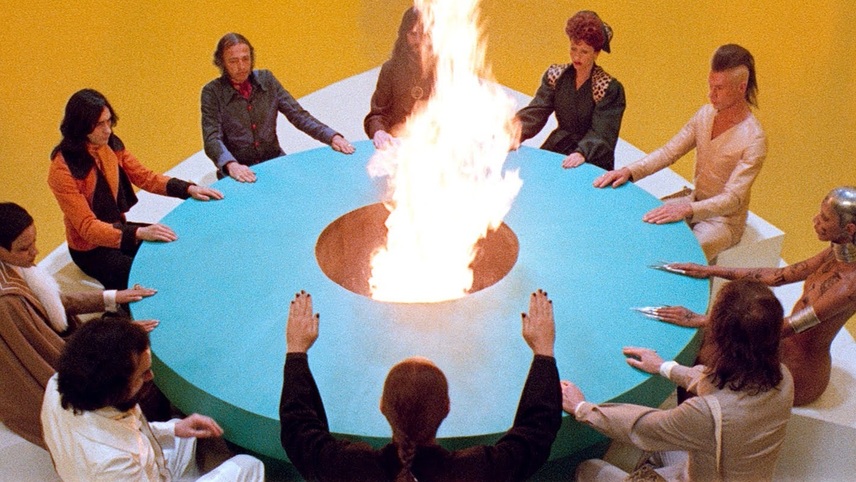
They reach the top. The gods of immortality are seated around a table. They are silent. They are waiting.
Stop here.
Warning
What happens next is the most important moment in the film. It is also the most important moment in this formula. If you do not wish to know, stop reading. Go watch The Holy Mountain. Come back when you have seen the summit for yourself.
If you continue, you accept responsibility for what the knowledge does to you.
Stage Seven: The Reveal
The seekers approach the table. They are ready to confront the gods. They have sacrificed everything. They have climbed the mountain. They have earned this.
Jodorowsky’s voice is heard: “Zoom back, camera.”
The camera pulls back. Slowly. The edges of the frame expand. You see the lights. The cables. The film crew. The set. The gods at the table are mannequins. The mountain is a location. The alchemist is a director. The thief is an actor. The entire film, every frame of it, every ritual and every symbol and every ounce of pain and beauty, was a construction. A fabrication. A movie.
Jodorowsky speaks to the audience: “Is this what you came for? Real life awaits us.”
Stage Eight: The Destruction
This is the step most people miss. The reveal is not a trick. It is not a wink. Jodorowsky is not saying “ha, it was all fake.” He is saying something far more radical. He is saying: the path was real. The transformation was real. The stripping, the climbing, the suffering, all of it was real. And it was also a film. And both things are true. And the only way to complete the transformation is to destroy the thing that made it possible.
The film kills itself so that you can live.
Every guru must eventually say: stop following me. Every sacred text must eventually say: put me down. Every film that claims to offer enlightenment must eventually reveal its own machinery, its own artifice, its own lie, and then say: now go. The real mountain is outside. The real climb begins when the credits roll.
Stage Nine: Your Part
Leave the room. Walk outside. Look at the sky. Notice that it is not a painted backdrop. Notice that the light is not designed. Notice that no one is directing you.
This is the last step. It has no end.
Expected Outcome: Confusion, followed by exhilaration, followed by silence, followed by the slow, permanent suspicion that every system you participate in is one of the seven planets, and that the mountain is always there, and that nobody is coming to carry you up it.
Shelf Life: Indefinite. The formula does not expire. It activates differently each time.
Dispose of these instructions after use.
The Holy Mountain Directed by Alejandro Jodorowsky Mexico / United States, 1973 | 114 minutes

Leave a Reply