Attempt 1: The Plot
In the future, humanity has surrendered its ability to dream in exchange for something like immortality. A few outlaws still dream. They are called Deliriants. A woman tracks one of them down. She captures him. She installs a film projector in his chest. Through this projector, she enters his dreams.
His dreams are five stories. Each corresponds to one of the six senses recognized in Buddhist thought. In the first, he is a monster in an opium den at the turn of the twentieth century, and the film has no dialogue, and the camera discovers the world through touch. In the second, he is a man accused of murder in a noir city of the 1940s, and sound enters the film for the first time. In the third, he is someone in a Buddhist temple, and taste arrives. In the fourth, he is a con artist running a scheme for a gangster, and there is smell. In the fifth, he is a stranger falling in love on New Year’s Eve 1999, and the entire chapter is filmed in a single unbroken shot lasting thirty minutes, and the sense is touch. Then there is a sixth chapter. It is about the mind. It takes place in a cinema. The cinema dissolves.
There. That is the plot. Does it help?
It does not help. Reading that summary is like reading the periodic table and claiming you now understand chemistry. Everything that makes Resurrection the film it is exists in the space between those sentences, in the textures and transitions that no summary can hold. The information is correct. The experience is missing entirely.
Let’s try again.
Attempt 2: The Genre
It is a science fiction film.
No. It opens as a silent film. The first twenty minutes have no dialogue at all. The screen narrows to the boxy ratio of early cinema. Intertitles appear. A figure that looks like Nosferatu moves through an opium den rendered as a dollhouse diorama with stop-motion puppets in the background. This is not science fiction. This is an excavation of cinema’s earliest language.
Then it becomes a noir. A man sits in an interrogation room. Shadows cut across faces. A murder involving a fountain pen. Mirrors multiply and fracture, recalling The Lady from Shanghai. This is not a silent film anymore. It is something else entirely.
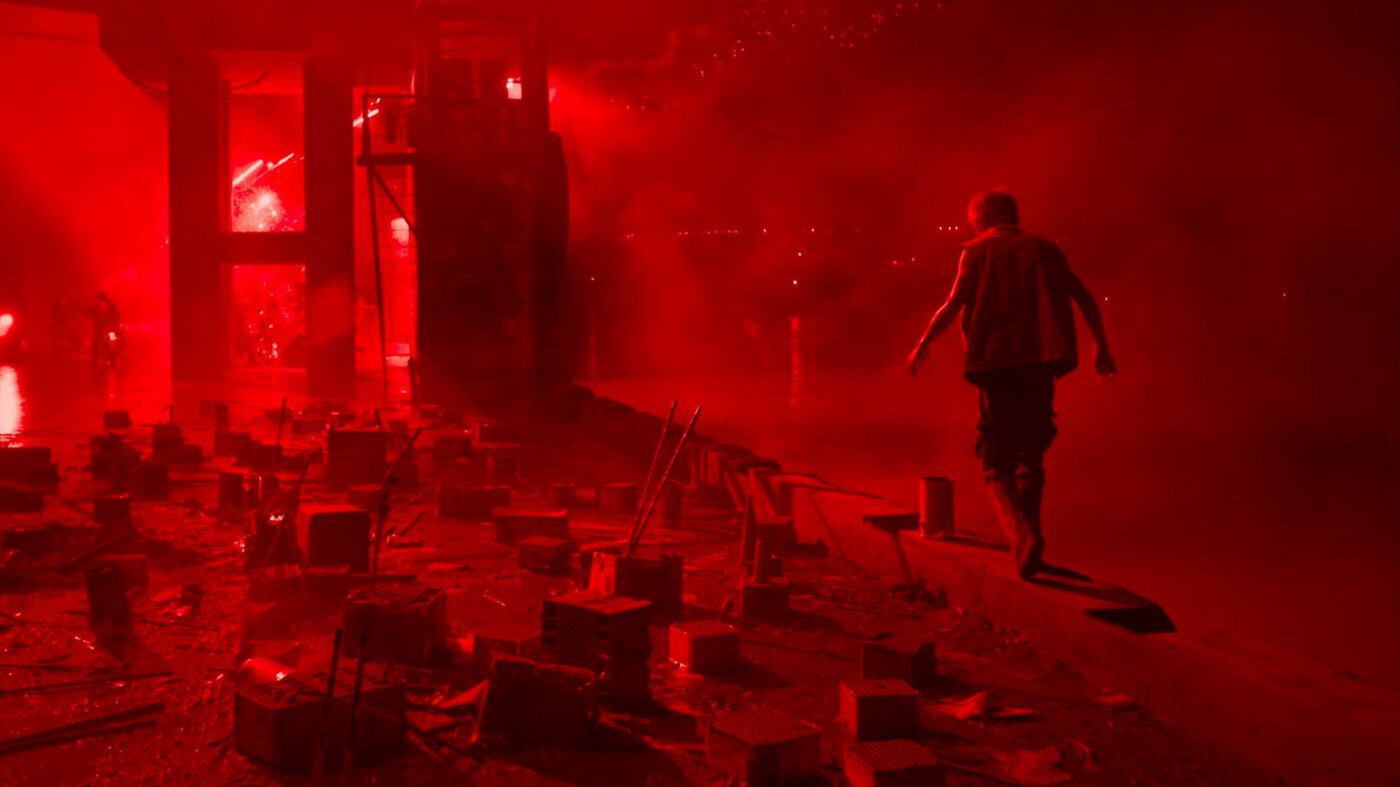
Then it becomes a fable. Snow. A crumbling Buddha statue. A spirit who takes the form of a dead father. Then it becomes a con-artist thriller. Then it becomes a love story filmed in one continuous shot through rain-soaked alleyways lit in red and amber.
So what genre is it? It is all of them. It is none of them. It does not blend genres the way other films blend genres, mixing two or three flavors into something new. It inhabits each genre completely, lives inside it for twenty or thirty minutes, and then sheds its skin and becomes something else. The film does not mix. It metamorphoses.
Genre will not work here. Let’s try again.
Attempt 3: The Comparisons
It is like if Andrei Tarkovsky directed a superhero origin story, except the superhero is a corpse who dreams, and the origin story spans a hundred years.
No. That’s clever but wrong. Tarkovsky moved slowly toward the sacred. Bi Gan moves at whatever speed the dream requires, which is sometimes glacial and sometimes a motorcycle chase through New Year’s Eve fireworks.
It is like a more ambitious version of Cloud Atlas.
No. Cloud Atlas connected its stories through reincarnation. Resurrection connects its stories through the senses of a single dying body. The architecture is different. Cloud Atlas was a novel. Resurrection is a reliquary.
It is like The Holy Mountain.
Closer. Both films destroy themselves at the end. Both films refuse the boundary between cinema and consciousness. But Jodorowsky built his film from provocation. Bi Gan builds his from tenderness. The Holy Mountain wants to wake you up. Resurrection wants to show you what dreaming looks like from the inside, knowing that showing you will kill the dreamer.
Every comparison fails because every comparison requires Resurrection to be a version of something else, and it is not a version of anything. It is the thing itself. Entirely.
Attempt 4: The Technique
Bi Gan is thirty-five years old and this is his third feature. His first, Kaili Blues, contained a forty-one-minute tracking shot that appeared without warning. His second, Long Day’s Journey Into Night, ended with a single continuous shot lasting fifty-nine minutes, filmed in 3D, introduced by having a character in the film put on 3D glasses so the audience would do the same. He is, by any measure, one of the most technically ambitious filmmakers alive.
Resurrection contains a continuous shot lasting approximately thirty minutes. It was filmed in Chongqing over the course of a month, with only one usable take per night in the final week, because the city’s fog created different conditions each evening. The shot follows two strangers through the last hours of December 31, 1999, through alleyways lit in shifting reds and ambers, past karaoke bars and fireworks, into a romance that feels like it was always going to happen and will never happen again. The camera was operated on a DJI Ronin 4D. It never cuts.
The film also uses stop motion. Reverse motion. Double exposure. Time-lapse. Three different aspect ratios. A score by M83 that shapeshifts as completely as the film does, becoming orchestral, becoming electronic, becoming something that sounds like the Vertigo love theme rearranged for the end of the world.
Dong Jingsong, the cinematographer, shoots darkness the way other cinematographers shoot faces. Every shadow in this film has weight and temperature. Every candle (and there are many candles, one for each chapter, each burning shorter) has a specific quality of light that belongs to that chapter and no other.
So: the technique is extraordinary. But describing the technique of Resurrection is like describing the engineering of a cathedral. You learn how the stones are stacked. You learn nothing about what it feels like to stand inside.
Attempt 5: The Theme
Resurrection is about dreaming.
More specifically: it is about what we lose when we stop dreaming. In the film’s future, humanity has traded its dreams for longevity. This is presented not as a dystopia but as a reasonable exchange. Who wouldn’t trade nightmares for more years? The film’s radical proposition is that this exchange is a catastrophe. That dreaming is not a side effect of consciousness but its purpose. That a life without dreams is not longer. It is just emptier.
Cinema, in this framework, is the last technology of dreaming. A film projector installed in a dying monster’s chest is not a metaphor. It is a diagnosis. We put our dreams in machines because we forgot how to have them ourselves. The machine dreams on our behalf. The machine is what keeps the dreaming alive.
This is beautiful and true, and it still doesn’t explain the film. Because the film is not an essay. It is not making an argument. It is doing the thing it describes. It is dreaming, on screen, in real time, through six chapters and five senses and a hundred years of Chinese history, and the fact that it is dreaming is more important than what the dream means.
We are getting closer. But we are not there.
Attempt 6: One Scene
Forget the whole film. Just one scene.
In the chapter about taste, Jackson Yee plays a former monk who leads a group of looters to an abandoned monastery. The looters leave him behind overnight. Alone in the temple, he finds a Buddha statue he doesn’t recognize. He touches it. It crumbles. But then it speaks to him in a dream, telling him how to remove his aching tooth. When he does, the extraction releases something called the Spirit of Bitterness, who takes the shape of his dead father.
The Spirit offers absolution. It has been waiting, it says, for this day, when it would discover the bitterest thing of all. The monk looks at the spirit wearing his father’s face and remembers that he killed his father. A mercy killing. The father had contracted rabies. The monk chose compassion, and the compassion became the bitterest thing he ever tasted.
In the morning, the monk is gone. A lone dog leaves the monastery.
That is one chapter. Twenty-something minutes. It contains a crumbling statue, a talking Buddha, a tooth extraction, a ghost father, a mercy killing, and a dog that may or may not be a reincarnation. It is filmed with the patience of a folk tale and the precision of a surgical procedure. It is heartbreaking. It makes complete sense while you’re watching it and almost no sense when you try to explain it to someone afterward.
Which is the problem. Which has been the problem all along.
Attempt 7
This is the one where I stop trying.
Bi Gan made a film that contains six films. Each one looks different, sounds different, feels different, and operates by different rules. They are connected by a single actor playing every lead role, by candles burning shorter with each chapter, by recurring images of reflections and fire and water, and by a premise about a dying creature who chooses dreams over immortality. The film’s Chinese title is 狂野时代. Wild Times. Its English title is Resurrection. Neither title is wrong. Both are incomplete.
The film is 159 minutes long. It won the Prix Spécial at Cannes. It is already in the Criterion Collection. It was scored by M83. It was photographed by Dong Jingsong in darkness so beautiful it feels habitable. It was made by a man from Kaili, a small city in Guizhou province, who has now made three features, each containing a single unbroken shot of increasing ambition and decreasing explicability.
I have written seven attempts to describe this film, and none of them have worked. That is not a failure of effort. It is a quality of the film. Resurrection does not want to be described. It wants to be experienced with the senses it is named for: sight, hearing, smell, taste, touch, mind. You cannot read your way into it. You cannot be told about it. You can only sit in a dark room and let it happen to you, the way a dream happens, the way a century happens, the way a candle happens, burning shorter with each story until the last one goes out and you are sitting in the dark, remembering light.
I cannot describe this film.
Watch it anyway.
Resurrection (狂野时代 / Wild Times) Director: Bi Gan Country: China Year: 2025 Runtime: 159 minutes

Leave a Reply