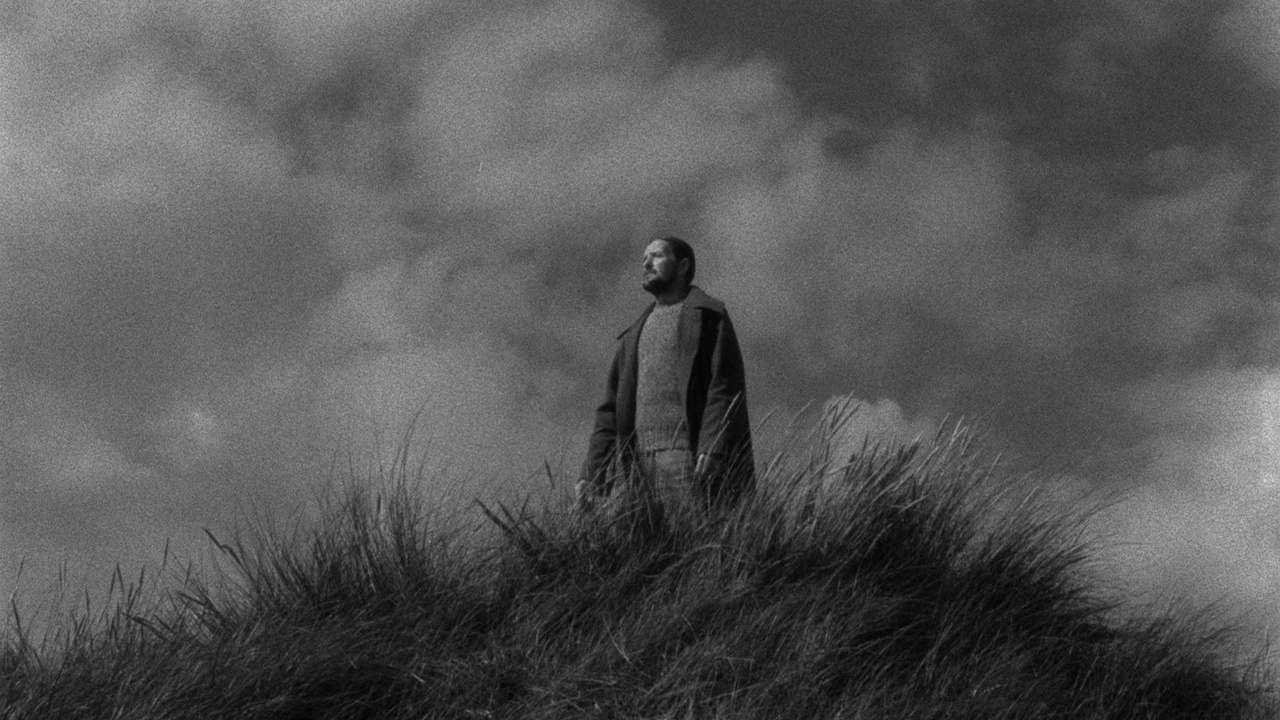
Ordet should not work. A dead woman is brought back to life by a man who thinks he is Jesus Christ, and the film asks you to take this seriously. Not as metaphor. Not as delusion. As fact. A corpse’s fingers twitch. Her eyelids struggle open. She sits up in her coffin and embraces her husband and the film ends and you are supposed to feel awe, not embarrassment. This is preposterous. This is something a child would believe. This is not cinema. This is a church service.
Ordet works. It is one of the most devastating experiences in the history of cinema. The miracle in the final scene is not preposterous. It is earned. It is earned so thoroughly, over two hours of such meticulous, rigorous, unsparing observation, that by the time Johannes speaks the word, you are not watching a man perform a miracle. You are watching the only possible ending to a film that has spent its entire running time preparing you to accept the impossible.
But that is a trick. Carl Theodor Dreyer admitted it. He said his intention was to deceive the audience. He shot two versions of the ending: one where Inger might only appear to be dead, and one where the resurrection is genuine. He chose the genuine miracle. He chose it because he wanted to see if cinema could make a rational audience believe the unbelievable. He was a magician, not a prophet. The miracle is sleight of hand.
But sleight of hand does not make you weep. Sleight of hand does not make a room full of strangers sit in silence for minutes after the credits end. Something else is happening. Something the word “trick” cannot hold. Dreyer may have intended deception, but the film transcended his intentions, the way a cathedral transcends the architect, the way a prayer transcends the person praying.
Johannes is ridiculous. He wanders the farm in a daze, speaking in a high-pitched monotone, staring at horizons, announcing that he is the returned Christ. His family tolerates him with exhausted patience. His father, old Morten Borgen, once hoped Johannes would become a great preacher. Instead, Johannes studied Kierkegaard until his mind broke, and now he shuffles through the house making pronouncements that nobody heeds. He is a figure of gentle comedy. He is the kind of character a lesser film would play for pathos or laughs.
Johannes is the only person in the film who is right about anything. He predicts Inger’s death. He is correct. He says he will raise her from the dead. He does. Every word he speaks that sounds like madness turns out to be prophecy. The doctor says miracles are the domain of science. The pastor says God does not break his own laws. Johannes says: “People believe in the dead Christ, but not in the living.” He is right. Everyone around him believes in a faith whose central event is a resurrection, and not one of them believes a resurrection is possible. Johannes is the only one who takes the religion at its word.
But that is dangerous. Believing a madman because his predictions came true is how cults begin. The film does not address this. It does not wrestle with the possibility that Johannes is simply lucky, or that Inger was not truly dead, or that the doctor made an error. It offers the miracle without caveat. This is irresponsible. A serious film should acknowledge doubt.
But doubt is exactly what the film has been doing for two hours. Every character in Ordet represents a form of doubt. Mikkel has lost his faith entirely. Morten believes but fears his belief is insufficient. The pastor believes in God but not in miracles. The doctor believes in science but fails to save Inger. Peter the tailor believes so rigidly that his faith has become a weapon he uses against his neighbors. The entire film is a catalogue of doubt, a taxonomy of ways to believe incompletely, and the miracle at the end is not a rejection of doubt but its culmination: the moment where every inadequate faith in the film is confronted with something it cannot explain.
The film is unbearably slow. The camera moves like a glacier. Scenes play out in single takes lasting seven minutes. The farmhouse has almost no furniture. The landscapes are flat and desolate and the sky is the grey of Denmark in autumn and nothing happens for stretches so long you begin to count your own breaths.
The slowness is the miracle. If the film moved at conventional speed, the ending would be absurd. You need the two hours of wind and silence and arguments about theology and long walks to the barn and conversations by lamplight. You need the weight. You need to feel the hours in your body the way the Borgen family feels them. Because the miracle is not a plot twist. It is not a surprise. It is a gravitational event, and gravitational events require mass, and the mass is the time, and the time is the slowness, and the slowness is the faith.
But the film is still slow. Let us not romanticize this. There are stretches where the arguments between the two old men about whose Christian sect is more correct are tedious in the way all theological disputes are tedious to those who stand outside them. Dreyer removed two-thirds of the dialogue from Kaj Munk’s original play and it is still talky. The beauty of Henning Bendtsen’s cinematography, with its luminous whites and stark interiors, does not always compensate for the feeling that you are watching a very well-lit argument between Lutherans.
But the talkiness is the point. The film is showing you what faith sounds like when it has been drained of experience and reduced to positions. These men are debating God the way lawyers debate a contract. They have forgotten that faith is not a position. Faith is what happens when the positions fail. And the positions fail, spectacularly, in the final scene, when every theological argument in the film is rendered meaningless by a pair of twitching fingers.
Inger is the best person in the film. She is kind, patient, warm, funny, loving, and wise. She mediates between the brothers. She defends Johannes. She tries to convince old Morten to let Anders marry the tailor’s daughter. She is pregnant. She is the moral center of the household. She believes in what she calls “little miracles that happen secretly.” When she dies, the film loses its warmth. The farmhouse becomes a coffin.
Inger’s goodness makes her death feel manipulative. The film kills its best character to generate pathos. This is the oldest trick in narrative: murder the saint, reap the tears. Dreyer is guilty of exactly the sentimentality he was supposedly above.
But Inger’s death is not sentimental because of what it does to Mikkel. Mikkel, who has no faith, who loves his wife with a devotion that has replaced God in his life, stands over her body and breaks. He does not weep beautifully. He does not deliver a speech. He collapses, and the collapse is physical, and the sound he makes is the sound of a man whose reason for living has been removed and whose body has not yet received the information. When Inger later rises and Mikkel embraces her and says he has found his faith, you do not think: how convenient. You think: of course. Because faith, for Mikkel, was never about theology. It was about Inger. She is his evidence. She is his proof. She is his god, and his god has just come back from the dead.
The child is the key. Little Maren, Inger’s daughter, is the only person in the film who believes Johannes without hesitation. She is not old enough to know that miracles are impossible. She takes Johannes’s hand at the coffin and asks him, impatiently, to bring her mother back. Not as a plea. As a request. As if she were asking him to pass the bread.
Johannes looks at her. He praises her childlike faith. He turns to the coffin.
This should not work. A child’s faith should not be presented as superior to adult reason. This is a fantasy. This is wish fulfillment. This is Dreyer choosing comfort over truth.
This works. It works because the film has spent two hours showing you what adult reason produces: bitterness, division, rigidity, grief. Every adult in the film who claims to have faith has used that faith to build a wall. Morten uses it to control his sons. Peter uses it to refuse a marriage. The pastor uses it to deny the miraculous. The doctor uses it to assert the supremacy of science. Only Maren uses faith the way faith was described in the text these men claim to follow: as a child’s trust that the world is capable of more than it has shown.
Ordet is a Christian film.
Ordet is not a Christian film. It is a film about what happens when people stop believing that the extraordinary is possible and settle for the merely correct. It does not matter whether you believe in God. It does not matter whether you believe in resurrection. What matters is the final scene, where a woman’s fingers move, and you feel something you cannot name, something that has no denomination, something that exists in the space between what you know and what you have just seen.
Dreyer was not a churchgoer. He was interested in faith the way a scientist is interested in gravity: as a force that operates whether or not you understand it. He made The Passion of Joan of Arc. He made Day of Wrath. He made Gertrud. In each film, he examined what happens to a person who believes absolutely in something the world refuses to accommodate. Joan believes in her voices. The old woman believes she is a witch. Gertrud believes in love. Johannes believes he is Christ. Dreyer films all of them with the same merciless patience, the same stripped interiors, the same luminous faces in close-up, and in each case he asks the same question: what if they are right?
This is a question that should not be taken seriously.
This is the most serious question cinema has ever asked.
Ordet won the Golden Lion at Venice. It is ranked among the greatest films ever made. Birgitte Federspiel, who plays Inger, was actually pregnant during filming and allowed Dreyer to record her real labor pains for the childbirth scene. Preben Lerdorff Rye, who plays Johannes, delivers his lines in a monotone so flat it borders on parody, and yet by the final scene his voice is the only voice in the room that sounds like it means what it says.
The film was made in 1955. Carl Theodor Dreyer was sixty-six years old. He would make only one more film before he died. He had spent most of his career in obscurity, unable to secure funding, running a movie theater in Copenhagen to pay the bills. He made Ordet because the Danish government gave him the theater and the theater’s profits gave him enough money to make a film and a producer suggested he adapt Kaj Munk’s play. Munk was a Lutheran pastor who was murdered by the Nazis in 1944 for preaching a defiant sermon during the occupation of Denmark.
The play was written in 1925. The film is set in 1925. The miracle was written by a man who would be killed for his faith. The miracle was filmed by a man who did not attend church. The miracle is performed by a character who is insane. The miracle is requested by a child.
None of this makes sense. All of this makes sense. That is the film.
A dead woman opens her eyes. You believe it. You do not know why you believe it. You were warned. You were told it was a trick. You watched a madman and a child walk up to a coffin and you sat in your seat and you waited and the fingers moved and you believed it anyway, and now you are sitting in the dark trying to decide whether what you just felt was faith or cinema, and the answer is that it was both, and the answer is that there is no difference, and the answer is that this sentence contradicts the last one, and the answer is that it doesn’t matter, because she opened her eyes.
Ordet (The Word) Director: Carl Theodor Dreyer Country: Denmark Year: 1955 Runtime: 126 minutes


Leave a Reply