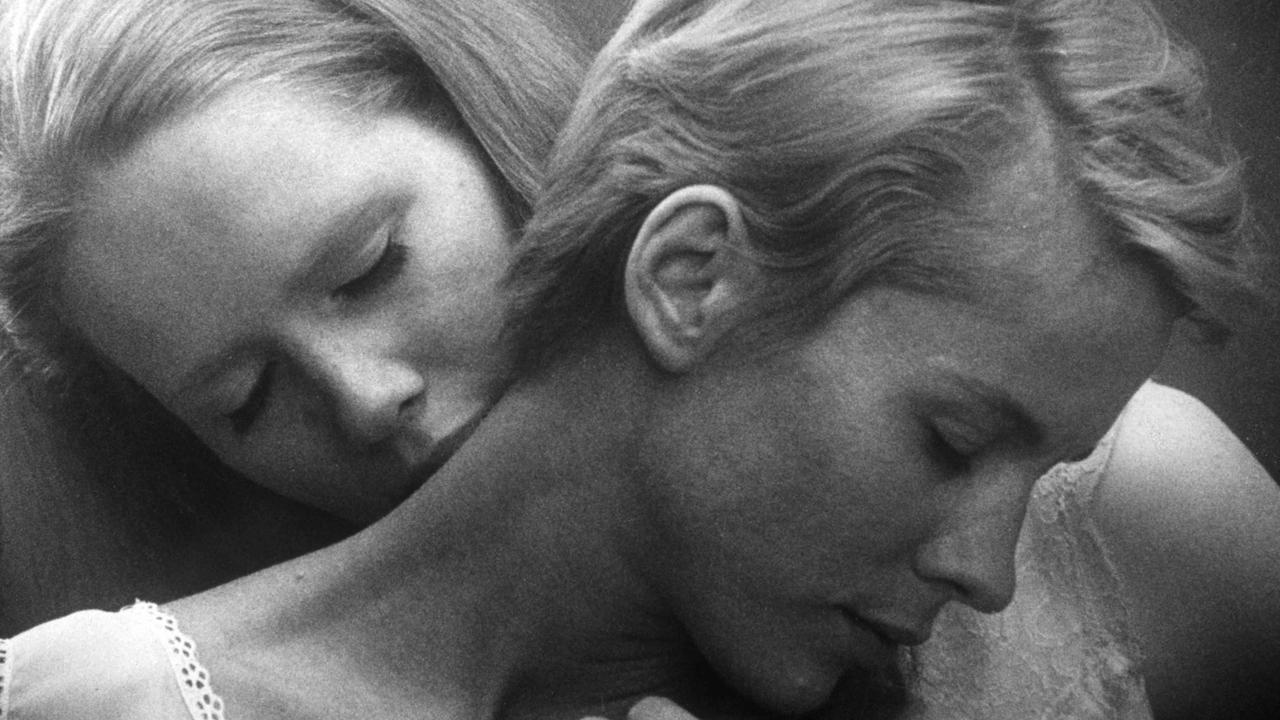
You were on stage. You were performing Electra. And in the middle of a line, you stopped. You looked out at the audience. You almost smiled. And you didn’t say another word.
The doctors examined you. Nothing wrong with your throat. Nothing wrong with your brain. You could speak. You simply chose not to. Or something deeper than choice made the decision for you. I don’t know which. Neither does the film. Neither does Bergman.
That’s where it starts. Ingmar Bergman’s Persona, 1966, eighty-five minutes, two women, one of whom will not speak and one who cannot stop speaking. Everything else that happens grows from that asymmetry like a vine growing through a crack in a wall.
Elisabet, they sent you a nurse. Her name is Alma. She is young, open, eager. She talks the way people talk when they’re nervous. She tells you about her life. Her fiancé. Her plans. She fills the silence because silence makes her uncomfortable. You listen. You nod. You watch her with those enormous eyes that give nothing away and take everything in.
She trusts you. That’s the mistake. Not because you’re cruel, but because silence looks like safety. A person who doesn’t speak can’t judge you, can’t repeat what you’ve said, can’t use your words against you. That’s what Alma believes. So she tells you things she’s never told anyone.
She tells you about a day at the beach. She and a friend, sunbathing. Two boys appeared. Young. Strangers. What happened next she describes in a long, unbroken monologue that Bibi Andersson delivers with a kind of terrified exhilaration. It is the most intimate confession in the history of cinema. It is six minutes long. The camera holds on Andersson’s face while she talks, and then it holds on yours while she talks, and both shots are unbearable for different reasons.
Elisabet, were you listening or feeding?
Because something shifts after that scene. Alma reads a letter you’ve written to your doctor. In the letter, you describe Alma the way a scientist describes a specimen. You find her amusing. You find her interesting. You are studying her. The silence was never neutral. It was a method.
Alma breaks. She rages. She throws things. She threatens. She demands that you speak. You don’t. And here is where Bergman does something that no film had done before and very few have done since. He makes the screen itself break. The image stutters. Burns. The celluloid appears to melt and catch fire. The projector seems to fail. For a few seconds, the film stops being a film and becomes an object, a physical thing that is being destroyed by the force of what it is trying to contain.
Elisabet, what did you do to this movie?
Because after that rupture, nothing is stable. Alma begins to look like you. You begin to look like Alma. In one shot, Bergman takes half of your face and half of hers and merges them into a single face that belongs to neither woman and both. The audience stares at this composite and cannot tell where one of you ends and the other begins.
A scene plays. Alma confronts you about your son, the child you didn’t want, the child you tried to will out of existence with your indifference. She describes your motherhood in brutal, clinical detail. Then the scene plays again. The exact same words. But this time the camera shows your face instead of hers. The meaning changes completely. Who is speaking? Who is being spoken to? Who is the patient and who is the nurse?
Elisabet, I need to ask you something. Did Alma ever exist? Or was she the voice inside your silence all along? Was she the part of you that still wanted to participate in language, in life, in the mess of being a person? And did you consume her the way a flame consumes the oxygen that feeds it?
Bergman never answers. The film ends with Alma leaving. Or with Alma staying. Or with neither woman having ever been separate to begin with. The boy from the opening sequence reaches toward a face on a screen that shifts between yours and Alma’s. He cannot touch it. He cannot hold it in focus. Neither can we.
Elisabet, here is what I think you understood. You understood that every word is a performance. Every conversation is a role. Every relationship is an act of mutual fiction. And you decided to stop. Not because you were broken, but because you were the only honest person in the room. Silence was not your illness. Silence was your critique.
And Bergman, who spent his entire career making people speak beautifully on screen, made a film that says: what if the most truthful thing a person can do is refuse?
You refused. And the film cracked open around you like an egg.
Eighty-five minutes. Two women. One speaks. One doesn’t. And when it’s over, you will not be sure which one was right. You will not be sure which one you are.
Elisabet, I’m still talking. You’re still not answering.
I think that means you win.
Persona Directed by Ingmar Bergman Sweden, 1966 | 85 minutes



Leave a Reply