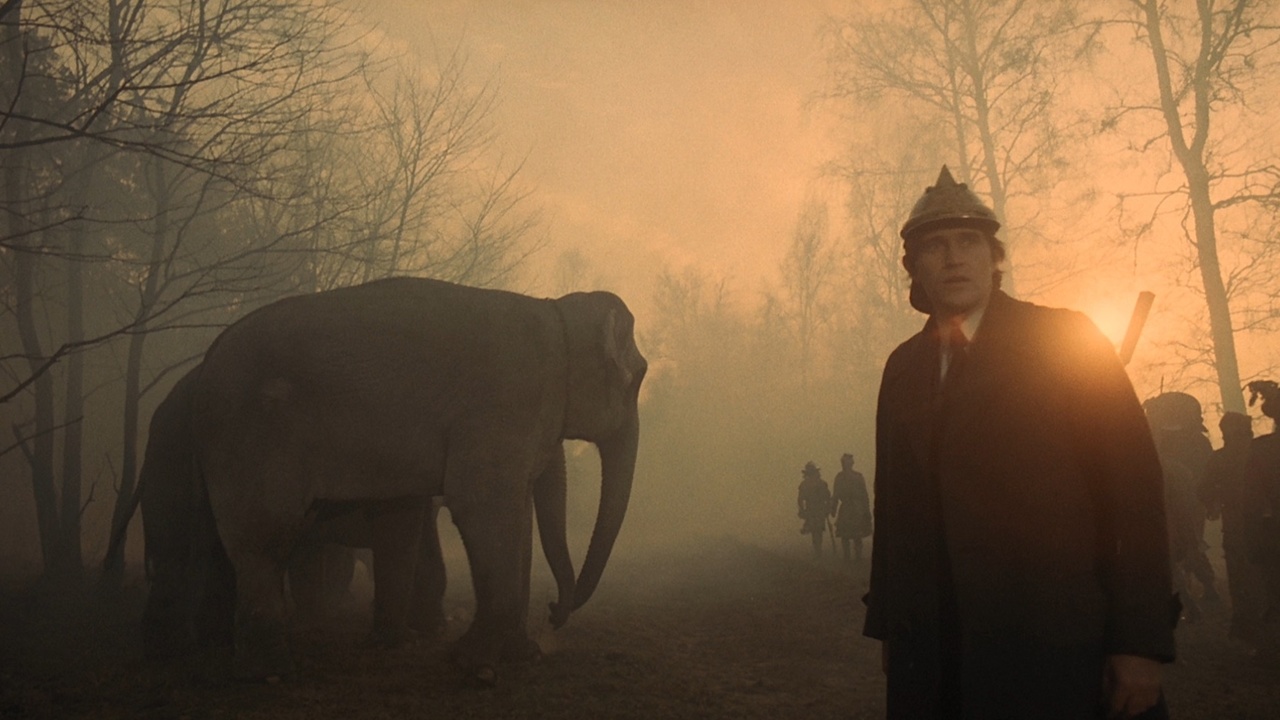
Please read in full before entering. Management assumes no responsibility for temporal displacement, misplaced relatives, or the loss of one’s century.
1. ARRIVAL
You will arrive by train. The train is dilapidated. The conductor is blind. Your fellow passengers appear to be frozen, or sleeping, or dead. It is difficult to distinguish between these states at this stage of the journey. Do not attempt to wake them. Do not attempt to leave the train before it reaches the station. The train knows where it is going. You do not.
When the train stops, exit through the left side. The platform will be deserted. Proceed along the overgrown path toward the main building. The vegetation will be dense and unfamiliar. The plants appear to be growing at an accelerated rate. This is normal.
2. RECEPTION
The sanatorium will appear abandoned. This is not the case.
The grounds are in disrepair. The paint is peeling from every surface. Houseplants have outgrown their pots and are climbing the walls. The restaurant, should you pass through it, contains grapes and sandwiches covered in cobwebs. Do not eat the sandwiches. The cobwebs are not decorative.
A nurse will eventually find you. She will inform you that everyone here is asleep. She is not speaking metaphorically.
Doctor Gotard will appear. He is a calm, well-spoken man who will lead you to your father’s room and explain the operational principle of the facility: “The trick is that we moved back time. We are always a little behind. The clocks here are not exact. We reactivate past time with all its possibilities.”
He will say this as if describing a plumbing upgrade. Nod. Accept the terms. There is no alternative treatment plan.
3. YOUR FATHER
Your father is asleep. Or your father is dead. Or your father’s death occurred outside the confines of the sanatorium and therefore has not yet taken effect within it. Time here is lagging behind the world you came from. Your father exists in the margin, the delay, the seconds that have not yet caught up. He is alive the way a letter is alive after the person who wrote it has died: the words are still there, but the hand is gone.
He may wake. He may speak to you. He may lead you through rooms you recognize from your childhood. He may keep birds in the attic. The birds are his. Do not touch them.
If he appears in more than one room simultaneously, this is not an error. Proceed to the room where he seems most present. Presence here is measured not by visibility but by warmth.
4. NAVIGATING THE BUILDING
The sanatorium contains more rooms than its exterior would suggest. This is because the rooms are not arranged spatially. They are arranged temporally. Each door opens onto a different period. Each corridor leads to a different layer of the past. The architecture is not fixed. It breathes.
You may encounter the following:
A market. It will appear inside a cavernous hall. Street vendors will be selling fabric and bread and objects you do not recognize. The market is a recreation of a shtetl that no longer exists. The people in it may or may not be aware that they are inside a building. Interact with them at your discretion.
A parade of soldiers. Their uniforms will span centuries. Renaissance, Napoleonic, Austro-Hungarian. They will march past you carrying a man on a litter. The man may be royalty or may be a mannequin. Do not salute.
A wax figure museum. The figures will be extremely lifelike. Some of them are historical. Some of them are personal. One of them may be your father. If you are uncertain whether a figure is wax or living, observe the eyes. Wax figures do not blink. However, in this facility, the living do not always blink either.
A room full of birds. Your father is here.
A girl from your boyhood. She will be standing on a balcony or lying in a bed or walking through a garden. She is not a memory. She is not a ghost. She is the feeling you had when you first saw her, preserved in amber, still warm. The sanatorium has kept her for you. Do not ask how.
5. THE BLIND CONDUCTOR
He will reappear throughout your visit. At the entrance. In the corridors. At the edges of rooms. He carries no lantern. He sees nothing. He sees everything.
The conductor is not staff. The conductor is not a patient. The conductor is the figure who brought you here and will take you away and he operates on a schedule that has no relationship to the clocks on the walls, which have stopped, all of them, every clock in the building, stopped.
When you see him, note the direction he is facing. If he faces the door, your time in the current room is ending. If he faces the wall, you may stay longer. If he faces you, leave immediately. Not the room. The sanatorium.
6. REGARDING TIME
Time in the sanatorium does not flow. It accumulates. It pools. It collects in corners the way dust collects, the way leaves collect against a wall in autumn. Rooms you visited an hour ago may now contain events from decades earlier. Rooms you have not yet entered may already contain your departure.
Do not attempt to track time using conventional methods. Your watch stopped when you entered. The clocks on the walls are ornamental. The only reliable measure of time here is the rate of decay of the building itself, and the building has been decaying for so long that decay has become a form of permanence.
Wojciech Has, the director of this sanatorium, filmed it at the Łódź studio in Poland in 1973. He shot with a camera that moves the way the building moves: in long, floating tracking shots that glide from room to room without cutting, as if the camera were another patient, wandering the corridors, opening doors it should not open, finding things it was not looking for.
Witold Sobociński was the cinematographer. He gave the sanatorium colors that should not exist: golds that pulse, reds that bleed off the screen, blues that smell of evening. The colors are not realistic. They are remembered. They are the colors of a world recalled by someone who loved it and lost it and is trying to bring it back through sheer visual intensity.
7. REGARDING BRUNO SCHULZ
This section is not optional.
The sanatorium was built from the writings of Bruno Schulz, a Polish-Jewish author and artist born in 1892 in the Galician town of Drohobycz. He wrote two collections of short stories: Cinnamon Shops in 1934 and Sanatorium Under the Sign of the Hourglass in 1937. Both are set in a provincial town that is also a dreamscape, where fathers transform into birds and shops sell impossible fabrics and the weather has moods and the furniture is alive.
On November 19, 1942, Schulz was shot dead by a Gestapo officer named Karl Günther in the streets of the Drohobycz ghetto. He had ventured outside the Jewish quarter. His crime was existing in the wrong place.
The sanatorium you are visiting is a reconstruction of the world Schulz described. That world no longer exists. The towns were destroyed. The people were murdered. The culture was erased. What Has has built on this soundstage in Łódź is not a set. It is a séance. Every bird in the attic, every vendor in the market, every girl on the balcony, every soldier in the parade is a ghost of something the twentieth century killed, and the camera moves through them with a tenderness that is almost unbearable because tenderness is the only appropriate response to a world that should still be here and is not.
The Polish government in 1973 did not want this film shown. Has had emphasized the Jewish elements of Schulz’s work, and this was shortly after the antisemitic campaign of 1968 that drove 30,000 Polish Jews from the country. The authorities forbade Has from submitting the film to Cannes. He smuggled a print out through his German co-producer. The jury, led by Ingrid Bergman, awarded it the Jury Prize.
8. THE ATTIC
If you reach the attic, you will find your father. He is here among the birds. They are exotic and ordinary and loud and they fill the room with feathers and sound and life. Your father is not dying here. He is living. He is living the way he lived before the illness, before the sanatorium, before the hourglass began its descent. He is wild and eccentric and free.
Stay as long as you can. The attic is the warmest room in the building. It is the room where the past has not yet learned that it is over.
9. DEPARTURE
You will not choose when to leave. The sanatorium will choose for you. The corridors will begin to narrow. The rooms will repeat. The blind conductor will appear more frequently, facing you, and his presence will become insistent.
The train will be waiting at the platform. The passengers will be in the same positions. The conductor will gesture toward the door.
Board the train.
As you leave, look back at the building. It will be smaller than you remember. The vegetation will have advanced. The windows will be dark. The hourglass on the sign above the entrance will be nearly empty.
Do not return. Not because it is forbidden but because the building will not be here next time. The rooms have served their purpose. The past has been visited. The birds have been seen. The father has been found. The market has opened one last time and closed forever.
This is what the sanatorium offers. Not a cure. Not a resurrection. A delay. A few hours borrowed from the portion of time your father has already used up, replayed in rooms that dissolve behind you as you walk through them. The most beautiful, temporary, impossible thing: a chance to say goodbye to a world that was already gone before you arrived.
These instructions are now void. The sanatorium has closed. The film remains.
The Hourglass Sanatorium (Sanatorium pod Klepsydrą) Director: Wojciech Jerzy Has Country: Poland Year: 1973 Runtime: 124 minutes



Leave a Reply