What happens when a man climbs into a white limousine at dawn and spends the rest of the day becoming other people?
Not acting. Not pretending. Becoming.
What if the film never tells you why?
Who Is Monsieur Oscar?
When Denis Lavant puts on the wig and the bent back of an old Roma beggar woman and shuffles out onto the streets of Paris, is he performing? Is he working? Is he living a life that someone assigned to him? Is there a difference?
When he strips down in the back of the limousine and covers his body in sensors for a motion-capture session, twisting and leaping in a black void until his body merges with a digital woman in something that looks like sex but also like prayer, what are we watching? Technology? Desire? The future of performance? The death of it?
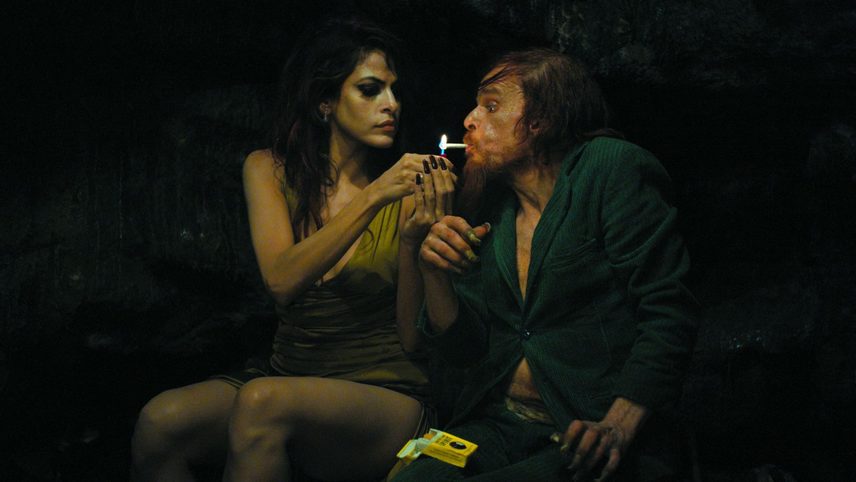
When he emerges from a sewer as a feral, flower-eating creature called Merde, with a ruined eye and fingernails like bark, and kidnaps a fashion model from a cemetery photo shoot, why does the scene feel more honest than anything civilized that came before it?
Does It Matter That Nothing Connects?
Each appointment is a different genre. A different tone. A different world. There is no plot threading them together. There is no reveal at the end that makes it all click.
So why doesn’t the film feel random?
Why does it feel, instead, like the most coherent film you’ve seen in years?
Is it because every appointment is about the same thing, even though every appointment looks completely different? Is the thing they share simply the act of inhabiting another life with total commitment? Is Monsieur Oscar an actor? A priest? An assassin of identities? Is he cinema itself, exhausted but unable to stop performing?
What About the Scene With His Daughter?
Midway through the film, Oscar is driven to a party to pick up his teenage daughter. In the car, it becomes clear she lied to him about the party. She sat alone. She hid from the other kids. The conversation between father and daughter is small, painful, unbearably real.
Is this an appointment too? Is his fatherhood another role? Or is this the one moment where the mask falls and the man underneath is visible?
Can you tell the difference?
Does the film want you to?
Why Does Édith Scob Break Your Heart?
She plays Céline, Oscar’s driver. She is patient. She is elegant. She has been driving him between lives all day.
Do you know who Édith Scob is? Do you know that in 1960 she starred in Eyes Without a Face, a film where she wore a pale, frozen mask to hide her disfigured features?
So when, at the end of Holy Motors, she reaches into the glove compartment and puts on a white mask before driving into the night, are you watching Céline or Édith? Are you watching a character reference or an actress carrying fifty years of cinema on her face? Is Leos Carax paying tribute to her or to the art form that made her?
Is there a difference?
What Happens When the Limousines Talk?
The film ends in a garage. The limousines are parked for the night. And they speak to each other. They worry. They wonder if they are becoming obsolete. If anyone still needs them.
Are the limousines talking about limousines?
Or about movie theaters? About the dark rooms where strangers used to sit together and watch other people’s lives? About whether those rooms still matter? About whether anyone will come tomorrow?
Why Can’t You Describe This Film to Anyone?
You’ve tried. You’ve said it’s about a man who goes through different identities in Paris. You’ve said it’s funny and strange and sad. You’ve mentioned the talking limousines. You’ve mentioned the scene where two people in motion-capture suits perform what might be love or might be combat in total darkness.
And the person you’re telling this to gets a certain look. Polite. Skeptical. They are trying to figure out if you are recommending a film or having a breakdown.
Isn’t that exactly what a peculiar film should do?
Is It a Masterpiece?
Would a masterpiece leave you with this many questions?
Would a masterpiece refuse, with this much grace, to answer a single one of them?
Would it trust you this completely?
Holy Motors Directed by Leos Carax France / Germany, 2012 | 115 minutes


Leave a Reply