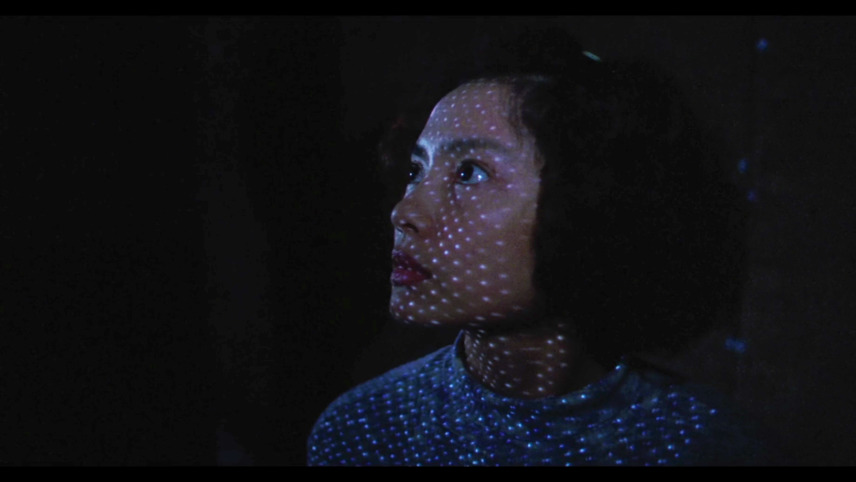
These images were taken on the last night of the Fu-Ho Grand Theatre, Taipei. The theater closed shortly after. The images are fading.
Hold them by the edges.
Polaroid 1: The Lobby
Rain outside. The ticket booth is unmanned. The glass partition reflects the wet street and the neon signs and nothing else. No line. No crowd. Behind the booth, a corridor recedes into aquamarine shadow, the walls stained with dark tendrils of water damage, as if the building has been quietly weeping for years.
On the screen inside, a film is starting. You can hear it from here. Swords. Voices. A story about heroes in a desert inn, surrounded by enemies. That film, King Hu’s Dragon Inn from 1967, is full of people. The lobby is empty.
This is the last screening.
Polaroid 2: The Ticket Seller
She walks. That is most of what she does in this film. She walks and walks and walks through the corridors of the Fu-Ho Grand, her left leg held in an iron brace, each step requiring a negotiation with gravity that makes you aware of every tile beneath her feet.
She is carrying something. A sesame cake in a rice cooker. She is looking for the projectionist. She cannot find him. She walks from the lobby to the basement, from the basement to the projection booth, from the booth back to the corridors. The cake is warm. The corridors are long. The projectionist is somewhere else.
Her name is never spoken. In the credits she is listed simply as the ticket woman. Chen Shiang-chyi plays her as if walking is a form of devotion. Every step hurts. Every step continues. The sesame cake never arrives where it is meant to go.
Polaroid 3: The Auditorium, Wide
Here is the room. Rows of red seats, most of them empty. The screen glows at the far end, throwing light across the empty rows, giving each seat its own small shadow. King Hu’s swordsmen are fighting. The soundtrack fills the room with the clash of metal and the shouts of men who died four decades ago.
A few people sit scattered through the hall. A woman eating peanuts with enthusiasm. A Japanese tourist who seems to have wandered in from another film entirely. Two old men, seated apart, watching the screen with a stillness that is different from everyone else’s stillness.
Tsai Ming-liang films this room the way you photograph a face you know you will not see again. Slowly. From a fixed position. Without blinking.
Polaroid 4: The Japanese Tourist
He sits alone. He gets up. He walks to the bathroom. He stands at the urinal. Another man enters. Then another. They glance at each other. Nothing happens. Something almost happens. Nothing happens.
He returns to the auditorium. He sits in a different seat. He gets up again. He walks the corridors. The theater is a maze of green-tinted hallways and locked doors and staircases that lead to more staircases. He is looking for something. Connection, probably. Company, maybe. Sex, possibly. What he finds instead is architecture. Room after room after room, all of them empty, all of them the same shade of soiled aquamarine, all of them echoing with the muffled sound of swords.
The comedy here is exquisite and almost invisible. In a nearly empty theater, a stranger sits right next to him. In a row of open urinals, a stranger takes the one adjacent. Tsai Ming-liang has the timing of Chaplin and the patience of a glacier, which is a combination that should not work and works perfectly.
Polaroid 5: The Corridors
Green walls. Dim fluorescent light. A dripping pipe. The sound of rain filtered through concrete.
The ticket seller walks through here again. And again. And again. Each time the camera holds its position and waits for her to enter from one edge of the frame and exit from the other. The time it takes her to cross is the time it takes her to cross. The film will not cut. The film will not help.
These corridors are the arteries of a dying body. The theater is the body. The film being projected is its final heartbeat. The ticket seller walking through the corridors with her warm sesame cake is the blood still circulating, stubbornly, after the prognosis has been delivered.
Polaroid 6: The Two Old Men
Here they are. Miao Tien and Shih Chun. You may not recognize them. They are old now, their faces carrying decades that the screen has not recorded. But on the screen in front of them, they are young. They are warriors in King Hu’s Dragon Inn. They are fighting. They are running. They are living inside a 1967 they can never return to.
Tsai Ming-liang cast these two men knowing exactly what he was doing. Miao Tien got his first starring role in King Hu’s original film. Now he sits in the decaying Fu-Ho Grand and watches himself, half a lifetime ago, being heroic. The camera finds his face in the dark. Something crosses it. He does not cry dramatically. He cries the way old men cry in theaters: quietly, without moving, letting the dark do the work of privacy.
Whether these men are ghosts or simply old is a question the film does not answer. Both possibilities are true. Both possibilities are the same.
Polaroid 7: The Projection Booth
Lee Kang-sheng sits with the projector. Tsai’s constant collaborator, his face in nearly every film Tsai has made, playing a variation on the same solitary man. Here he is the projectionist. He operates the machine that keeps the dead film alive. He threads the celluloid through the gate and the light passes through it and the shadows of 1967 fall across the screen and the empty seats and the few remaining faces.
He does not know the ticket seller is looking for him. Or he knows and does not come down. The sesame cake grows cold. The corridors grow longer. The film plays on.
The projection booth is the only room in the theater that faces away from the screen. The projectionist sees everything backward: not the image but the light that makes the image, not the story but the machinery of the story. He is the most essential person in the building and the most invisible.
Polaroid 8: Dialogue
Forty minutes into the film, someone speaks. It is the first line of dialogue that does not come from King Hu’s Dragon Inn. In eighty-two minutes of running time, there are perhaps a dozen lines total. The words, when they arrive, feel like someone coughing in a cathedral.
The line, spoken by a woman to the Japanese tourist: “Did you know this theater is haunted?”
That’s it. That is the entire thesis of the film, delivered as a casual aside in a corridor, and you don’t know whether she means it literally or figuratively and the film does not clarify because clarification would be a form of cruelty. Let it remain a question. Let the theater be haunted or not. Let the old men be ghosts or not. Let the ticket seller’s walk be devotion or just a woman doing her job. The film will not explain. The film is eighty-two minutes of not explaining, which turns out to be the most eloquent thing a film about cinema has ever done.
Polaroid 9: The Rain
It rains for the entire film. You hear it constantly. Through the walls. Through the ceiling. Through the sound of King Hu’s swords. The rain is the bass note beneath everything, the continuous weather of a city that does not care that a theater is closing, a frequency so constant that you stop hearing it until you realize you’ve been hearing it all along.
Tsai Ming-liang’s films are always raining. It is his signature, the way Ozu’s signature is the low camera angle and Tarkovsky’s is water and Akerman’s is real time. But in Goodbye, Dragon Inn, the rain is not a signature. It is a eulogy. The rain is the city washing the theater away. The rain is what replaces the audience. The rain is what fills the seats when the people leave.
Polaroid 10: The Emptying
The film ends. King Hu’s Dragon Inn reaches its final battle. The swordsmen triumph. The credits roll on the screen within the screen. The patrons stand. They leave. One by one. The Japanese tourist. The woman with the peanuts. The old men. They all leave.
Nobody says goodbye. Nobody lingers. They file out into the rain and the street and the rest of their lives and the theater absorbs their absence the way a sponge absorbs water.
The ticket seller walks one more corridor. She finds the auditorium. She finds the projection booth. She finds Lee Kang-sheng. They do not speak. What could be said? The theater is closing. The film is over. The sesame cake is cold.
Polaroid 11: The Empty Theater
This is the last shot. The camera is positioned in the auditorium, facing the seats. All of them empty. The screen is dark. The lights are on, revealing what the dark concealed: the torn upholstery, the cracked armrests, the stains on the floor, the sheer physical exhaustion of a room that has held people in the dark for decades and is now being asked to hold nothing at all.
The shot lasts nearly six minutes. Nothing happens in it. No one enters. No one leaves. The seats are empty. The rain continues. The camera does not move.
Tsai Ming-liang rented the Fu-Ho Grand Theatre on impulse when he learned it was about to close. He had no script. He had only the building and the memory of theaters like it: the vast concrete cinemas of his childhood, where you went in summer to escape the heat and sat in the dark with strangers and watched enormous stories on enormous screens and were, for two hours, not alone.
He wrote the film to save the building. He could not save the building. The Fu-Ho Grand closed shortly after filming. A researcher who visited in 2016 found it abandoned, still containing props from the shoot.
Apichatpong Weerasethakul, the Thai filmmaker who made Uncle Boonmee Who Can Recall His Past Lives, called Goodbye, Dragon Inn “THE best film of the last 125 years.”
Polaroid 12:
[This image did not develop.]
Goodbye, Dragon Inn (不散) Director: Tsai Ming-liang Country: Taiwan Year: 2003 Runtime: 82 minutes


Leave a Reply