Submitted by: [name withheld] Institution: [affiliation pending] Region of study: Colombian Amazon, upper tributaries Period of observation: Two expeditions, separated by approximately thirty years (1909, 1940) Filed under: Ethnobotany, Contact Narratives, Colonial Science, Loss
Entry 1: Specimen
Subject: Yakruna. A sacred plant, possibly fictional, possibly not. Said to possess healing properties of an unspecified but extraordinary nature. No Western botanical classification exists. No herbarium sample has been preserved.
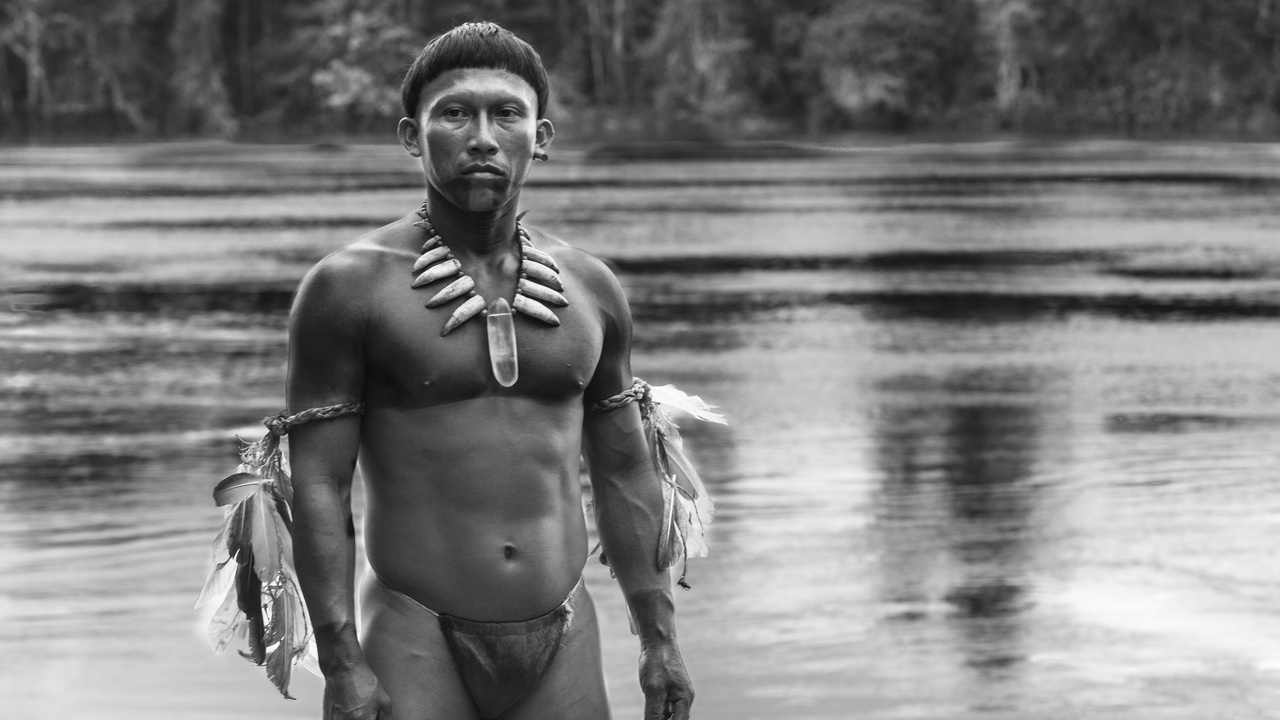
The entire film is organized around the search for this plant. Two Western scientists, decades apart, travel upriver into the Colombian Amazon to find it. Their guide for both journeys is the same man: Karamakate, an Amazonian shaman and the last surviving member of the Cohiuano people.
Taxonomic note: The yakruna does not appear in any recognized botanical index. It exists only in the film, which is based on the real travel journals of Theodor Koch-Grünberg and Richard Evans Schultes, neither of whom recorded a plant by this name. Ciro Guerra invented it. He invented a sacred plant and placed it at the center of his film, and by doing so he did something that Western science has never been able to do: he made the search more important than the specimen.
This report will attempt to catalogue the film’s contents. It will fail. The failure is the point.
Entry 2: First Expedition (1909)
Personnel: Theo (based on Koch-Grünberg), a German ethnographer who has spent years in the Amazon and is now dying of an unidentified illness. Manduca, an indigenous man Theo freed from enslavement on a rubber plantation, now serving as his companion and translator. Young Karamakate (played by Nilbio Torres), who lives alone on the riverbank, the last of his people, furious and brilliant and unwilling to help a white man unless given a reason that matters.
Observations: The three men travel upriver by canoe. Karamakate agrees to guide Theo to the yakruna, which he says is the only cure. He prolongs Theo’s life by blowing a white powder called “the sun’s semen” into his nostrils. He insists that Theo eat no meat and no fish. He insists that Theo treat the river as a living thing. He insists on rules that Theo’s scientific training has no framework to accommodate.
The camera, operated by David Gallego, photographs the Amazon in black and white. This is the first thing you must understand. The jungle is not green in this film. It is silver and grey and black and white, and somehow this makes it more alive than any color photograph has ever made it. The river shines. The leaves have weight. The shadows in the canopy look solid enough to hold. Gallego has done something paradoxical: by removing color, he has made the Amazon look the way it feels rather than the way it looks.
Entry 3: Second Expedition (1940)
Personnel: Evan (based on Schultes), an American botanist carrying Theo’s published journal. Old Karamakate (played by Antonio Bolívar, one of the last sixteen surviving Ocaina people on Earth), who has forgotten his own customs, his own language, his own purpose. He calls himself a chullachaqui: a hollow copy of a person. An echo with nothing left inside it.
Observations: The two expeditions are intercut throughout the film. Guerra moves between 1909 and 1940 without announcement, without title cards, without the courtesy of telling you which decade you’re in. You learn to tell them apart by Karamakate’s face. Young Karamakate burns with anger and knowledge. Old Karamakate has the stillness of someone who has already lost everything and is now losing the memory of having lost it.
This is not a structure designed for Western comfort. Linear time is a Western invention. The river does not flow in one direction.
Entry 4: Contact Sites
Site A: The Catholic Mission (1909)
Theo, Manduca, and Karamakate encounter a mission run by a Spanish priest. Indigenous children, orphaned by the rubber trade, are being raised here. They are forbidden from speaking their languages. They are beaten for practicing their customs. They are fed and clothed and educated and destroyed.
Karamakate sees a boy. He recognizes the boy’s tribal markings. He tries to teach the boy something of his heritage. The priest intervenes. The encounter is brief and devastating and filmed with the same quiet distance as every other scene in the film, which makes it worse, because the camera refuses to perform outrage on your behalf. It simply shows you what happened. What you feel about it is your problem.
Site B: The Same Mission (1940)
Thirty years later, Evan and old Karamakate return to the same mission. The priest is gone. In his place is a man who calls himself the Messiah. He wears a crown of thorns. He has declared himself divine. The children from 1909 have grown into adults who worship him, having traded one form of colonization for another, having built a new cage from the ruins of the old one.
The Messiah tells his followers to eat him. He opens his robes and offers his body. It is a perversion of the Eucharist staged in the jungle by a man who has been driven insane by the same colonial project that created him. Karamakate gives the congregation a hallucinogenic drink. They lose their minds. Evan and Karamakate leave.
Field note: This is the sequence that most clearly reveals what the film is doing. It is showing you that colonialism does not simply extract resources. It extracts meaning. It takes the systems people use to understand the world and replaces them with systems designed to make people understand themselves as inferior. The mission in 1909 steals language. The mission in 1940 steals God. By 1940, the theft is so complete that the victims have become their own oppressors.
Entry 5: The Compass
In 1909, Theo gives his compass to an indigenous chief as a gift. Karamakate is enraged. He seizes it. He demands that Theo take it back.
Why? Because the compass works. Because if the chief begins using a compass to navigate, he will stop using the stars, the current, the behavior of birds, the angle of the sun, the taste of the water. He will lose the knowledge that has been accumulating in his people for thousands of years, replaced by a metal disc that points north. The compass does not add knowledge. It replaces it. And replacement, Karamakate understands, is the mechanism by which cultures die.
This is a scene about a compass. It is also a scene about this report. Every field report written by a Western scientist about an indigenous culture performs the same operation as the compass: it translates living knowledge into a format that is portable, legible, and dead. The journal becomes the compass. The taxonomy becomes the compass. The classification system becomes the compass. Everything that makes the knowledge useful to the people who created it is stripped away in the act of recording it.
I am aware of what I am doing. I am writing a field report about a film that argues against the existence of field reports. I am cataloguing a work of art that says cataloguing is violence. The irony does not excuse the act.
Entry 6: Languages Spoken
Ocaina. Ticuna. Bora. Andoque. Yucuna. Muinane. Spanish. German. English.
Nine languages appear in this film. The indigenous languages are not subtitled for decoration. They are the primary mode of communication. The Western languages are the intrusions.
Antonio Bolívar, who plays old Karamakate, is one of the last speakers of Ocaina. He is not an actor. Guerra spent over a decade looking for the right person and found Bolívar in a two-minute appearance in a short film made during a Ministry of Culture workshop. There was nobody else who could play this role because there is almost nobody left who carries what this role requires.
When Bolívar speaks Ocaina on screen, you are hearing a language that may not survive the century. The film does not tell you this. The film does not need to tell you this. You hear it in the sound itself: something precious carried in a voice that knows it is among the last.
Entry 7: The River
The Amazon is not a setting. It is a character with its own logic and its own demands.
For Theo and Evan, the river is a means of transportation. You get in a canoe. You paddle upstream. You arrive somewhere. The river serves the journey.
For Karamakate, the river is alive. It communicates. It has moods and intentions and memory. To travel on it is not to use it but to negotiate with it. To treat it as transportation is to insult a god.
The film is on Karamakate’s side. You know this because of how Gallego photographs the water. The river in this film does not look like water. It looks like mercury. It looks like the skin of something enormous and slow and aware. Every shot of the river reminds you that you are a guest in a place that was not built for you and does not require your understanding to exist.
Entry 8: The Rubber
The rubber boom is the historical backdrop. It is also the wound that everything in the film flows through.
Between 1879 and 1912, the demand for rubber in Europe and North America transformed the Amazon into a killing floor. Over 100,000 indigenous people were enslaved, mutilated, or murdered in the extraction of rubber from the jungle. Trees were bled. People were bled. The distinction between the two was not recognized by the men doing the bleeding.
In 1909, Manduca and Theo discover a rubber grove. Beside it, a small graveyard. A man with a missing arm appears, begging to be killed. The scene is brief. The camera does not move. There is no score. Just a man with one arm standing among rubber trees and graves, asking for death, in a film that is entirely in black and white, which means you cannot see the red but you can feel it.
Entry 9: Color
The film is in black and white for 120 of its 125 minutes. You forget that color is possible. You accept the silver jungle and the white river and the grey sky as the truth of this place.
Then Karamakate prepares the yakruna for Evan. Evan drinks it. And the screen erupts.
Color arrives like a detonation. Swirling patterns. Fractal geometries. The Amazon seen not with eyes but with whatever faculty the yakruna activates: something beyond sight, beyond taxonomy, beyond the reach of any field report. Evan flies over the canopy. He sees the river from above. He sees the interconnectedness that Karamakate has been trying to explain for the entire film, the thing that could never be explained because explanation is itself the problem.
The color lasts only minutes. It is the most beautiful thing in the film. It is also the film’s argument, distilled to its purest form: you had to sit in black and white for two hours to earn this. You had to unlearn what you thought you knew about seeing before the film would show you what seeing actually is.
Entry 10: Conclusion
Findings: Inconclusive.
Recommendation: Discard this report.
Ciro Guerra made this film over five years. He dedicated it to all the Amazonian cultures that have been lost. He shot it in the jungle, in indigenous languages, with indigenous actors, in black and white because color would have made the Amazon look like a nature documentary and this is not a documentary. This is an elegy in the shape of a river.
It premiered at Cannes in 2015 and won the Art Cinema Award. It was nominated for the Academy Award for Best Foreign Language Film, the first Colombian film to receive that distinction. These facts are true and they are also beside the point, because the film does not exist to win awards. It exists to show you the shape of a wound that has not healed, and to suggest that the tools we use to understand the wound are the same tools that made it.
I set out to write a field report. I have written something else. The form has broken because the film broke it, the way the compass breaks the stars, the way the mission breaks the language, the way the rubber trade breaks the arm of a man standing in a grove asking to die.
This report is now closed. Its findings belong to no one.
Embrace of the Serpent (El abrazo de la serpiente) Director: Ciro Guerra Country: Colombia Year: 2015 Runtime: 125 minutes

Leave a Reply