ERRATA
The following corrections are issued for the film previously catalogued as a martial arts epic based on Louis Cha’s novel The Legend of the Condor Heroes. Readers who watched the film expecting a wuxia adventure are advised that the source material has been significantly altered. The publisher regrets any confusion. The director does not.
Page 1, paragraph 1. The text states that Ouyang Feng is a swordsman. This is incorrect. Ouyang Feng is a man who sits in a desert inn and brokers violence for others. He was once a swordsman. He was once many things. He lives in the desert now because the desert is what remains after you subtract everything you were willing to lose, and then keep subtracting.
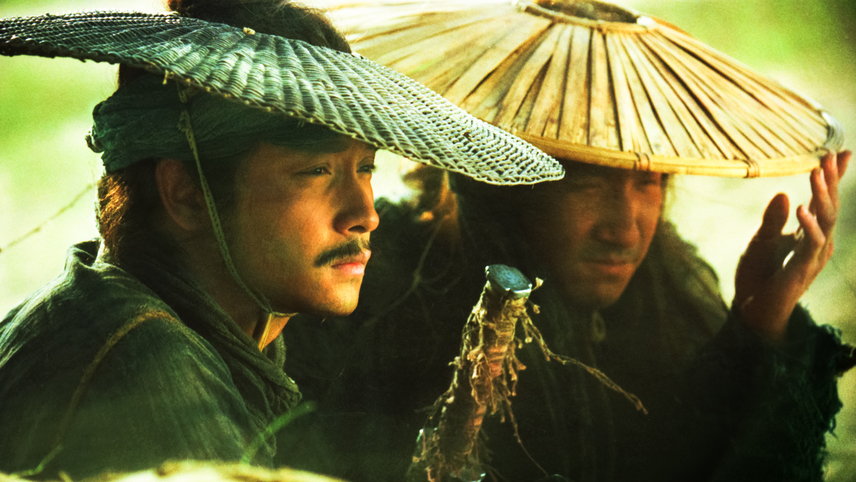
Leslie Cheung plays Ouyang Feng, and what he does in this film is almost impossible to describe in the language of performance. He narrates. He sits. He watches other people arrive and leave. He drinks. He remembers things he tells us he has forgotten, which means he has not forgotten them, which means the narration is lying, which means the film has told you, from its first minutes, that nothing you hear from this man can be trusted entirely.
Wong Kar-wai built Ashes of Time across two years of chaotic production in the Chinese desert. The shoot was legendarily difficult. Actors came and went according to their own schedules. The script changed daily. Christopher Doyle, the cinematographer, shot on instinct, chasing light across dunes and ruins with a camera that moved like it was remembering something it hadn’t quite seen. The resulting film feels less made than excavated: dug up from sand, some pieces missing, some pieces belonging to a different structure entirely.
Page 3, paragraph 2. The text states that Murong Yin and Murong Yang are two characters. This requires correction. They may be one character. Brigitte Lin plays both: Murong Yin, a woman, and Murong Yang, her male alter ego. Or: Murong Yang is a separate person who shares her face. Or: one of them does not exist and is a projection of the other’s heartbreak. The film does not clarify. It presents both as real. It presents both as reflections in the same water. It lets you hold the contradiction.
Brigitte Lin’s face in this film is one of the permanent images of 1990s cinema. She stands at the edge of a lake. The water reflects her. She asks Ouyang Feng to kill the person who hurt her. Then she asks him to kill a different person. Then it becomes clear that both people may be the same person, or that the person she wants killed may be herself, or a version of herself she cannot reach. The scene is shot with the water rippling between them, splitting every reflection into shards.
This is what Wong Kar-wai does with wuxia. He takes the genre’s architecture — the swordsmen, the honor codes, the vendettas, the impossible feats of combat — and fills it with something the genre was never designed to carry: ambivalence. Every character in Ashes of Time wants something they cannot name precisely. They arrive at the inn and say they want revenge, or justice, or a hired sword. What they actually want is to be relieved of a memory. The revenge is an excuse. The sword is a metaphor they haven’t recognized as a metaphor.
Page 7, paragraph 4. The text states that the blind swordsman fights because he has nothing left to lose. This is incorrect. The blind swordsman fights because fighting is the last thing he can still do, and the last thing he can still do is not the same as having nothing to lose. Tony Leung Chiu-wai plays this role, and his scenes are among the most beautiful in a film that is relentlessly, almost punitively beautiful. He is going blind. He knows he is going blind. He takes one last job. He fights a band of horsemen in a reed marsh, and Doyle films the fight as an impression rather than an event: blurred steel, fractured light through reeds, water kicked into spray, the sound of impact arriving before the image that explains it.
Wong Kar-wai’s fight scenes in Ashes of Time are the opposite of martial arts choreography. They are not legible. You cannot track the sequence of moves. You cannot count the combatants. You see fragments: a blade, a body, a splash of blood across sand. The violence is experienced the way memory experiences violence — in flashes, out of order, with the cause arriving after the effect. Sammo Hung choreographed the fights, and what Doyle and Wong did with that choreography is something between homage and sabotage. The fights are there. You cannot quite see them. They are gorgeous.
Page 12, paragraph 1. The text states that Huang Yaoshi visits Ouyang Feng once a year, on the same day, bringing wine. This is correct. The text further states that the wine is called “Drunk Dream” and that it erases memory. This is also correct. The text does not state that this is the film’s central mechanism and its deepest cruelty. This omission is the most significant error in the document.
Tony Leung Ka-fai plays Huang Yaoshi, and each year he brings the wine and each year he offers it to Ouyang Feng and each year Ouyang Feng refuses. Because Ouyang Feng does not want to forget. He wants to remember the woman he loved and lost and the reason he lives in the desert and the reason he cannot leave. Memory is his punishment and his only remaining possession. The wine would take both.
The woman he loved married his brother. This is stated plainly. What is not stated plainly is everything else: why he left, what he said or failed to say, whether the loss was inevitable or chosen. The film circles this wound without entering it. You learn the facts but not the feeling. Or you learn the feeling but not the facts. The errata cannot determine which version is authoritative because both exist in the film simultaneously and neither cancels the other.
Page 15, paragraph 3. The text states that Ashes of Time was a commercial failure. This requires context. The film was released in 1994 after two years of production. Hong Kong audiences expected a wuxia epic with clear heroes, villains, and combat sequences. They received a film where the heroes cannot remember why they are fighting, the villains do not exist, and the combat sequences are photographed as though the camera itself was losing consciousness. The film performed poorly. Wong Kar-wai, having gone massively over budget, immediately made Chungking Express in twenty-three days as a palette cleanser. Chungking Express was a hit. Ashes of Time remained an orphan.
In 2008, Wong Kar-wai released Ashes of Time Redux, a re-edited version with a new score and color correction. The Redux is more watchable. It is also less itself. The original cut, with its rougher textures and more disorienting structure, is the version that earns the errata. It is the version where you can feel the film struggling against its own making, where the seams show, where the beauty is inseparable from the confusion that produced it.
Page 18, final paragraph. The text attempts to classify the film. The following classifications have been proposed and rejected:
Wuxia film. Rejected. The genre requires clarity of motive, legibility of action, and the restoration of a moral order. Ashes of Time provides none of these.
Art film. Insufficient. The term implies a stable aesthetic program. This film’s aesthetic was built from accident, exhaustion, and the desert light that Christopher Doyle chased without knowing what he would find.
Romance. Closer, but incomplete. Every character in the film is in love with someone who is absent, dead, or a different version of the person they remember. The love is real. The object of love is not. This is not what romance typically means.
Tone poem. The nearest approximation. Ashes of Time has the structure of music, not narrative. Themes are introduced, varied, returned to in different keys. Characters echo each other. Seasons cycle. The same desert appears under different light and means something different each time. But “tone poem” suggests control, and this film was not controlled. It was wrestled into shape from material that resisted shaping, and the resistance is part of what makes it extraordinary.
No classification has been accepted. The errata remain open.
General correction. Throughout the text, the word “remember” has been used as though it refers to a stable act. In the context of this film, it does not. To remember, in Ashes of Time, is to revise. Every memory is a draft. Every draft replaces the one before it. The characters remember their losses and their loves and their reasons for fighting, and each time they remember, the details shift. Names change. Motives blur. The season in which something happened slides from autumn to spring and back again.
Wong Kar-wai made a martial arts film about people who fight because they cannot stop remembering, and who cannot stop remembering because memory is the only evidence that they once felt something. The fights are beautiful. The memories are wrong. The corrections will continue indefinitely.
This erratum is also subject to correction.
Ashes of Time (東邪西毒) — Directed by Wong Kar-wai. Hong Kong, 1994. 100 minutes.

Leave a Reply