On January 3, 1889, in the city of Turin, Friedrich Nietzsche stepped out of his lodgings and saw a coachman beating a horse. He walked to the horse. He put his arms around its neck. He wept. He collapsed.
He was carried home. He never recovered. He lived another eleven years in silence and darkness, cared for by his mother and then his sister. The man who had declared God dead spent the last decade of his life unable to speak, unable to write, unable to do anything but exist in a room.
This story is famous. Philosophers tell it. Biographers tell it. It has been repeated so many times it has become a parable about the limits of the human mind, about what happens when a person thinks too hard, sees too clearly, feels too much.
Béla Tarr’s film begins by telling you this story. And then the narrator says six words that change everything:
“Of the horse, we know nothing.”
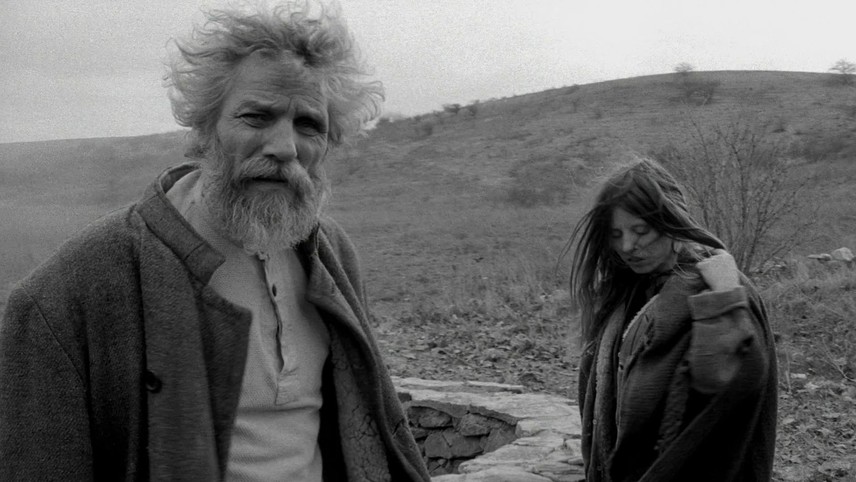
The camera turns away from Nietzsche. It turns toward the horse. Toward the coachman who beat it. Toward his daughter. Toward their farmhouse on a treeless, windblown plain. Toward six days.
This is The Turin Horse. It is Tarr’s final film. He has not made another. He said there was nothing left to say. After you watch it, you will understand why.
Day Six
They wake. The daughter gets up first. She walks to the window. Outside, the wind is blowing. It is always blowing. It does not gust or surge. It is constant, mechanical, relentless, as if the air itself has decided to leave and is taking everything it can carry.
She dresses her father. He has one working arm. Every morning, she pulls his shirt over his head, threads his dead arm through the sleeve, buttons him up, and laces his boots. Tarr films this in a single, unbroken take that lasts several minutes. You watch every button. Every lace. You feel the weight of each gesture. This is not a scene. It is a ritual, and rituals are only meaningful when you perform them without shortcuts.
They go to the well. They haul water. They carry it inside. She boils potatoes. Two potatoes, one for each of them. They eat with their hands. The potatoes are too hot. They blow on them. They eat in silence. The wind pushes against the walls.
The father goes to the stable. He hitches the horse to the cart. He tries to make it move. The horse takes a few steps. Then it stops. It will not continue. He unhitches it. He brings it back. He sits down.
This is the entire film. This routine. This day. Repeated six times. Each time, with less.
The film has thirty shots in two and a half hours. The score is a single piece of music by Mihály Víg, played on an organ, cycling and cycling like the wind, like the days, like the potatoes boiling in the same pot in the same water on the same stove. Everything repeats. Everything is the same. And each day, something is missing that was there before.
Day Five
The horse will not eat. It stands in the stable with its head down. The daughter puts feed in front of it. Water. The horse does not move. It is not sick, exactly. It has simply stopped participating. It has opted out of being a horse.
The father stands in the stable doorway and stares at the animal. He does not shout. He does not strike it. He has used this horse his entire working life. He knows what refusal looks like. He has never seen it from the horse before.
Outside, the wind blows. You have stopped noticing it by now. It has become the texture of the world. It has become what silence sounds like in this place.
Day Four
The well dries up. The daughter walks out with the bucket, lowers it, and it comes back empty. She tries again. Empty. She carries the bucket back inside.
They have some water left. Not much.
A neighbour arrives. He sits at the table. He delivers a monologue about the degradation of everything. Everything excellent has been ruined, he says. Everything noble has been pulled down. Not by a single catastrophe but by a slow, patient, relentless touching. Everything has been touched and touched and touched until it is worn away. He speaks with the conviction of a man who has thought about this for a long time and wishes he hadn’t.
The father listens. He says: “That’s rubbish.”
The neighbour leaves. The wind blows.
Day Three
They try to leave. They pack their things into the cart. They bundle their clothes, their pots, their remaining food. They hitch the horse, which moves now only because the daughter pulls it. They walk away from the farmhouse, down the road, into the wind.
The camera watches them go. They become small against the plain. They reach a hill. They disappear over it.
Minutes pass.
They come back. They unpack. They carry everything inside. They do not explain why they returned. They do not speak about what they saw on the other side of the hill, or whether there was anything to see at all.
Day Two
A group of men arrive with a cart. They take water from the well, though the well is dry for the father and daughter. The daughter chases them away. They leave a book behind. She reads from it later, by the lamp. The words are about the ruin of holy places, the destruction of everything sacred. She reads without expression. The words land on the room like ash.
The father eats his potato. He eats it more slowly now.
Day One
The lamp will not light.
The daughter tries. She strikes the match. The wick catches, holds for a moment, and goes out. She tries again. It goes out. The room darkens. Outside, the wind is still blowing but it sounds farther away now, as if even the wind is leaving.
The father sits at the table. A potato is in front of him. He picks it up. He looks at it. He puts it down.
The daughter sits across from him. Her potato is untouched.
They sit in the dark.
Zero
The Turin Horse (A Torinói ló) Directed by Béla Tarr and Ágnes Hranitzky Hungary, 2011 | 146 minutes

Leave a Reply