It is not a mystery.
Mysteries have solutions. Someone did something. A detective finds out what. The audience learns the truth. The credits roll over the relief of knowing.
In Picnic at Hanging Rock, three schoolgirls and their mathematics teacher walk up a volcanic rock formation in Victoria, Australia, on Valentine’s Day, 1900. They do not come back. The film does not tell you what happened to them. Not in the middle. Not at the end. Not in a postscript. Not in the source novel by Joan Lindsay, who presented it as fiction but hinted it might be fact, and who died without explaining. Not in decades of cottage-industry investigation by Australians who searched old newspapers and historical records for reports of missing schoolgirls and found nothing.
The disappearance is not the mystery. The mystery is why the film does not solve it and why, after 115 minutes, you do not feel cheated. You feel as though solving it would be a violation. Of what, exactly, you cannot say.
It is not a horror film.
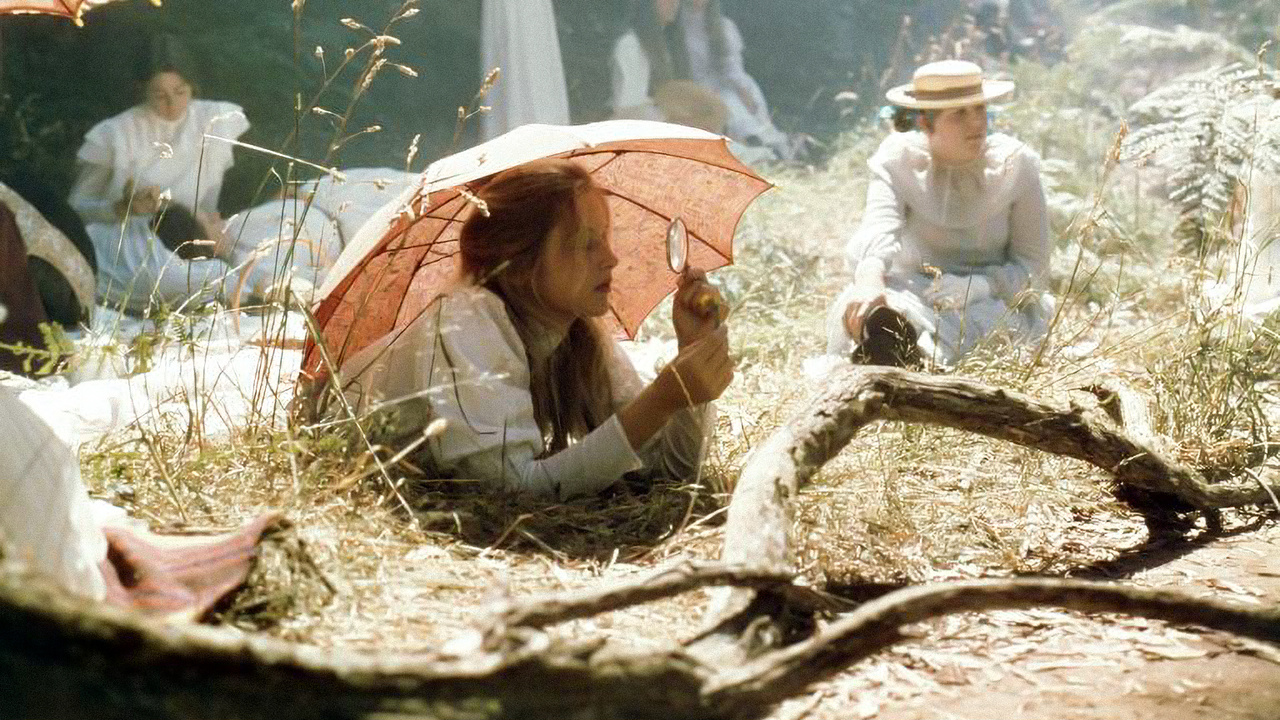
Nothing identifiably horrific happens on screen. No blood. No violence. No monster. No threat you can point to and name. The girls walk up the rock in their white muslin dresses, moving through the scrub and the heat and the eucalyptus with the dreamy slowness of figures in a painting, and they simply stop being there.
Edith, the fourth girl, the one who turns back, comes running down screaming. She has cuts and bruises. Her dress is torn. She cannot remember what she saw. Later she will recall one thing: Miss McCraw, the mathematics teacher, climbing the rock in her underwear. That is all.
No scream from above. No sound of struggle. No shadow on the rock. Just absence, arriving without announcement, and a girl running downhill with the knowledge that something has happened that she cannot describe. The film offers you the shape of horror without the content, which turns out to be far worse, because content can be processed and shape cannot.
Peter Weir said: “Horror need not always be a long-fanged gentleman in evening clothes or a dismembered corpse. It may be a warm sunny day, the innocence of girlhood, and hints of unexplored sexuality that combine to produce a euphoria so intense it becomes transporting, a state beyond life or death.”
The warm sunny day is the horror. The beauty is the horror. That is not a paradox. That is the film.
It is not a period drama.
Yes, it is set in 1900. Yes, the costumes are immaculate. Yes, there is a boarding school with a headmistress named Mrs. Appleyard who rules with corsets and discipline and a voice that could starch linen. Yes, the girls lace each other into their undergarments and read Valentine’s Day cards aloud and whisper in corridors about love and boys and freedom. Yes, it is a world of repression so thorough that the removal of stockings on a hot afternoon carries the charge of revolution.
But the period is not the point. The period is the surface. Beneath it, the film is about something much older than the Edwardian era. It is about a landscape that predates every human structure built upon it and does not recognize any of them. Hanging Rock is a volcanic formation. It is six million years old. Appleyard College is a building. It was built yesterday, geologically speaking. The tension in the film is not between classes or genders or Victorian manners. It is between human time and geological time. The rock was here before the school and will be here after the school and does not care about the school, and the film shows you this without stating it, which is how Peter Weir works, which is quietly.
It is not based on true events.
The opening titles say: “On Saturday 14th February 1900 a party of schoolgirls from Appleyard College picnicked at Hanging Rock near Mt. Macedon in the state of Victoria. During the afternoon several members of the party disappeared without a trace.”
Valentine’s Day, 1900, fell on a Wednesday.
Joan Lindsay wrote the novel in 1967. She was seventy-one. She wrote it quickly, allegedly after a vivid dream. She presented it as fiction that might be fact. She never confirmed either way. After her death, a final chapter was published in which the girls pass through a hole in time at the top of the rock. Lindsay had removed this chapter before publication. Whether she removed it because it was too literal or because it was the truth she wanted hidden is another question the film does not answer.
The book is fiction. The film is fiction. The rock is real. The rock does not care about the distinction.
It is not a dream.
Except that it moves like one. Russell Boyd’s cinematography wraps every outdoor scene in a soft-focus haze achieved by draping bridal veil fabric over the camera lens. The light is golden and diffused. The edges of the frame blur. The girls seem to float rather than walk. The panpipe music by Gheorghe Zamfir rises and falls on a rhythm that has no relationship to the action on screen, creating the sense that the film is being scored by the landscape itself, or by something inside the landscape that you cannot see.
The approach to the rock is filmed like an ascension. The girls drift upward through the scrub, their white dresses catching the light, their hair loose, their shoes and stockings removed. They pass through curtains of heat. Insects move in extreme close-up. A lizard watches. Time behaves strangely: watches stop at noon. Mrs. Appleyard’s mantel clock stops at noon. Every timepiece in the film stops at the same moment.
But it is not a dream, because dreams end and you wake up, and nobody in this film wakes up. The girls do not return. The film does not snap back to reality. The haze does not clear. Whatever the rock did, it did it while everyone was awake.
It is not about what happened on the rock.
It is about what happens below.
After the disappearance, the film shifts. The search. The investigation. The disintegration of the school. Mrs. Appleyard, who maintained order through force of personality and the rigidity of routine, begins to crack. Sara, the orphan girl who loved Miranda with a devotion the film presents without commentary, is told she must leave because her tuition is unpaid. A young Englishman named Michael, who saw the girls climbing, becomes obsessed with finding Miranda. He goes up the rock alone and comes back changed, clutching a torn scrap of petticoat, unable to explain what happened. One girl, Irma, is found days later. Unconscious. Unharmed. She remembers nothing.
When Irma returns to the school, the other girls swarm her in the gymnasium, screaming, demanding to know what happened. Tell us. Tell us. Tell us. She cannot tell them because she does not know, and they cannot accept her not knowing because the not-knowing is unbearable, and the scene is the most violent thing in the film even though nobody touches anyone.
This is what the film is about. Not the disappearance. The aftermath. Not the event but the hole the event leaves behind. The hole is shaped like four women and nobody can fill it and nobody can stop looking into it.
It is not an allegory about colonialism.
Except that it cannot help being one. European settlers built a school in the Australian bush and imposed their corsets and their clocks and their mathematics onto a landscape that was already occupied, already ancient, already possessed of its own time. The rock takes three of their daughters and their mathematics teacher and gives nothing back. If you want to read that as the land reclaiming what was always its own, the film will let you. If you want to read it as coincidence, the film will let you do that too. It will not argue with you. It has better things to do than argue.
It is not a film that answers questions.
Every question you bring to it will remain your question. Who took the girls? Where did Miss McCraw go? Why was she in her underwear? What did Edith see? Why did the watches stop? Why was Irma spared? What happened to Sara? What did Michael find on the rock? Why does the film end the way it ends?
The film does not answer. Peter Weir said it is “a mystery without a solution and that’s what will keep it alive.” He is right. Forty years of analysis have produced theories involving time portals, alien abduction, sexual awakening, Aboriginal sacred sites, geological magnetism, collective hallucination, and murder. None of them is confirmed. None of them is denied. The film holds all of them the way the rock holds the heat: absorbing everything, releasing nothing.
It is not forgettable.
This is the thing that surprises people. They expect to be frustrated. They expect to leave the film angry at its refusal to explain. Instead they leave the film carrying it, the way Michael carries the torn petticoat, unable to let go, unable to say why.
Because Picnic at Hanging Rock does something that almost no other film does: it reproduces in the viewer the exact experience of the characters. The girls are gone. You do not know where. You will not find out. The not-knowing will stay with you. It will sit in the back of your mind the way the rock sits in the landscape: silent, enormous, older than you, indifferent to your need for answers.
The film was made for $440,000. It was Peter Weir’s second feature. It launched his career and helped create a new era of Australian cinema. The cinematography was inspired by the Heidelberg School of Australian impressionists. The rock itself, during filming, made the entire crew nervous. Weir recalled that nothing unusual happened, but everyone was glad to leave.
The rock is still there. Six million years old. It does not know that a film was made about it. It does not know that girls in white dresses climbed it in 1975 while cameras rolled and panpipes played. It does not know anything. It is a rock. And it is the most unsettling character in the history of cinema, because it does nothing, and says nothing, and the nothing is everything.
It is not like anything else.
Try.
Picnic at Hanging Rock Director: Peter Weir Country: Australia Year: 1975 Runtime: 115 minutes


Leave a Reply