HABITAT
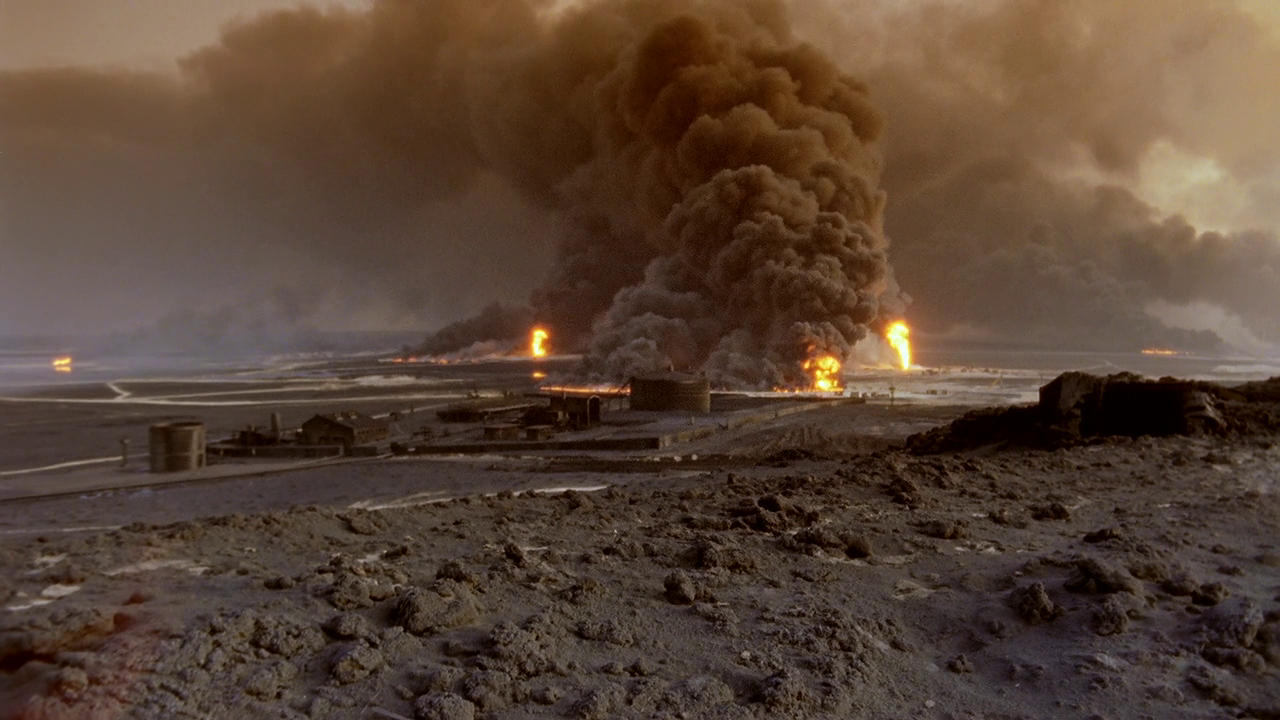
The planet’s surface is black. Not the black of soil or stone but the black of something that was liquid and became solid and forgot the difference. The ground reflects light in places, as though a shallow sea has been replaced by its own shadow. In the distance, columns of fire rise from the earth’s crust at irregular intervals. They are not eruptions. Eruptions end. These do not end. The fire is a permanent feature of the landscape, as constant as the horizon itself.
The atmosphere is dense with particulate matter. The sky shifts between amber, grey, and a brown so deep it resembles an old bruise. The sun is visible but indirect, a white disc behind layers of smoke that give it the appearance of a second, lesser moon. Visibility is limited. The air itself seems to have a texture: granular, heavy, reluctant to be breathed.
Werner Herzog brought a camera to Kuwait in 1991, after the retreating Iraqi army had set fire to over 700 oil wells. He filmed what he found. What he found looked like science fiction. What he made from it looks like nothing else in the history of cinema.
SPECIES OBSERVED
Two kinds of creatures inhabit this landscape.
The first are large mechanical organisms, articulated and slow, moving across the blackened terrain on treads or wheels. They have long appendages that extend toward the fire columns. Their purpose appears to be engagement with the flames: they approach, extend, and direct streams of liquid toward the base of the fire. The liquid is sometimes water. The interaction between water and fire produces enormous clouds of steam that join the existing atmosphere and thicken it further.
These are firefighters. They are men operating heavy equipment to cap burning oil wells. Herzog knows this. He does not tell you. He films them from such a distance, and with such deliberate estrangement, that they become something else. They become figures in a landscape that has surpassed human explanation. They move with the patience of deep-sea creatures. They are dwarfed by the fires they approach. Their work seems both heroic and futile, in the way that any organism’s effort to alter its environment seems both heroic and futile when the environment is large enough.
The second species is smaller. Upright. Bipedal. They appear in clusters near bodies of dark liquid. Some of them are carrying smaller members of their species. Their faces are visible in close-up. They do not speak. Or: they speak, but their language has been removed from the soundtrack and replaced with music. Mahler. Verdi. Wagner. Prokofiev. The human voice appears only once, when a woman holds a child and speaks directly to the camera. She is telling Herzog something terrible. He does not translate it. He does not subtitle it. The words exist as sound, as a quality of anguish that does not require semantic content to be understood.
These are Kuwaiti survivors. Mothers. Children. People who lived in the landscape before it became this landscape. Herzog films them with the same distant, awestruck attention he gives the fires. He does not distinguish between the human and the geological. This is the choice that caused the Berlin audience to boo.
FEEDING BEHAVIOR
The fires consume oil. The oil rises from beneath the surface through ruptured well casings and ignites on contact with the atmosphere. Some wells produce fire columns thirty meters high. Others produce rivers of burning crude that flow across the ground like lava, pooling in depressions, filling craters, creating lakes of flame.
Herzog films a lake of oil. It is black and still. A thin rainbow of color sits on its surface, petroleum iridescence, the same phenomenon you see in a parking lot puddle magnified to the scale of a small sea. Workers approach the lake. They set it on fire. On purpose. They have just finished capping one well, and now they ignite another spill to burn off the excess crude. The fire lifts from the lake’s surface in a curtain.
Herzog narrates this moment in voiceover. He says the firefighters have become so accustomed to their work, so addicted to the fire, that having extinguished it, they must reignite it. They cannot live without it. He is lying. This is standard procedure. He knows it. He lies anyway, because the lie produces a truth that the fact cannot: the image of creatures who have become so intimate with destruction that they cannot stop destroying. That image is not journalism. It is not documentary. It is something closer to hallucination, and it is one of the most disturbing moments in Herzog’s career, which is a career built from disturbing moments.
ENVIRONMENTAL CONDITIONS
There is no weather here. There is only smoke.
The smoke creates its own climate. It produces artificial twilight in the middle of the day. It generates localized rainfall: oil-dark rain that falls in thin greasy sheets and leaves residue on every surface. The landscape it produces is not terrestrial. It is what a planet looks like when its atmosphere has been replaced by the exhaust of its own burning interior.
Herzog opens the film with a quote attributed to Blaise Pascal: “The collapse of the stellar universe will occur, like creation, in grandiose splendor.” Pascal never wrote this. Herzog invented it. He attributed it to Pascal because Pascal has the authority to make the statement feel true, and because the statement needed to feel true before the first image appeared. The lie at the beginning is the key to the entire film. It tells you: what you are about to see is real, but the frame through which you will see it is invented. The footage is documentary. The meaning is not.
REPRODUCTION
The fire reproduces. This is not metaphor. When one well is capped, the pressure in the underground reservoir redirects, and crude oil finds new fractures, new exits. New fires appear where none existed before. The landscape regenerates its own destruction. The firefighters move from well to well in a cycle that resembles not repair but maintenance of a permanent condition.
Lessons of Darkness is forty-nine minutes long. It contains no interviews. No historical context. No maps. No dates. No names of countries, leaders, armies, or wars. If you knew nothing about the Gulf War, the film would not educate you. It would show you a planet on fire and let you draw your own conclusions about what kind of species would do this to its own home.
This is what caused the controversy. When the film premiered at the Berlin Film Festival in 1992, the audience understood that the footage was from Kuwait. They understood the political context. And they objected to Herzog’s removal of that context. They felt he had aestheticized suffering. Made war beautiful. Turned a crime into an opera.
Herzog’s response, delivered with characteristic calm, was that they were philistines. That the footage transcended its origin. That the burning oil fields of Kuwait were not merely a political event but a glimpse of something larger: the capacity of the human species to transform its own planet into an alien world. He said the images deserved a frame equal to their strangeness, and that journalism was not that frame.
He was right and he was wrong and the film does not care about the argument. The film simply shows you the fire.
ECOSYSTEM COLLAPSE
The title is Lessons of Darkness. The word “lessons” implies instruction. The word “darkness” implies a subject. But the film teaches nothing. It demonstrates. It places you on the surface of a world that should not exist and lets you observe.
There is no genre for what Herzog made here. It is not a documentary, because it refuses every obligation of documentary: context, accuracy, fairness, the pretense of objectivity. It is not an essay film, because it has no argument. It is not experimental cinema, because it is not difficult; it is, in fact, extraordinarily easy to watch. The images are so astonishing, so visually overwhelming, that the forty-nine minutes feel like fifteen.
It is closer to a nature film than anything else. A nature film about an unnatural landscape. David Attenborough for the end of the world. The narration is calm. The creatures are observed without judgment. The habitat is documented with precision. And the habitat happens to be hell.
Herzog has always been drawn to landscapes that dwarf the humans inside them. Aguirre on the river. Kaspar Hauser in the field. Fitzcarraldo and his ship. But in Lessons of Darkness, he found a landscape that had been made by humans and then exceeded them entirely. The oil fires of Kuwait were human in origin and inhuman in scale, and Herzog responded the only way he knows how: by looking at them until they became something else. Something older. Something that does not belong to politics or history or any single war.
Something that belongs to the planet, and to fire, and to the species that lit the match and then stood back and watched.
Lessons of Darkness (Lektionen in Finsternis) — Directed by Werner Herzog. Germany, 1992. 50 minutes.

Leave a Reply