Start here. At the end.
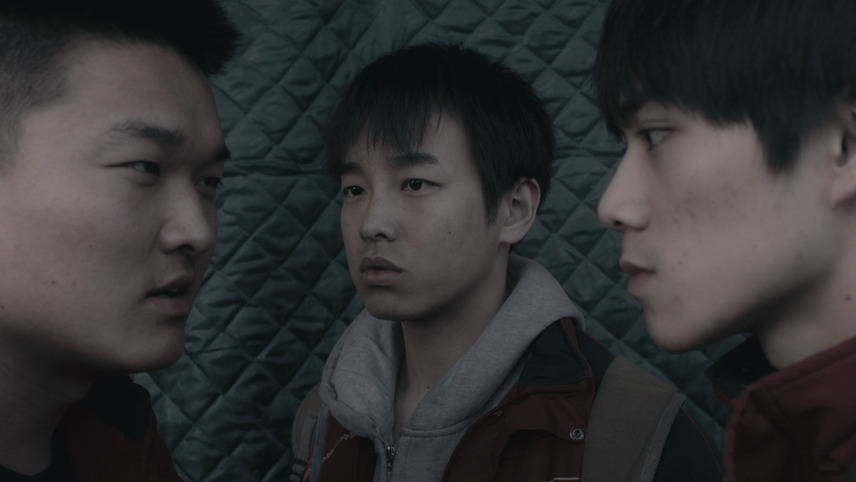
It is dark. A bus has stopped somewhere on a road near Manzhouli. Four people get off. A teenage boy. A teenage girl. An old man carrying his granddaughter. They stand on the side of the road in the cold and they cannot see the elephant because it is dark and they have not arrived yet, not quite, but they are close.
The boy kicks a shuttlecock into the air. It arcs up and comes back down and he kicks it again. The girl catches it. They pass it back and forth in the dark by the side of a road in northern China. The old man watches. The granddaughter watches.
Then you hear it. From somewhere in the darkness ahead. A sound. Low and enormous and patient. The roar of an elephant.
The film ends.
You have been watching for nearly four hours. You do not see the elephant. You will never see the elephant. But you hear it, and by now you understand that hearing it is enough, that these four people did not need to see the elephant, they needed to get here, they needed to have somewhere to go, and now they are here and the elephant is real and the elephant does nothing and does nothing and does nothing, and that is the most beautiful thing any of them have encountered all day.
How did they get here?
Work backward. The day was long. It lasted 234 minutes of screen time and it contained enough violence and grief and exhaustion to fill a season of television, except Hu Bo did not make television. He made one film. It was his first and his last. He was twenty-nine.
Before the bus: the train station
The four of them converge here without planning to. They have been moving through the same city all day, their paths crossing and separating and crossing again, drawn toward the same rumor: that in Manzhouli, in Inner Mongolia, there is an elephant in a zoo that just sits. People stab it with forks. People offer it food. People stand around it and watch. It does not move.
Wei Bu arrives first. He has been running all day. He tried to buy a ticket from a scalper and was scammed. He was beaten when he demanded his money back. The scalpers recognized him as the kid who pushed Yu Shuai down the stairs and called Yu Cheng, the older brother, the gangster, and now everything is collapsing at once.
Yu Cheng arrives. His brother has died in the hospital. He should want revenge. He should want to hurt Wei Bu. Instead, something strange happens. When he learns that Wei Bu also wants to see the elephant, he orders his gang to get the boy a ticket. Even the gangster is tired. Even the gangster wants someone to reach Manzhouli.
Then Li Kai appears with a gun. Li Kai, the friend Wei Bu trusted, the friend who lied, who stole the phone, who posted the video. He shoots Yu Cheng. He says he is proud of himself. He tells Wei Bu he did not post the video of Huang Ling. Wei Bu looks at him with disgust and walks away. Li Kai shoots himself.
Two gunshots and a suicide at a train station and the film does not flinch. It keeps its camera on Wei Bu’s back as he walks toward the platform where Huang Ling is waiting. Where Wang Jin is waiting with his granddaughter. Where the train to Manzhouli is waiting.
Before the station: Huang Ling
Her day. She is a teenager. She has been having an affair with the deputy head of her school. When the affair is exposed through a stolen phone video, the deputy head drops her. Her mother screams at her. The deputy head and his wife come to the apartment. Huang Ling climbs out the window of her room, picks up a baseball bat, and beats the deputy head and his wife with it.
She did not plan this. The baseball bat was just there. The anger was just there. Her entire life has been a series of adults who failed her and she has run out of ways to absorb it, and the bat was there and her arms moved and now she cannot go home.
She goes to the train station. Wei Bu is there. He once invited her to come to Manzhouli and she mocked him for it. She said he was only good at kicking a shuttlecock. Now she is here too, and the mockery has evaporated, and she has nowhere else to go.
Before the station: Wang Jin
His day. He is sixty years old. He lives with his daughter, her husband, and their granddaughter in an apartment that is too small for all of them. The son-in-law wants him out. Wants him in a nursing home. Wants the room for the granddaughter. Wang Jin is being erased from his own family, smoothly, politely, with conversations that sound reasonable and feel like murder.
His dog is killed. Bitten to death by another dog. He carries the body and does not know where to bury it. He is accused by the other dog’s owner of having caused the fight. He is cornered by Yu Cheng’s gang, who mistake him for someone else. He fights them off with a pool cue.
By dusk, he has decided. He is not going to the nursing home. He is taking his granddaughter to Manzhouli to see the elephant. The granddaughter did nothing wrong. The granddaughter should see something that does not move, something that refuses to participate, something that sits in the middle of everything and says: no.
Before the station: Wei Bu
His day. It begins with the discovery that his father, the man he defended, the man he thought was wronged, was actually fired for taking bribes. This news comes from Yu Shuai, the school bully, who delivers it with a smile. Wei Bu’s friend Li Kai is there. Yu Shuai pushes them. There is a scuffle at the top of a stairwell. Wei Bu shoves Yu Shuai. Yu Shuai falls.
He does not mean to push him that hard. He does not mean for him to fall. But Yu Shuai falls and lies at the bottom of the stairs and does not move, and Wei Bu runs.
For the rest of the day he is running. He goes home to collect money. His father has already stolen his savings from under his mattress. He goes to his grandmother’s apartment. His grandmother is dead. He finds her lying in her bed, still, and he stands there and absorbs it, and then he calls his aunt and keeps moving. He borrows money from Wang Jin, the old man with the dead dog. He tries to buy a ticket. He is beaten. He keeps moving.
Wei Bu is sixteen years old and in a single day he learns that his father is corrupt, his friend is a liar, his grandmother is dead, and he has killed a boy. The world gives him nothing. He keeps walking. This is not courage. It is the step before despair, the one where your legs are still moving because they have not received the message yet.
Before the day: Yu Cheng
His day begins in bed with a woman who is not his girlfriend. She is the wife of his friend. As he leaves, she tells him not to come in the evening. He walks through the city. He tells someone about the elephant in Manzhouli. He says: it sits there all day long. Perhaps some people keep stabbing it with forks. Or maybe it just enjoys sitting there. I don’t know.
His friend, the husband, jumps from a building. Yu Cheng sees it. Or hears about it. The film does not dramatize the moment. The suicide happens off screen, the way most suicides happen: in the gap between scenes, in the space you were not looking at.
Then his brother falls down the stairs and goes to the hospital and dies, and Yu Cheng spends the rest of the day looking for the boy who pushed him, not because he wants revenge but because he does not know what else to do. He is a gangster. Finding people is what he does. But his heart is not in it. His heart is in Manzhouli, with the elephant, which does nothing.
Before the day: the city
Shijiazhuang. An industrial city in Hebei province. The apartment blocks are gray. The streets are gray. The sky is gray. The school is rundown. The pool halls are fluorescent. New buildings rise behind demolition sites, pristine and blinding, surrounded by rubble. Fan Chao, the cinematographer, shoots everything with a handheld camera that follows the characters from behind, hovering just over their shoulders, close enough to feel claustrophobic but never close enough to see their faces clearly. You spend four hours looking at the backs of people’s heads. You know their necks better than their eyes. This is deliberate. This is how these people experience each other: from behind, in passing, never quite face to face.
The city looks like the end of something. Not the apocalypse. Something quieter. The end of the expectation that things will get better. Everyone in this city has been told that things are getting better and they can see that things are not getting better and the distance between those two facts is the distance this film lives in for four hours.
Before the film: Hu Bo
He was born in 1988 in Jinan, Shandong. He studied film directing at the Beijing Film Academy. He was a novelist. His short story collection was called Huge Crack. He studied under Béla Tarr, who recognized in him something fierce and wounded and necessary.
He made this film for roughly $135,000. He wrote, directed, and edited it himself. The producers wanted him to cut it in half. He refused. He fought for the four-hour version because the four hours were the film, because the weight of the running time was inseparable from the weight of the day, because you needed to feel the hours in your body the way these characters feel them, because cutting the film would be like telling the elephant to stand up.
On October 12, 2017, during the final stages of editing, Hu Bo died by suicide. He was twenty-nine years old.
The film premiered posthumously at the Berlin International Film Festival. Béla Tarr, who presented it, wept. He said he had done too little to prevent his student’s death. He said the film would be remembered forever. He said people should look after individuals like Hu Bo.
It won the Golden Leopard at Locarno. It won the FIPRESCI Prize. Ang Lee praised it. Wang Bing praised it. Gus Van Sant praised it. It has not been commercially released in mainland China.
The elephant
You never see it. Four hours and you never see it. You hear it once, in the dark, at the end, after the bus stops, after the shuttlecock is kicked, after the roar rises from somewhere ahead.
The elephant does nothing. That is its gift. It sits in a world that demands constant motion, constant justification, constant performance, and it does not move. It does not explain itself. It does not improve. It does not try to be something it is not. It sits.
Four people traveled all day through a city that was trying to crush them and they arrived at the edge of something, in the dark, by the side of a road, and they heard the sound of an animal that has refused to participate, and that was enough. That was the whole film. Not the arrival. The traveling. Not the answer. The question of whether there is anything in the world that is allowed to simply sit still.
There is.
You just heard it.
An Elephant Sitting Still (大象席地而坐) Director: Hu Bo Country: China Year: 2018 Runtime: 234 minutes

Leave a Reply