Miniature I: The Poet as a Child
A boy lies among open books. The books are drying on a rooftop. Their pages move in the wind like breathing. Pomegranates sit on a white cloth nearby. One of them is bleeding. The juice spreads slowly, darkly, into the fabric. The boy does not move. He is surrounded by the instruments of language, and language has not yet reached him.
Let Me Be Honest With You
This is not a film with a plot. There is no story in the way you expect a story. There are no conversations. No one explains anything to anyone.
If that description makes you want to close this tab, wait.
Because The Color of Pomegranates is not difficult. It is different. It asks you to watch it the way you would walk through a cathedral you’ve never been inside before. You don’t need a guide. You don’t need to understand the theology behind every fresco. You just need to look.
Miniature II: The Poet in Love
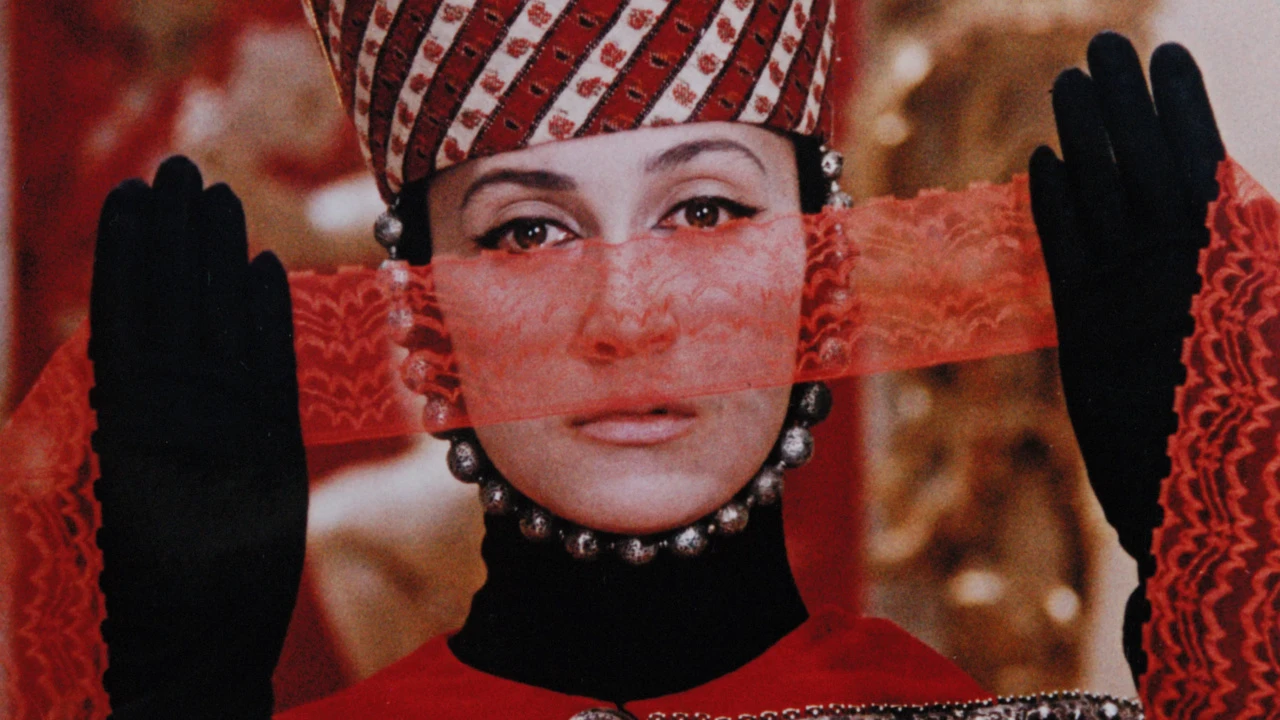
Two figures face the camera. A man and a woman, though both are played by the same actress, Sofiko Chiaureli. They hold a single pomegranate between them. Behind them, white lace trembles. Chickens wander through the frame. A thorn presses into skin. Love, in this film, is not a feeling between two people. It is an arrangement of objects and gestures that, taken together, produce something the chest recognizes before the mind does.
Who Made This?
Sergei Parajanov was born in Tbilisi, Georgia, in 1924. He was Armenian by heritage, Soviet by circumstance, and ungovernable by nature. He made films the Soviet authorities hated because they refused to behave like Soviet films. They were not about workers or progress or the glorious state. They were about color and texture and ritual and the deep, stubborn memory of cultures the state wanted to flatten into uniformity.
He was arrested. Imprisoned for years on charges that were partly political, partly homophobic, entirely vengeful. His films were censored, re-edited, shelved. He made collages in prison because they couldn’t stop him from making things.
The Color of Pomegranates was his most radical work. The authorities let it be released only after another director, Sergei Yutkevich, re-edited it into something slightly more conventional. The original cut, Parajanov’s cut, was thought lost for decades. Fragments have surfaced. The version most people see today is the Yutkevich edit, and even that version is like nothing else in cinema.
Miniature III: The Poet Among the Monks
A monastery. Stone walls. Men in black robes move in unison, slowly, like a tide pulling back. Books are stacked in towers. A sheep is held aloft, its wool impossibly white against the grey. A man wrings dyed yarn and the color runs down his arms like veins becoming visible. Everything in this sequence is about devotion: to God, to craft, to the act of making something with your hands that will outlast your hands.
What Is It Actually About?
Sayat-Nova was an 18th-century Armenian troubadour. He wrote love poems. He served in the court of King Heraclius II of Georgia. He became a monk. He was killed during a Persian invasion.
Parajanov does not dramatize any of this. He does not show Sayat-Nova writing a poem or falling in love or being struck down. Instead, he builds a series of images that feel like the poems themselves might feel if they could exist outside of language. Each chapter of the poet’s life is rendered as a visual composition: still, symmetrical, dense with symbols. Wool, pomegranates, daggers, lace, books, blood, stone, feathers, dye, bread.
You don’t decode these images. You receive them.
Miniature IV: The Poet Grows Old
An old man sits among carpets. His face is a landscape. Around him, objects accumulate: weapons, instruments, sacred texts. They are the debris of a life lived across courts and monasteries and battlefields. A candle burns. It is the only thing in the frame that moves. Everything else has come to rest.
Why Isn’t This Film More Famous?
It should be. Martin Scorsese has called it one of the most extraordinary films he has ever seen. Tarkovsky admired it. Filmmakers and visual artists return to it constantly as a source, a well, a proof that cinema can do things nobody thought it could.
But it comes from Armenia. It was made under Soviet censorship. It has no stars, no plot, no dialogue, no genre. It resists every mechanism by which films become famous. You cannot put it in a trailer. You cannot summarize it at a dinner party. You can only describe what it looks like, and then hope the person listening is the kind of person who wants to see for themselves.
You are reading this. So perhaps you are.
Miniature V: The Poet’s Death
Red. A deep, arterial red that fills the frame. Pomegranate juice or blood or dye or wine. It does not matter which. The poet is gone. What remains is color. What remains is the stain a life leaves on the surfaces it touched.
Why It Belongs Here
Some films are peculiar because they break conventions. The Color of Pomegranates is peculiar because it exists outside the space where conventions operate. It is not experimental in the way that word usually implies. It is not trying to shock or provoke or deconstruct. It is simply making images the way a medieval craftsman made mosaics: piece by piece, color by color, with absolute patience and no interest whatsoever in whether you understand the method.
You will not understand the method. You will understand the result.
It will sit inside you like a stained-glass window sits inside a wall: silent, luminous, older than anything around it.
The Color of Pomegranates (Sayat Nova) Directed by Sergei Parajanov Soviet Armenia, 1969 | 79 minutes

Leave a Reply