TO DO:
☐ Visit Mom.
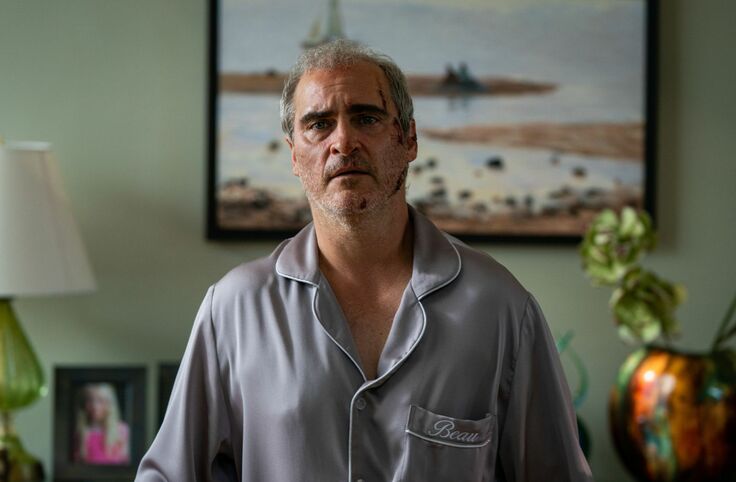
That’s it. That’s the entire task. Beau Wassermann has a flight to catch. His mother is expecting him. He needs to pack his bag, leave his apartment, get to the airport, and go home.
He cannot do this.
The film is three hours long.
☐ Take anxiety medication.
Beau’s prescription says to take with water. His apartment has no water. The taps are dry. He goes into the hallway to investigate, and someone steals his keys. And his luggage. He retreats into his apartment and locks the door. Outside, the street has become something between a riot and a carnival. A naked man stabs someone. A figure called Birthday Boy Stab Man is loose. This is the first fifteen minutes.
Ari Aster builds Beau’s neighborhood as a zone of pure, exaggerated urban menace: every anxiety about city life made flesh and turned up to a frequency that is simultaneously absurd and genuinely frightening. You laugh because the escalation is ridiculous. You stop laughing because the film is not joking. It is showing you what the world looks like to someone for whom every interaction is a potential catastrophe. Beau is not paranoid. Or he is paranoid and the world has risen to meet his paranoia and the distinction no longer matters.
Joaquin Phoenix plays Beau as a man whose entire body is an apology. His shoulders curve inward. His voice starts every sentence in the middle, as if the beginning was already too assertive. He moves through the world like someone expecting to be hit, not by anything specific but by everything in general. It is one of the most committed physical performances in recent cinema. Phoenix does not play fear. He plays the absence of every quality that might protect a person from fear. What’s left is a man who is nothing but nerve ending.
☐ Call Mom to explain the delay.
He calls. She doesn’t answer. He calls again. A stranger answers. The stranger tells him his mother is dead.
This information arrives roughly forty minutes into the film, and it detonates everything. Beau now needs to get to his mother’s house for the funeral. The simple to-do list (visit Mom) has been replaced by a worse one (bury Mom), and the journey to complete it will take the remaining two hours and twenty minutes, across terrain that no film has previously attempted to map.
☐ Recover from injuries.
Beau is hit by a car. He wakes up in the home of Grace and Roger, a suburban couple who have taken him in. They are kind. Their home is clean and warm. Their daughter, Toni, is not kind. Their other child is absent. A soldier named Jeeves lives in the house. None of this is explained. The suburban home is as threatening as the urban nightmare that preceded it, but the threat has changed frequency. Here, the danger is politeness. Obligation. The impossible debt of kindness from strangers who may want something from you that you cannot name and therefore cannot refuse.
Aster is doing something in Beau Is Afraid that he did not do in Hereditary or Midsommar. Those films, whatever their power, operated within recognizable genre architecture. Family horror. Folk horror. You could name the tradition. You could trace the influences. Beau Is Afraid has no architecture. It is built from anxiety itself: not the anxiety of a specific situation but the anxiety of being a self in a world that seems designed to punish the act of existing. Each section of the film has a different tone, a different visual grammar, a different relationship to reality, and no section prepares you for the next.
☐ Escape the suburban house.
He does, eventually, into a forest. In the forest, he encounters a theater troupe performing a play. Beau watches the play, and the film becomes an animated sequence.
This is the part that loses some viewers and converts others. The animation tells the story of a man who searches for a home his whole life, building a family he keeps losing and finding and losing again. It is beautiful. It is devastating. It appears to be Beau’s fantasy of the life he might have lived if he were not Beau: a life with a wife, children, a house, continuity. The animation is rendered in a style that recalls storybook illustration, warm and handmade, and its beauty is almost unbearable because you know it is not real. It is the one section of the film where Beau is not afraid, and its tenderness is what makes it the saddest part.
☐ Reach Mom’s house.
He reaches it. She is laid out for the funeral. Things go wrong in ways that are too specific and too strange to describe without ruining their impact. What can be said: Aster has built the mother, Mona Wassermann, as the organizing gravity of the entire film. She is barely on screen. She is in every frame. Every room Beau enters is shaped by her. Every decision he makes or fails to make is a response to her. The film’s central question is not “will Beau get home?” It is “what did Mona do to Beau, and can what was done be survived?”
Patti LuPone plays Mona in the scenes where she appears, and she is terrifying in the precise way that only a mother can be terrifying: not through violence but through the absolute, unchallengeable claim of having given you life and the debt that comes with it. She is a monument. She is a wound. She is the reason the to-do list can never be completed, because the person at the end of the list is the person who made completion impossible.
☐ Be forgiven.
The film ends with a trial. Of sorts. In a flooded arena. Before an audience.
This is as far as description should go. What Aster does in the final act of Beau Is Afraid is stage the question that every anxious child has carried silently for their entire life: Am I guilty? Not of a crime. Of something older and less specific. Of not loving enough. Of not being enough. Of existing in a way that disappointed the person whose approval was the only currency that mattered.
The trial has a verdict. The verdict is the most peculiar moment in a film made entirely of peculiar moments, and it is either the cruelest joke Aster has ever played or the most honest thing he has ever filmed. It might be both.
☐ Complete the list.
The list is not completable. That is the film.
Three hours, four distinct sections, two tonal universes, one animated interlude, a theater performance, a flooded colosseum, Joaquin Phoenix carrying every scene with the posture of a man who has been apologizing since birth. There is no genre for this. It is not horror, though it is more frightening than most horror films. It is not comedy, though it is often very funny in the specific way that watching someone fail to do a simple thing can be funny when the failure is total and the person cannot understand why. It is not surrealism, because surrealism implies a departure from reality, and Beau Is Afraid is not departing from reality. It is showing you reality as experienced by someone for whom reality has always been a series of tasks that cannot be completed, obligations that cannot be met, and a voice that says you should have tried harder no matter how hard you tried.
Critics were divided. Audiences were baffled. The film was a commercial disaster. None of that changes what it is: the most ambitious and unclassifiable American film of the 2020s so far. A film that asks you to spend three hours inside the mind of a man who is afraid of everything, and then shows you that the thing he is most afraid of is the one thing he cannot escape.
Himself. His mother. The difference between the two.
The list remains open. Nothing is crossed off. Nothing will be.
Beau Is Afraid — Directed by Ari Aster. United States, 2023. 179 minutes.

Leave a Reply